
International comparisons of Cayman’s minimum wage have caused some to ask whether the planned increase to $8.75 an hour should go further – but others call for caution because of the knock-on costs to businesses.
One under-acknowledged impact of national minimum wage increases is the effect on those who earn slightly more than that.
For example, if, at present, a restaurant server earns $6 an hour and his supervisor earns $8 an hour, the waiter will earn $8.75 after the minimum wage increase, meaning his supervisor may ask for a pay rise to $10.75 to preserve the differential between the two salaries.
Similarly, staff who started at minimum wage but have received increases to $7 or $8 due to training or long service, may feel their pay should rise to $9.75 or $10.75 once the new minimum wage is implemented.
The Minimum Wage Advisory Committee examined this phenomenon. Their report notes, “Research has shown increasing the minimum wage tends to have a “spill effect” on other workers earning wages near that threshold.
“The “spill-over” effects are indirect wage increases because employers and workers want to maintain differences in job status or higher wages for workers with more seniority or skill.”
The committee used a conservative estimate that workers earning up to 15% more than minimum wage would benefit from spillover effects.
Proposed minimum wage beneficiaries
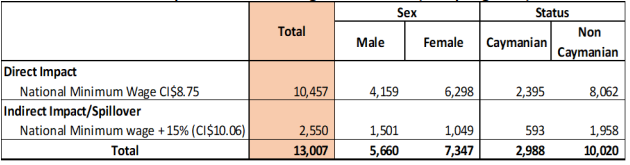
They based the calculations on the latest data that 10,457 people would be directly affected by the proposed increase, with a further 2,550 (593 Caymanian and 1,958 non-Caymanian) benefiting from the spillover impact, remunerated for greater skill sets and/or supervision of lower-level workers.
Troy Leacock, business owner and president of the Cayman Islands Tourism Association, spoke of this impact.
“Every wage is going to have a push-up factor, a ‘ripple-up effect’,” he told the Compass.
“The minimum wage is an entry level wage. You have minimal skills or perhaps no skills, you have minimum experience, you come in at minimum wage – entry wage.
“If the entry level goes up to $8.75, and you’ve got employees who’ve been earning $8.75, they’re going to ask, ‘Why am I on minimum wage when I’ve been here two years?’
“And this isn’t just impacting small businesses. Look at a supermarket – they may have people who are on perhaps $7 or $8 an hour.
“When the wage is increased, that employee is going to expect psychologically not to be on minimum wage, they’re going to expect minimum plus $2, because they’re currently above the minimum wage.”
He called for caution in the speed of the increases.
“If you take things in steps you can achieve more than if you do it in one jump.

“If it was to increase by a dollar a year, after four years it’s gone up $4, but if you wait four years and then go up $4, no one can adjust to that.
“So the recommended increase to $8.75 – that’s a very significant increase in one step.”
A report for the UK’s Low Pay Commission by the Incomes Data Research think tank found that some businesses try to manage the issue of differentials by narrowing pay bands, but this can cause difficulty when it comes to staffing more senior roles.
They found that at one leisure business, “the low differential of just 25p between grades means that staff are less interested in applying for internal promotion” and reported one major retail chain “perceives reluctance among staff to move from team leader to (salaried) assistant manager roles who feel the 50p differential between sales assistant and team leader rates is also of questionable value given the increase in responsibility involved.”
Related Videos