

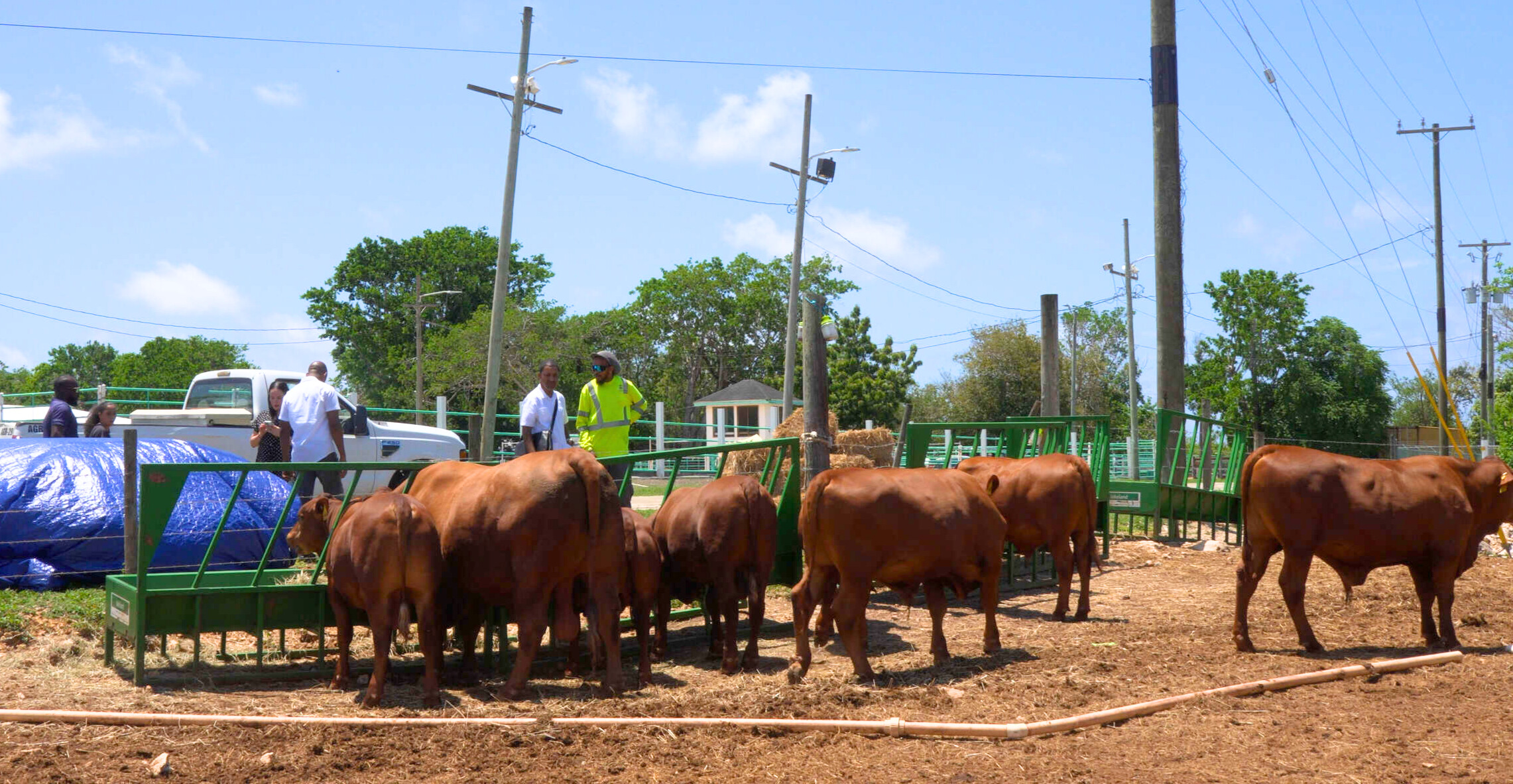
On a sweltering Monday afternoon, in a patch of shade at the Cayman Islands Department of Agriculture, a group of Red Poll calves crowd around their towering, chestnut-coated father.
These Red Poll cattle are at the centre of a government-led initiative to transform Cayman’s livestock industry — aimed at improving local genetics, reducing multi-million-dollar reliance on imported beef and laying the groundwork for a premium, grass-fed Caymanian product.
In 2023, under the leadership of Agriculture Minister Johany “Jay” Ebanks, the Department of Agriculture imported 22 Jamaican cattle of the Red Poll breed — three bulls and 19 heifers — from the Cattle Breeder’s Society of Jamaica. The animals, known for their resilience, docility and superior meat quality, were selected to help build a sustainable, genetically superior local beef supply.
Their arrival marked the launch of the nucleus breeding herd project, a central pillar of Cayman’s livestock and food security strategy.
“This is the first time there has been a deliberate strategy by government to pass on specific genetics in the community and upgrade the genetic pool,” said Acting Deputy Director of Agriculture Demoy Nash in an interview with the Cayman Compass.
Red Poll: A strategic opportunity for Cayman
Data on local livestock demand underscores the strategic opportunity. In 2023, Cayman had about 1,551 head of cattle — a mere fraction of what’s needed to satisfy local demand. In the same year, beef imports topped 7,000 tonnes, valued at over US $6.8 million, mostly from the United States. That works out to about 10 kilos of beef per person annually — nearly all of it imported.
At the same time, Department of Agriculture analysis has found that much of the existing local cattle stock is poorly suited to local conditions. The 2023 livestock census revealed a proliferation of breeds designed for cooler, temperate regions — animals that struggle with the island’s heat, demand high feed volumes and often deliver lower productivity.
“We’ve seen too many cases where poorly suited breeds collapse under the stress of the heat or fail to reproduce effectively,” Nash said.
“That is why this strategic approach was taken to look at something that’s more suitable.”
Veterinarian Michael Motta, known for producing Jamaica’s first Brahman embryo transfer calf, supported the Department of Agriculture in its analysis and planning.
Promising progress
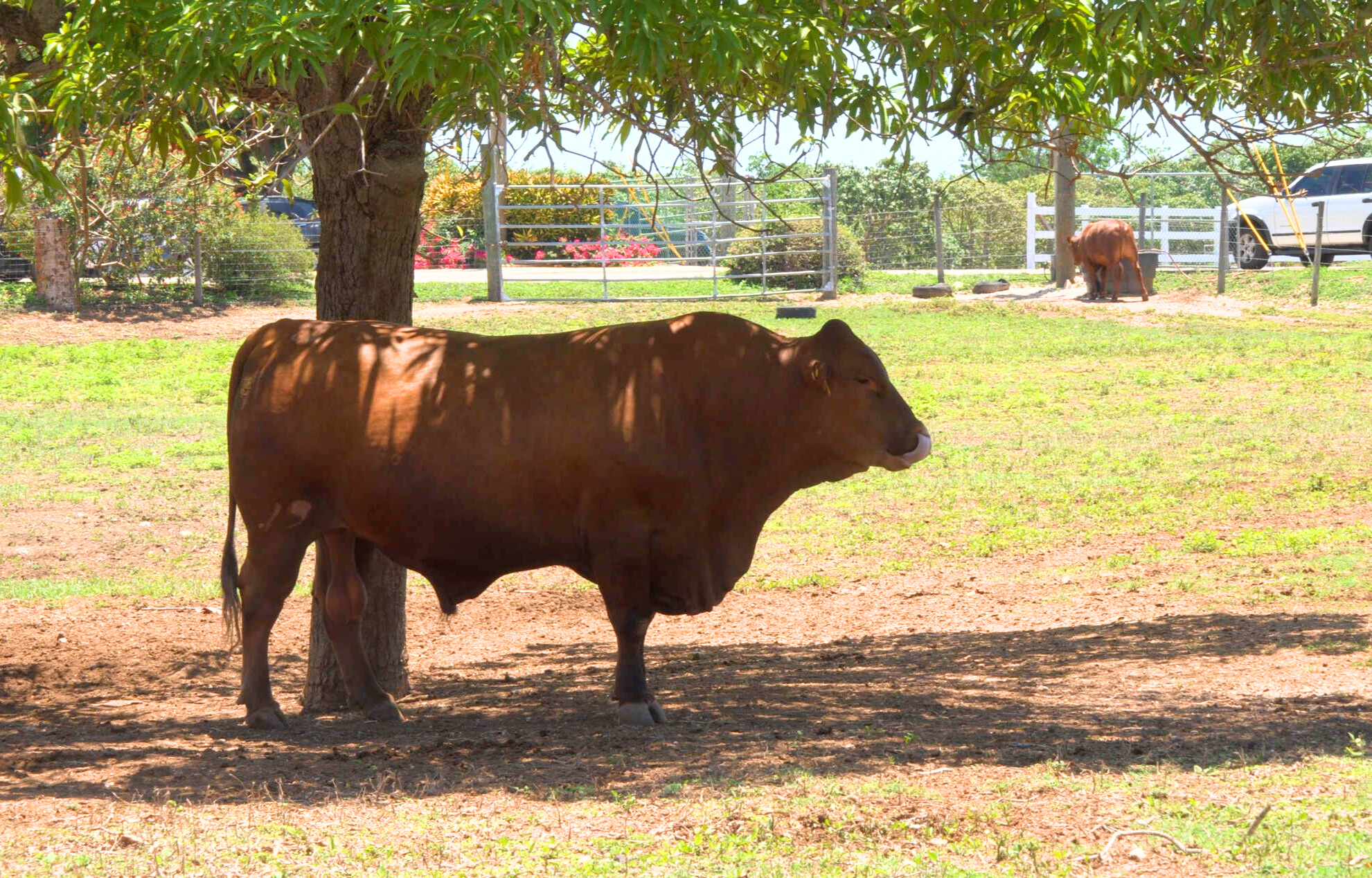
The Department of Agriculture’s early results are encouraging. Red Poll calves are already reaching weights of up to 219 pounds, with mature bulls growing as large as 2,400 pounds — strong indicators of the breed’s adaptability and productivity in Cayman’s climate.
The department currently manages a herd of 35 Red Poll cattle and plans to auction off 10 animals soon. Two bulls were previously sold at the annual Agriculture Show, amid growing interest among local farmers.
Through the department’s stud bull programme, farmers can bring their heifers for natural servicing. Plans are also underway to launch an artificial insemination programme, supported by a locally developed Red Poll semen bank.
“We are talking about better quality beef, better tasting beef, and also, because of the increase in the population, it means that we could be importing less beef,” Nash said.
Cayman artisanal beef?

A higher-quality product would also cater to the sophisticated preferences of Cayman’s local market.
“Red Poll beef has this rich, old school, juicy flavour,” Jamaican chef Peter Ivey told the Compass.
“It’s tender, has great marbling without being overly fatty, making it perfect for everything from a steak to a slow-cooked Cayman-style beef.”
Cayman-Jamaican chef Sara Mair Doak agrees.
“Red Poll is known for its great marbling and I wouldn’t hesitate to use it,” she told the Compass.
Doak noted that while Cayman’s limited grazing space makes full self-sufficiency in beef production unlikely, there is clear potential for something smaller.
“There’s a real opportunity for a cottage industry, producing artisanal, grass-fed Cayman beef,” she said.
“With the right branding, it could be sold at a premium.”
In 2023, 257 cattle were slaughtered across Cayman — hardly enough to make a dent in total demand. But with improved genetics and better breeding tools, the Department of Agriculture believes it can change that trajectory over time. The goal isn’t to eliminate imports entirely, but to build capacity and quality.
“The breed, based on the performance we are seeing locally, is corroborating the research data that is available, so farmers can be assured that they are getting animals that are suitable and adaptable,” Nash said.
“They use minimum feed to convert to weight, so there’s no doubt that you will get a high-performance animal.”
Related Videos








Bravo!