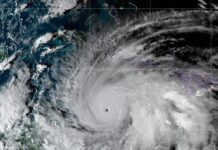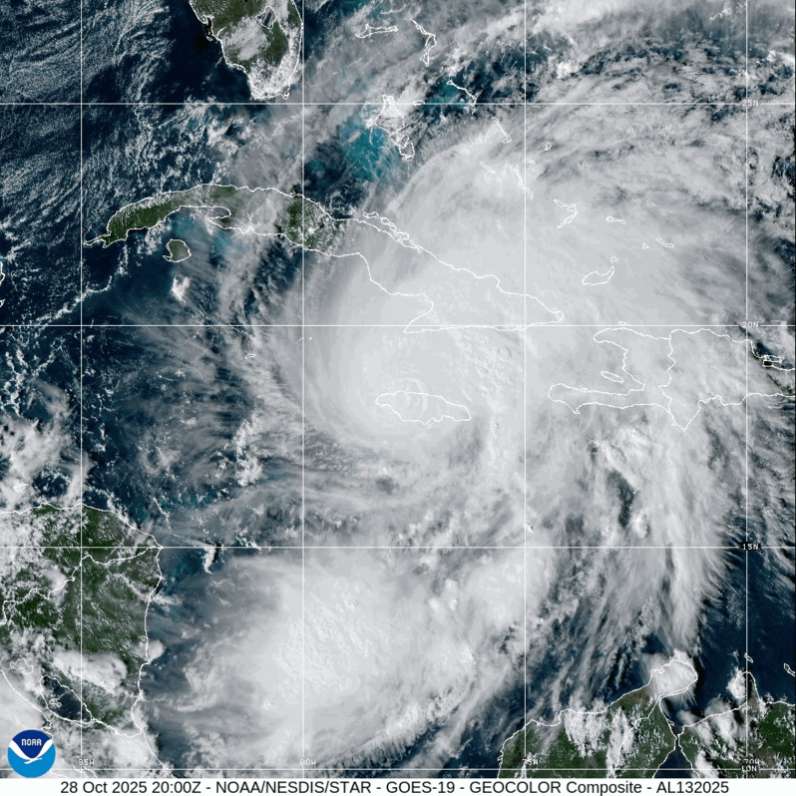
Hurricane Melissa roared ashore in southwestern Jamaica on Tuesday, 28 Oct. as the strongest storm of the year on Earth and as one of the strongest Atlantic Basin hurricanes in history.
The Meteorological Service of Jamaica said Category 5 Hurricane Melissa made landfall in New Hope in the parish of Westmoreland at 12:02pm, with sustained winds of 185 miles per hour, a life-threatening storm surge of up to 13 feet, and large and destructive waves.
As it came ashore in Jamaica, Melissa had a minimum central pressure of 892 millibars, tying it with the 1935 Labor Day hurricane as the strongest Atlantic Ocean storm to make landfall.
Only Hurricane Gilbert and Hurricane Wilma were ahead of Melissa in terms of the lowest barometric pressure. Wilma recorded a minimum sea level pressure of 882 millibars, and Gilbert had a minimum central pressure of 888 millibars, but neither made landfall at those pressures.
Prior to making landfall, the hurricane has already been blamed for seven deaths in the Caribbean, including three in Jamaica, three in Haiti and one in the Dominican Republic.
Enormous damage, power outages
Jason Henzell, past president of the Jamaica Hotel and Tourist Association, who grew up in the Cayman Islands and is the current chairman of Jakes Hotel in Treasure Beach, Jamaica said, “There has been enormous damage, especially along the south coast of Jamaica, large parts of the western side of Jamaica are already without power.”
Henzell added, “The destruction has been particularly severe in the Black River area. The roof has come off the Black River hospital and the generator at that facility has also failed,” he said, “Currently there are 74 patients in that hospital, and the roof has also come off the JPS electricity facility in Black River, we are hearing reports of very serious and significant damage,” he said.
Caymanian Christopher Nixon, who also lives in Treasure Beach, St Elizabeth Jamaica said communication has been intermittent to the area, but he was aware that there had been major impacts, “I have heard a lot of roofs have come off the buildings in the Treasure Beach, but the building I live in has a concrete roof,” he said.
By 2pm on Tuesday, 28 Oct., Hurricane Melissa was located about the mid-point in it’s south to north transit across Jamaica. Winds had decreased slightly to 165 miles per hour but that still placed it as a category 5 hurricane on the Saffir Simpson scale and the barometric pressure was still below 900 millibars at 899.
The National Hurricane Centre has been reporting that some locations in Jamaica will experience four-day rainfall totals between 20 and 30 inches, leading to catastrophic flooding and numerous landslides.
According to Newsweek, officials in Jamaica urged 50,000 people to evacuate, but only 1,700 had reached shelters by Monday night.
Photos and video on social media showed trees falling on buildings and cars, and in some locations, such as Cave Valley, Jamaica, the photos showed scenes of partially submerged houses.
Earlier the prime minister of Jamaica, Andrew Holness told the Associated Press “There is no infrastructure in the region that can withstand a category 5, the question now is the speed of recovery. That’s the challenge.”
Cuba, the Bahamas and Bermuda
After devastating Jamaica, Melissa is forecast to strike eastern Cuba late Tuesday and Wednesday, still as a major hurricane, before sweeping across part of the central and southern Bahamas as a hurricane before potentially impacting Bermuda late Thursday night and into Friday morning.
Former head of the Cayman Islands Public Works Department, Max Jones who has family in eastern side of Cuba which is forecast to be impacted by the hurricane said, “I have family members in Santiago which is expected to be in the path of Hurricane Melissa, but fortunately they are hunkered down in a concrete building, so we are really hoping they will be okay, but there are certainly many homes that are not very strong and is likely there will be significant damage in the area,” he said.
The U.S. Naval Institute was reporting that more than 1,000 non-essential military personnel, family members and residents, along with their pets, had been evacuated from the Naval Station Guantanamo Bay ahead of Hurricane Melissa’s impending landfall.
The Cuban government has also ordered the evacuation of over 600,000 people prior to the approach of the hurricane. Melissa is forecast to impact parts of the eastern Cuba with major hurricane force winds and up to 20 inches of rainfall, which is expected to result in life-threatening and potentially catastrophic flash flooding with numerous landslides.
Related Videos