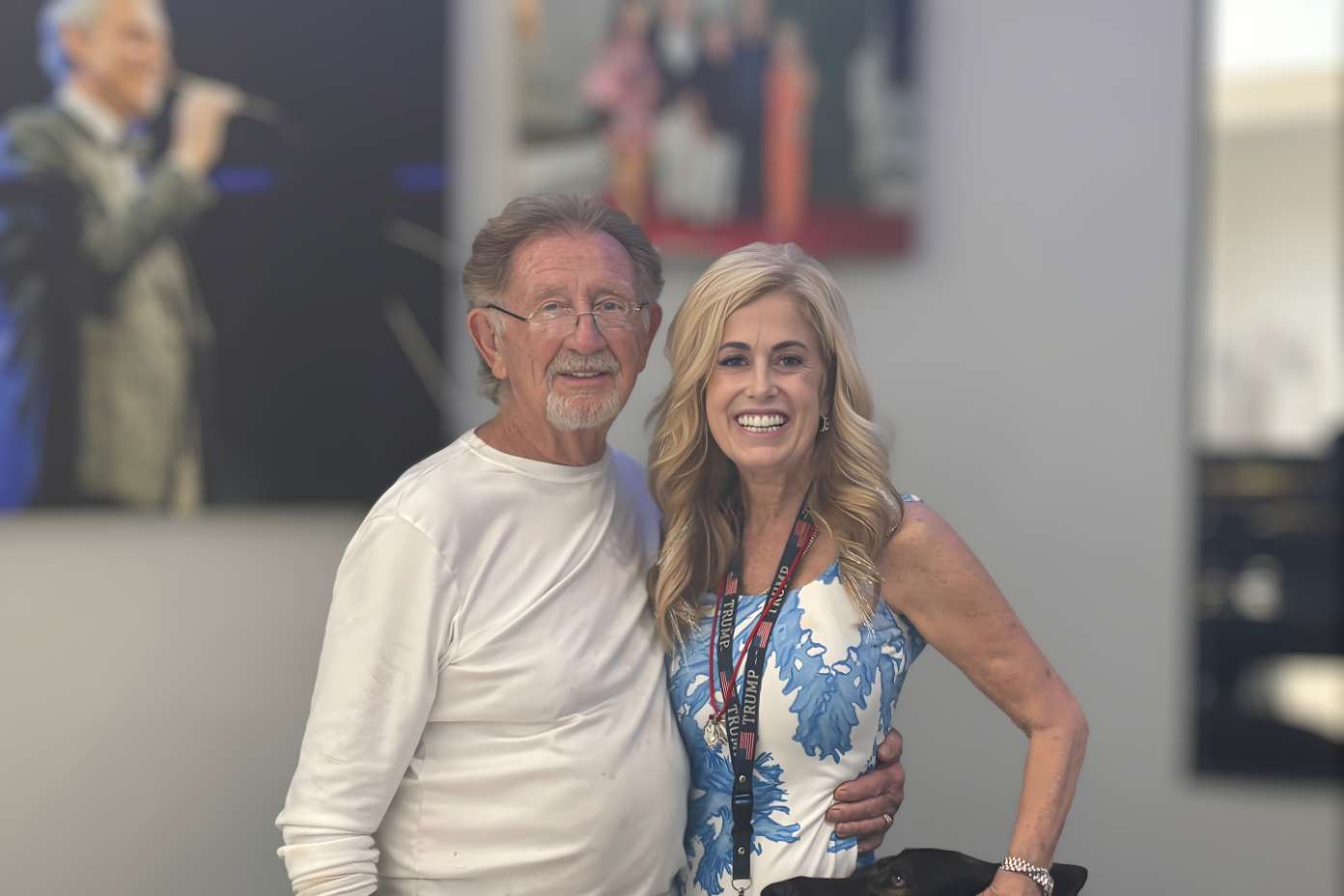
In a home laboratory in Grand Cayman, medical imaging pioneers Dr. Ronald Nutt and Lynda Nutt are developing a new cancer imaging technology that they believe will reshape how the disease is detected at its earliest stages.
The technology, known as time-resolved positron emission tomography, or TPET, is designed to overcome limitations of existing PET/CT scanners – co-invented by Dr. Ronald Nutt – that are used globally to stage cancer and monitor treatment, but are not approved for routine population screening.
The setting is modest, but the ambition is anything but.
In the Nutts’ home lab-office, fluorescent lights cast a flat glow over tables crowded with machinery, wires and loose papers. A heavy iron desk, occupied by computer screens and handwritten notes, anchors the room. On another table sits an oscilloscope that, by Nutt’s telling, measures signals “to the gigahertz,” alongside a radiation-monitoring detector system. Nearby, a majestic black desk sits almost bare beneath a framed PhD diploma from the University of Tennessee and a simple nameplate.
Far from any major research campus, this is where he works through one of medicine’s most enduring problems.
Where legacy meets the future
That mix of domestic life and high-precision engineering forms the backdrop for the invention the Nutts are now advancing.
To understand the scope of their claim, it helps to understand the standard they helped establish. Ronald Nutt is best known as a co-inventor of PET/CT, a breakthrough imaging platform that became the global gold standard for cancer staging and treatment monitoring and was recognised by Time magazine as medical invention of the year in 2000.
PET/CT remains essential for diagnosing known cancers and tracking how disease responds to treatment, but it is not approved for screening of asymptomatic populations because of its cost, radiation exposure and infrastructure requirements.
In 2005, the Nutts sold their company to Siemens Medical. They say their current work is driven by a desire to address what PET/CT cannot.
“We’re trying to give people the ability to find cancer early, before there are physical signs of the disease,” Nutt said. “Early detection allows for successful treatment. That’s really what this is about.”
Their new technology is a disruptive one in that it departs from conventional PET/CT in both design and operation. Instead of a circular tunnel of detectors and complex reconstruction algorithms, TPET uses two parallel detector plates positioned in front of and behind the patient.
By measuring timing differences at the picosecond rate, the system is intended to directly localise tumours in three dimensions, reducing reliance on heavy computing power. TPET functions like a true 3D camera – while older systems rely on 2D images – captured as the scanner rotates in a circle around the patient.
The Nutts say the design requires fewer detectors, delivers a lower radiation dose and allows for faster scan times, potentially making TPET both more affordable and suitable for screening. PET/CT, while effective for staging known cancers, is not currently approved for widespread screening for those reasons.
Another key difference from PET/CT is its scale and portability. Unlike conventional PET/CT machines, which can weigh up to 8 tons, TPET is designed to be shipped in standard-sized boxes, a feature intended to make the technology far more accessible globally.
The couple believes TPET could become the first practical whole-body cancer screening imaging system, capable of detecting disease before symptoms appear and at radiation levels low enough for routine use.
They position the technology as complementary to emerging blood-based cancer tests, which can indicate the possible presence of cancer but cannot identify its location or stage.
Ronald Nutt uses a Cayman-specific example to describe the limitations of blood-based cancer screening.
“One hundred thousand people,” he said, referring to the population of the Cayman Islands. “If you did a blood screening test for all 100,000, you would find about 1,000 people that the blood test would say you may have cancer. Only about half of those actually would.”
Without accessible imaging, he said, those individuals would face uncertainty and delays. “That’s what we’re trying to produce,” he added. “A whole-body scan that will tell you where your cancer is, what stage it’s in and diagnose it – we believe before any anatomical signs are present to us.”
Cancer remains a leading cause of death worldwide, with roughly 10 million cancer-related deaths each year, a figure projected to rise in the coming decades. The Nutts argue that earlier detection could reduce late-stage diagnoses and improve survival outcomes, much the way that mammography has done for breast cancer.
“We believe this new technology will qualify as a screening tool for most cancers occurring in the human body,” said Lynda Nutt in a prior interview with the Compass.
She has presented the technology to the US Department of Health and Human Services and believes that several factors could streamline the regulatory process. These include leadership by the same scientist who developed PET/CT, as well as the system’s lower radiation dose and reduced cost. She believes these could shorten approval timelines compared with PET/CT – a process that took 15 years.
“When the goals of very low radiation dose requirements and lower cost of scanning are met, TPET scanning will be similar to that of breast cancer screening and can be made more available to everyone. … We are enthused that this pivotal change will begin right here in Grand Cayman.”
For the Nutts, the work is also deeply personal. They have spoken about losing their daughter to cancer and believe that earlier detection might have changed her outcome. That experience, they say, has shaped their urgency, informed by first-hand knowledge that the impact of cancer extends far beyond the patient to families and friends who endure the suffering alongside them.
“There’s got to be a better way to do this,” Ronald Nutt said.
The technology is still in the research and prototype development phase, with detector materials and system design being finalised. The team is now preparing to build the prototype.
The Nutts are working with academic partners, including Yale University and the University of Chicago, where early clinical evaluation is expected to take place. Broader clinical use will depend on trial results, regulatory approval and commercialisation, a process likely to take several years.
Significance of the Cayman setting
While much of the technical development behind TPET involves overseas collaborators, the ideas driving the technology were conceived in the Nutts’ home laboratory on Grand Cayman.
Nutt acknowledges that building advanced hardware on the island presents challenges, but says the couple never hesitated to make Cayman home.
They first arrived as tourists in 2009 and later settled permanently in the Spotts Bay area, on a rugged stretch of coastline where they take regular walks and tend to an aviary of birds. Asked what first drew them to the island, Cayman, Ronald Nutt smiled and glanced at his wife.
“I didn’t,” he said. “Lynda chose Cayman.”

Living by the sea, he added, has played an unexpected role in sustaining his work. “It helped me get to 88 years old. That’s very important,” he said, crediting the natural landscape, fresh air, daily exercise, their dog Lucin and their birds.
Cayman is a global crossroads for finance, tourism and expatriate life, but it is not widely seen as a place where hardware-intensive medical breakthroughs are built. The Nutts have encountered that skepticism directly.
“We had one gentleman, a very close friend of ours, saying, ‘Ron and Lynda, you can’t do that. You cannot do that in Cayman. We’ve tried to do that in Cayman,’” Nutt said.
Their response is not to claim Cayman as an exception, but to question the assumption itself.
Ronald Nutt points to Knoxville, Tennessee, where he built his career and where his research and development teams, he said, included scientists from 22 countries. Innovation, they argue, is not defined by geography, but by connection – and in Cayman, people and ideas arrive from everywhere.
Raising funds and awareness
The Nutts formally introduced TPET to potential supporters in December 2025, hosting a private fundraising event at their oceanfront residence.
The gathering, titled ‘Where Science & Culture Meet’, was held in support of LRN Charitable, the nonprofit organisation backing their research.
The event was hosted and emceed by Toni Holt Kramer, a longtime television personality and event host with experience spanning Hollywood media, politics and philanthropy.

Holt Kramer characterised the evening as a celebration of culture and humanitarian science, noting Ronald Nutt’s earlier role in developing PET/CT technology and Lynda Nutt’s design contributions to the new TPET system.
“The venue was beautiful, the stage was set for a stunning oceanside evening and Lynda brought the warmth of Christmas to the tropics with a special performance by local Christmas carolers and ballet dancers,” she said.
Laurence Leamer, a six-time New York Times best-selling author, read from his forthcoming work exploring the life and relationships of President John F. Kennedy. Lidia Bastianich, the Emmy-winning chef, restaurateur and public television host, prepared and presented the evening’s dinner.
The event also featured a private jewellery presentation by Dolce & Gabbana, displayed in partnership with Island Jewellers, against the ocean sunset backdrop.
The December gathering also underscored the message that globally significant medical innovation can originate outside traditional research hubs.
By hosting the event at their Cayman residence where the technology was conceived, the couple challenged assumptions about where serious scientific work can be developed and positioned the island not as a limitation, but as a base for ideas with global reach.
Related Videos