

CFA, MBA
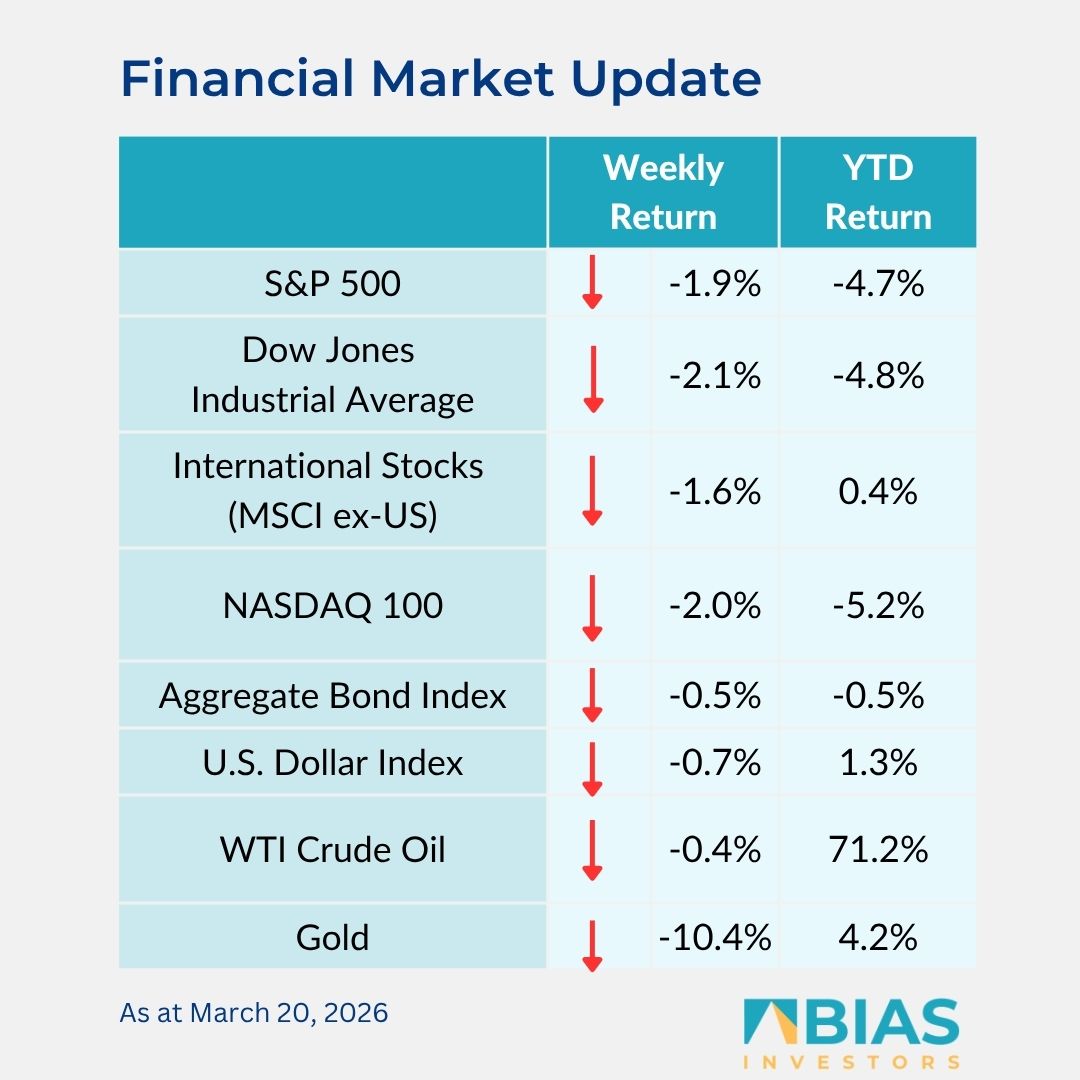
Equities declined for a fourth consecutive week as military action in the Middle East has pushed energy prices higher.
For the week, the S&P 500 Index was -1.9%, the Dow Jones Industrials -2.1%, and the NASDAQ -2%. The energy, financials, and communication services sectors led the S&P 500 Index for the week, while the utilities, materials, and consumer staples sectors lagged.
The 10-year USTreasury note yield was 4.389% at Friday’s close versus 4.284% the previous week.
Gasoline prices continue to rise. The US average price of regular unleaded gasoline is $3.925 per gallon. This is 6.8% higher than a week ago and 33.7% higher than a month ago. Diesel fuel is also higher at $5.208 per gallon, up 5.4% from a week ago and up 40.6% from a month ago.
The Federal Reserve held interest rates steady at its policy meeting last week with the Fed funds rate in a 3.5% to 3.75% target range. The Summary of Economic Projections was updated with a modestly higher GDP outlook for 2026 of 2.4% versus 2.3% previously, but also higher inflation of 2.7% versus 2.4% previously.
The projected year-end 2026 Fed funds rate range is 3.25% to 3.5% which is consistent with the Fed’s prior projection. CME Fed funds futures have shifted in the opposite direction and currently expect a 0.25% increase at the September policy meeting.
This week three companies in the S&P 500 Index are scheduled to report quarterly earnings. First quarter earnings are expected to grow by 12.5% and quarterly revenue growth is expected at 9.6%. Full-year 2026 earnings are expected to grow by 16.3% with revenue growth of 8.3%.
In our ‘Dissecting headlines’ section, we look at the impact of higher energy prices.
Dissecting headlines: Fuel impacts
Higher energy prices induced by the conflict in the Middle East are having near-term inflationary pressure on consumers.
In a normal energy price environment, the average US family spends about 3% to 4% of its monthly budget on gasoline. and about 6% total on energy expenses to include electricity and natural gas. In periods of spiking energy prices that rises to about 4% to 5% on gasoline, and 7% to 8% on total energy costs.
Higher diesel fuel prices impact the cost of moving freight and can translate into higher cost for almost all goods.
Seeing higher prices at the pump and on store shelves can cause consumers to pull back on spending.
One way of reducing costs at the pump is a temporary suspension of fuel taxes. Georgia has already enacted a 60-day suspension of state gasoline and diesel taxes, which are $0.33 and $0.37 per gallon, respectively.
Other states have announced proposals to suspend fuel taxes but none have enacted yet. The US federal level fuel tax is $0.184 per gallon, and state taxes range from $0.07 per gallon in Alaska to $0.71 in California. The US national average state fuel tax is $0.335 per gallon.
The International Energy Agency member countries, to include the US, have already announced plans to release oil reserves to lower prices during the current crisis.
This, along with potential fuel tax suspensions like those enacted in Georgia, can help consumers bridge the gap. A cessation of hostilities is the longer-term solution to lower prices.

BIAS Investors (Cayman) Ltd.
Grand Pavilion (Hibiscus Way)
802 West Bay Road
Grand Cayman, Cayman Islands
W: biasinvestors.com
E: [email protected]
T: 345-943-0003
Subscribe to the BIAS Investors newsletter here.
Related Videos