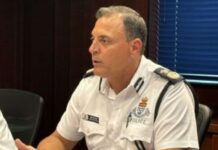
Derek Haines, detective chief superintendent with the Royal Cayman Police and one of the country’s top anti-drug warriors, has won the Administrator’s Award for Public Service from the US Drug Enforcement Administration.
In a rare honour for a non-US officer, the award for outstanding contributions to the mission of the DEA between 1992 and 2005 was presented to Mr. Haines, 56, by agency head Karen Tandy in a 23 March ceremony in Washington, D.C.
‘I was very pleased and very proud to receive the award,’ Mr. Haines said, ‘but more important was that in the citation both the Turks and Caicos and the Cayman Islands Police Task Force were mentioned.
‘They are excellent officers, all of them, and they work extremely well. They are as good as anyone I have worked with in the UK or elsewhere,’ he said.
Generally, the DEA awards outstanding performances annually. Mr. Haines said he had shared the spotlight with a number of other officers and agents.
‘Some of the awards are posthumous and a number go to agents and officers for bravery in places like Afghanistan.’
He was the only non-US officer recognised this year.
‘I’m not sure how far back the last time was, but it is a rarity,’ he said.
Mr Haines, who initially joined the police in 1965 in Leicester, England, said the DEA honour came for his work since 1992, when he initially arrived in the Caribbean, taking up a post in Britain’s Turks and Caicos Islands.
‘We co-operated quite a lot with issues in control and delivery [of drugs], grabbing dope bound for the US, even refuelling of aircraft, that kind of assistance,’ he said.
‘On top of that, I have been involved with the International Conference for Drugs and Enforcement. I have been secretary for 10 years and am now the chairman for the Caribbean region,’ he said.
Undercover operations
While Haines’ citation was for more than a decade of work, he recalled a particular incident after moving to Cayman in 1995.
‘There was one operation when we lured some people in here to us,’ he said. ‘Undercover officers captured about nine smugglers coming into Cayman, but first there was a controlled delivery into the US, which led to the capture of people in Tampa, including guys down from New York to do the pick up.
‘This very nicely wrapped up guys in Jamaica, here and in the US. We seized several thousand pounds of ganja, which was from Jamaica, and 50 kilograms of cocaine from South America, from Columbia,’ he said.
Most cocaine emanates from Columbia, which has largely replaced Peru as a source because of Bogota’s ongoing civil war and the growing power of the Communist guerrilla movement, which has found the drug trade a lucrative enterprise.
Mr. Haines said police were now seeing increasing quantities of heroin shipped from South America.
‘It [heroin] is increasing as a threat as 60 per cent of the dope that is manufactured in South America passes through the Caribbean.
‘South America has not yet replaced Asia and Southeast Asia as a source, although we first thought that the heroin out of Columbia was coming from Asia because they employed the guys out of Asia to make it, and they used the same agents; the chemical signatures were the same,’ he said.
Related Videos