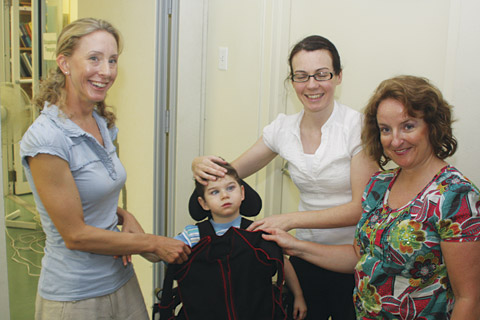
Young Brandon Kent-McTaggart lies on a large blue pillow on padded flooring in an occupational therapy at Lighthouse School as he is measured for a new suit.
Five-year-old Brandon has cerebral palsy. He is being measured for a Dynamic Movement Orthoses suit as part of a on-Island trial to determine the health benefits of these suits.
Beside him, his mother Michelle McTaggart fingers a variety of stretchy, Lycra-based materials, one shaped like a long evening opera glove, another blue-and-red piece reminiscent of Spider-man’s body suit and two other full body suits in lilac and flesh-colour, as she tries to decide which colour and contrasting stitching to choose for her son.
Dynamic Movement Orthoses, or DMO, suits are reputed to improve the wearer’s stability and muscle tone and reduce involuntary movements. According to Lynda Burgess, a clinical specialist physiotherapist with DM Orthotics Ltd, which supplies the close-fitting suits, they can an be used by children or adults – anyone with neurological dysfunctions, whether from cerebral palsy, Down’s Syndrome, multiple sclerosis, stroke, head trauma or other conditions.
Ms Burgess arrived here Friday to begin training therapists how to measure the children for the custom-made suits and how to handle and prescribe the suits.
Twenty children in Cayman, with a variety of conditions and disorders, have been chosen to participate in the three-month trial. Some are being fitted with special gloves, some with leggings, and others with full suits.
Donations helped
The trial was made possible by a donation from the Aal Foundation, said Anna Cartwright, an occupational therapist with Student Services at the Department of Education Services. “They’ve given us a very substantial recurring grant for the mobility needs of children under 18 in Cayman,” she said.
The qualitative data resulting from the trial will be sent to local paediatricians and insurance companies including the government’s insurance agency CINICO to provide evidence that the suits can improve movement and stability. “We want to show paediatricians and CINICO that they are effective,” Ms Cartright said, adding that she hopes the results of the trial will convince insurance companies to cover the costs of them.
Parents have donated $50 each to cover the expenses of videotaping the children undergoing occupational therapy and checks while wearing the suits which will form part of the results of the trial.
Ms McTaggart said she heard about the suits from Ms Cartwright. “When Brandon was in the US, we tried similar types of suits, but they came in bits and pieces and we had to Velcro each piece onto him. It was a real hassle. Anna told me about these one pieces that can be zipped up and down,” she said.
Fittings normally take about an hour and suits are usually delivered within two weeks, barring any postal delays to Cayman.
“These suits can help with infrastructural tone, improve posture alignment and increase stability,” Ms Burgess said.
Depending on the severity of the condition and whether it is progressive, wearers may use the suits for two or three years – although children usually have to get a new suit every six months or so – and prolonged wearing of the suits, combined with therapeutic sessions, can improve movement and stability permanently.
Ms Burgess said parents sometimes complain that their children cannot do as much as they did before donning the suits and that their functions seems to be deteriorating in the first two weeks, but this is because their bodies are getting used to the new alignment of their arms, legs or backs – just like a person doing new exercises in the gym or trying to improve their posture can initially feel pain or weakness in areas that are not used to being exercised or stretched.
Ms Cartwright said the 20 children chosen to take part in the trial were picked to ensure there were a wide variety of capabilities and conditions that could be tested with the suits.
Each parent has set three targets for their child to reach during the trial. For example, one young girl taking part in the trial falls down involuntarily. One of the targets set for her in the trial is to improve her postural control.
“The aim to make them more functional,” said Ms Cartwright.
Related Videos