By the time readers pick up Thursday’s paper, marathon swimmer Penny Palfrey should be several hours into her record-making attempt to swim from Little Cayman to Grand Cayman.
She was due to set out from Little Cayman at 3am Thursday, 9 June, and swim almost 68 miles as far as East End, where she hopes to arrive sometime between noon and 8pm Friday.
The swim is estimated to take between 30 and 40 hours, during which she will take ‘eating on the go’ to a whole different level.
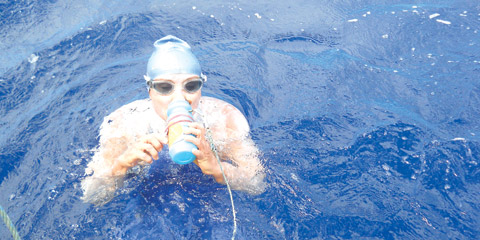
Because marathon solo swimmers trying to break world records are not allowed to touch the boats or kayaks accompanying them, they have to come up with novel ways to ensure that they eat and drink enough while they’re in the open sea.
One way involves tying a drink bottle to a rope and tossing it into the water to the swimmer and then simply pulling the bottle back into the boat or kayak (or the swimmer will toss the bottle back to the boat).
There is also a “feeding stick” – an extendable pole with two cup holders containing food or drink attached to the end is lowered into the water near the swimmer. The feeding stick stays level even in rough waters and ensures that the swimmer does not have to get too close to the boat where she might get hit or accidentally touch the boat, thus negating the record.
Chris Palfrey, Penny’s husband and member of the support crew on her record-breaking attempt to swim from Little Cayman to Grand Cayman on Thursday, 9 June, said she will eat “very little” during her crossing.
“She’ll have Power Bars, porridge, carb drinks and Gu [energy gel],” said Mr. Palfrey at a pre-swim briefing for media and crew on Saturday. The couple brought their own porridge from Australia and they make a very watery version so Penny can drink it rather than eat it.
During her two-day, non-stop swim, she will need to eat every hour and drink every half hour, stopping for just a few seconds each time. “She’ll chug it down and go,” said Mr. Palfrey.
Keeping hydrated is one of the biggest challenges of sea swimming. Swimmers lose a litre of liquid every hour, and Penny will be consuming about 600 millilitres of liquid every hour, her husband explained.
“We’re going to be trying to replace as much fluid as we can, but she is going to gradually get dehydrated,” he said. A popular foodstuff among swimmers and other athletes is Gu or similar energy gels, which are easy to digest and come in a variety of flavours in one-serving packages.
But flavours don’t really matter when it comes to long sea swims, said Steven Munatones, who is also a marathon open water swimmer and will be on one of Palfrey’s support boats.
“After about 20 hours, she won’t be able to taste anything. And then, she won’t be able to taste anything for three or four days afterward.
“Your body changes when you spend hours in saltwater,” he said. Marathon swimmers cannot hear very much during their swims, so they rely on visual cues from the boat to tell them how far they’ve gone, how far they have to go and when to eat and drink, as this is done according to a strict schedule.
Part of the equipment onboard is the “bible” for her sea swim, said Mr. Munatones, which contains all the information the crew and support teams need to know and also what they need to communicate to her. These include laminated sheets of paper with distances of how far she has swum and how far she has to go and a “Time to Eat” sheet in large bright lettering.
Related Videos