

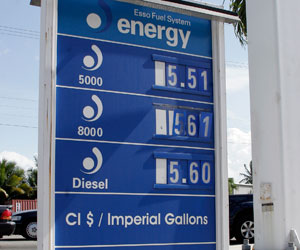

With news reports swirling of gas prices in the United States forecasted to rise more than 30 per cent on current prices to roughly US$5 by summer, one of the local experts said it would be difficult to forecast what this might mean for the Cayman Islands.
Alan Neesome, country manager of ESSO Standard Oil Ltd. Cayman Islands, said he first wanted to establish that speculation as to what prices may be anywhere by summer was not helpful because of the lack of accuracy in such conjecture.
“No one can accurately forecast what fuel prices will do in the future,” he said. “There are too many variable factors affecting prices of crude oil and finished products such as gasoline and diesel.”
Mr. Neesome said, “Historically, global supply and demand for crude oil and petroleum products has the biggest influence on the price of fuel at the pump in the United States but here are other factors, which include geopolitical, taxation and weather, which can also have a major impact on pricing.”
The average cost of a US regular unleaded gallon of gasoline was US$3.39 on Wednesday, according to AAA’s daily forecast compilation. According to the most recent local data, the cheapest price of an imperial gallon of gasoline at an ESSO station in the Cayman Islands as of 3 January was CI$5.38, according to the Cayman Islands Department of Planning Petroleum Inspectorate website.
Taking into account the exchange rate and that the Cayman Islands uses an imperial measurement for a gallon of gasoline, which is 0.76 litres more than a US gallon, the price differential is 57.8 per cent higher for gasoline in Cayman. In the event gasoline prices reach US$5 in the United States, a similar percentage increase in the Cayman Islands would see Caymanians paying CI$7.10.
However, in attempting to explain why Cayman had not seen the relief at pump US consumers enjoyed late last year, Mr. Neesome said, “The US petroleum market is different to Cayman’s, so trying to make a comparison on pump pricing is not going to be a fair comparison. The US has a huge petroleum market with extensive distribution networks by pipeline, rail and road with prices changing frequently, sometimes by the hour. Cayman’s fuel consumption is miniscule by comparison; a fraction of one percent of the US market’s consumption and we receive small parcels of fuel by sea on a periodic basis often weeks apart.”
He said ESSO does not set the prices at the pumps.
“Each service station is operated by independent Caymanian businessmen and businesswomen and they are free to set their own prices.”
Mr. Neesome did not say what wholesale prices were to stations in the Cayman Islands nor what the markups were subsequent fuel being purchased from wholesalers. However he did say that, “There were several reductions in ESSO wholesale fuel prices to their customers in Cayman in 2011.”
Why those savings were not passed on to consumers and the Islands saw mostly only increases last year is still unknown.
Several calls to various gas stations around the Islands late last year to enquire whether there is a petroleum retailer’s association on Island that comes together to set the price of gas saw Johnny Brown, owner of Brown’s ESSO in Industrial Park reveal that, “There is no official association, but owners meet when issues arise or if they need to meet.”
He did not say whether price was one of the issues, which required owners of competing gas stations to meet.
There is no legislation in the Cayman Islands expressly outlawing the practice of collusion.

Related Videos












Allowed Collusion/Price fixing in a free enterprise system is like saying Cayman Island do not have laws against robbery.
What the market will bear.!@#
Evolved democracies have learned that greed if not placed under restraint will break the back of the consumers.. Consumer protection agencies and government regulatory bodies fight these businesses organized collusion/crime every day..
Recent activity in the Straight of Hormuz will be cause for an emergency meeting for a proactive hike I bet..
@ CAYMAN ON GUARD
So true but…
Consumer protection agencies and government regulatory bodies fight these businesses organized collusion/crime every day..
Cayman has no consumer protection agencies, so basically there is zero recourse if any company in Cayman rips you off (and there are lots of them). We need to get with the times and make companies accountable for bad business practices.
Its very simple folks, we are being screwed and without foreplay.
The gas stations are taking great advantage when prices change. When prices go up its instant and when they go down its rather slow. And believe you me, its got nothing to do with the cost price of the gasoline in the reserve tanks. It’s take every opportunity to gouge the consumer and hide behind the theory that it costs more. Rubbish and theres nothing we can do except to turn to the government and ask that some regulatory controls be put in place to protect us.
What a novel idea, the government protecting the citizens. Must mention it to the big guy when I see him again. Yeah right.
same goes for the meteoric rise in residential electricity charges that we have seen for the past year and a half. There is no reason for a such a hike when the reason given by CUC is ‘increase in fuel oil’ and we supposed to believe that.
Surely it calls for a Consumer Protection organization in the land given that the Govt. has done little to help the residents.
that what is called Economic Sabotage, need regulators!
I do have some sympathies for petrol station owners who, like all business owners in Cayman, have seen significant increases in their operating expenses over the last couple of years. Mr Brown, mentioned in the article, wrote a cogent letter to the Compass in November 2011 and outlined some of the issues facing small business owners like him.
However, what was telling about that letter was the absence of any comment on suggestions that petrol retailers are colluding in the setting of prices at their stations. It is not difficult to compare the percentages by which petrol prices in the US and those in Cayman have changed over a given timeframe. As others have noted, such a comparison shows Cayman petrol stations are not reducing prices in a way that might be expected based on the reductions in the US market.
The only reasonable conclusion one can draw from this is that there is no genuine competition between the petrol retailers in the Cayman Islands. Regardless of the operating costs of the petrol business, an environment where retailers are not forced to be price-competitive is only beneficial to the retailers, and not their customers. Government must address this situation if it is at all interested in acting in the best interests of the citizens who elected it.
As an aside, there are some very simple ways to reduce fuel costs which I beleive are largely ignored here. You can choose a smaller more economical vehicle and ease off the accelerator when driving. Do we really need to be driving huge trucks and SUVs and be constantly switching between gas and brake pedals?