


Proposed legislation would radically change the regulatory structure of private sector pension plans, and raise the minimum age at which pension entitlements can be collected to 65 years.
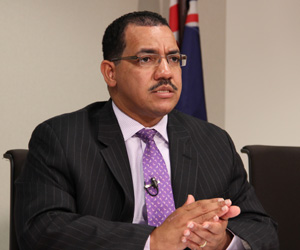
The National Pensions Bill 2012 is the first major revision to the National Pensions Law, which was created in 1998. Employment Minister Rolston Anglin said the system is simply not working and needs to be overhauled.
“If after a career of working hard, one isn’t able to retire with dignity and be able to maintain one’s self, then oftentimes we may ask, ‘Was it all for naught?’” he said.
As an example of dysfunction, Mr. Anglin said there is a case backlog of “600-plus” companies not in compliance with the Pensions Law.
People have until 22 June to participate in the public consultation process. Documents and an online survey can be found at www.npo.gov.ky, and printed copies can be collected at the Department of Labour and Pensions, on the second floor of Midtown Plaza.
New structure
If the bill is approved, the National Pensions Board and National Pensions Office would be dissolved, with the Cayman Islands Monetary Authority taking over the regulation of pension plans, trustees and administrators, and the new Department of Labour and Pensions taking over functions related to employers and employees.
Board Chairman Orren Merren said he supports the plan to dissolve the board, which is charged with administering the Pensions Law and regulations but did not have a staff or budget apart from the Pensions Office.
“It wasn’t a perfect setup, and I think time will tell whether or not having a board is or is not a net benefit, but certainly moving from what we have to what is envisaged, it doesn’t need a board to continue,” he said.
Gordon Rowell, head of insurance supervision at the monetary authority, said the monetary authority is well-positioned to take over the licensing and regulation of pension plans, in the same way that it oversees health insurance plans. He said the new responsibilities would not require additional resources or staff. Conversely, Mr. Anglin said central government would have had to spend $500,000 to hire enough staff to handle regulatory functions within the Department of Labour and Pensions.
Describing the monetary authority as a “natural fit” to oversee pension plans, Mr. Rowell said. “There’s been a major global push toward separating the consumer protection arm away from the prudential arm because the skill sets are much, much different.
“I think it’s actually a very good move by government to actually separate out the two items. It’s worked very well in the health sector with the Health Insurance Commission and CIMA managing the oversight of the insurance companies, and we’ve got no reason to think it won’t work exactly the same way in the Department of Labour and Pensions,” he said.
Fixed penalty regime
One major change under the new legislation will be the introduction of a fixed penalty system for noncompliant companies. After an investigation, the department can issue a ticket – similar to what occurs with a traffic offence, according to Mr. Merren – to the offending persons, carrying a penalty of $1,000 to $5,000. The person receiving the ticket can request a trial or accept liability. If the person ignores the ticket, the matter will go to court with potentially higher penalties.
Superintendent of Pensions Amy Wolliston said once the bill is approved, she expects the department to “write a significant number of tickets soon” in relation to the 600 or more outstanding cases. The penalty fees will go to government, while the pension plan will receive payments in arrears plus interest.
The new legislation also stipulates protections for employees who report their employers for noncompliance with the Pensions Law. “Unfortunately I must tell you that employers are not always nice to their employees when they report their employer as not being compliant,” Ms Wolliston said.
The bill requires that employers maintain pension records for seven years, and also requires the pension plan administrator to notify members – in addition to the regulator, as is required now – if their employer is not complying with the Pensions Law.
Changes for employees
The existing Pension Law sets the normal retirement age at 60 years old. The new bill would replace the term “retirement” with “pension entitlement”, which would be set at 65 years old. The change in terminology is meant to clarify that the age of 65 is when a person can start receiving pension benefits – not that the person is expected to retire before receiving pension benefits.
The legislation allows current workers to access their pension benefits at age 60, if they choose, for a period of three years. Early entitlement ages would similarly be raised from 50 to 55 years.
The new bill does not propose any changes to the 5 per cent contributions by employers and employees, or the maximum pensionable earnings of $60,000.
However, the bill permits additional voluntary contributions that would not be accessible until the age of entitlement, and also proposes designated voluntary contributions that can be withdrawn before the age of entitlement, for the specific purposes of health, education and housing. Accordingly, the new legislation incorporates the pension-for-property swap amendment passed by the Legislative Assembly last year.
Under the new legislation, pension plans must issue quarterly statements of pension benefits, as opposed to the annual statements now required. Also, pension plans must convene annual general meetings for members of the plans. Additionally, new information about pension fund performance must be made available to employees enrolling in a plan.
The new bill continues the exclusion of domestic helpers from Pension Law requirements.


Related Videos













The new law needs to include the responsibility and authority to enforce your own law. It appears that more time is wasted on creating new laws and revisions, when the focus should be on enforcement and actually holding those that are not in compliance accountable!
Mismanagement of retirement funds is happening all over the world for both private and public retirement funds. The cause is simple: fund managers are violating their fiduciary duties (plenty of laws already on the books to prevent this if they were just enforced). Fund monies are being used for everything except retirement. You will be better off taking your retirement money and managing it yourself. Even a bank savings account will net you more for retirement than most of these so-called retirement programs. I call them retirement ponzi schemes.
I suppose this is one way of dealing with the enormous unfunded pension liability. If they increase the retirement age to 75 it will probably disappear altogether. Reading between the lines it looks like the politicians pension entitlements will not be affected, only those that work for a living.
Let us observe if this is pure political rhetoric and grandstanding or not. There are already multiple laws on the books that the government do not have the guts to enforce for fear of upsetting their political business supporters and big corporations with deep pockets.
Passing new laws to join the list of unenforced laws is not the answer. Action against those employers in violation would be the only way to convince the people that government is serious this time around.
A government that passes laws with no enforcement of those same laws is only politically grandstanding to buy time off voters in hope of hoodwinking them during election season one more time !
Prove me wrong.
Now that the pension law has changed and the honorable lady Mrs. Magistrate Grace Donalds was forced to leave or retire at the young age of 60, why not consider asking her to come back until age 65?
We do need the brightest minds and people of integrity Judging our society. We have at least identified one person fitting that criteria; former Magistrate Mrs. Grace Donalds.
I hope the person replacing her is not over the age of 60.