Like most locals who experienced Hurricane Ivan, Sai Eccles remembers the sound that replaced that of roaring winds once the storm passed: The loud, never-ending drone of generators.
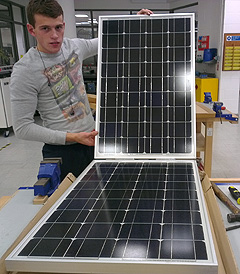
Most teenagers would have just tried to ignore the noise, but Sai began envisioning a generator that was both silent and eco-friendly. Two years later, and with the help of his friend Jack Halstead, the young inventor began working on the prototype for a solar generator that could be used after natural disasters.
“There are solar generators out on the market right now, but what you find with them is that their solar capacity is far too small for their battery capacity so they’re incredibly heavy units,” he said. “Even the smallest ones weigh about 400 pounds so you can’t move them by yourself. You need a team or forklift to move them, which is really not ideal for a disaster situation.”
Sai envisioned a light-weight generator that could float and would run on sunshine alone.
“You have this massive problem after a natural disaster where you can’t get your hands on fuel because it’s too scarce, the entire infrastructure breaks down,” he explains. “A solar generator works completely independently, which is quite ideal.”
The pair used a crowd-funding site called “Please Fund Us” to raise the money necessary to fund the project, which they named Block 77.
“From there we went on and got it built. We built it in my school’s design and technology department,” Sai said.
A month or so later, the prototype was complete. That does not mean, however, that Sai and Jack’s venture into solar technology was completely smooth sailing.
“Neither of us do design and technology as a subject so, from that perspective, we were a little off in some of the academic stuff and the techniques we weren’t familiar with,” Sai explained.
Initially, the two young men attempted to build the generator shell from fibreglass, but switched to aluminium when their first attempts failed.
“Probably about ten hours of work just went down the tubes there,” he said.
After figuring out a better material for the mould, however, it was not long before the generator was in working order.
“Once we rigged the internal components together and it turned on the light it was really quite satisfying,” Sai said.
The prototype, named GS1, is still only the first step in the journey to a mass-marketable design.
“There’s still a lot of refinement to do to get our capabilities up to where they need to be to get this to be something that a real family could use in a disaster situation,” Sai said.
Although solar panel technology is being improved upon every year, the pair is still confident that their invention will have a place in fulfilling future energy needs.
“Obviously from a technical standpoint there’s a huge amount of people working in labs who have intelligence we don’t have,” Sai said. “But that’s the beautiful thing about things like the Block 77 project. What we’ve been able to do is create really simple and robust technology that I think, to be honest, anybody would be able to grasp after about 20 minutes […] and I think that, in terms of energy independence, is the biggest thing you can ask for.”
Doddlr
In case they did not have enough to do already, on top of attending classes, applying to universities, and building solar generators, Jack and Sai also decided that they would take over the social network scene.
They began building Doddlr, a social network aggregation site, when they were both just 16 years old.
The online programme allows you to access all your social networks, as well as Youtube feeds and e-mail, through one website.
“The best way to think about it is what a smart phone does, but as a web service,” Sai explained.
Instead of having to individually check each social networking site, users of Doddlr only have to sign into one website.
This time, however, the two young men realised they could not complete this project by themselves.
“To do that it would take you years and years of programming knowledge and expertise, which we didn’t have, so we had to work alongside professionals because otherwise we were never going to get anything done,” Sai said. “We had to make the judgement call that we can’t build this ourselves and, especially in the web space, if you’re going to compete you have to compete at the highest level. It’s easy to get in the door but the catch is that when you’re inside it’s very, very competitive.”
After years of overseeing the site’s development, Doddlr was finally launched this year.
But this does not mean that Jack and Sai have come to the end of their journey. This is just the beginning. Indeed, for two entrepreneurs and inventors who have already successfully built a social aggregation site and a solar generator, 18 is really far too young to retire.


Related Videos