Amendments to the Marine Conservation Law are offering more protection to stingrays in the Cayman Islands.
The Legislative Assembly is expected to pass the amended law during its current session, which was scheduled to begin on Wednesday, 13 March.
The Marine Conservation Amendment Bill includes for the first time stingray as species which cannot be removed from the wild.
It states: “Whoever, in Cayman waters, takes, injures or has in his possession … rays taken from Cayman waters is guilty of an offence.”
The amendments were introduced following public outrage over the discovery of stingrays in a holding tank in Dolphin Discovery which had, prior to their capture, been tagged by scientists at the Sandbar a few months earlier. The presence of the stingrays at the dolphinarium and reports of declining numbers of rays at the Sandbar and Stingray City led to renewed calls from the water sports tourism industry and conservationists for the government to pass the long-delayed National Conservation Bill, under which rays would be protected.
Instead, the government opted to amend the Marine Conservation Bill to include rays among species that cannot be taken from local waters.
Environment Minister Mark Scotland described the legal change as “a small amendment to the law, but of huge positive benefit for the environment and the tourism industry”.
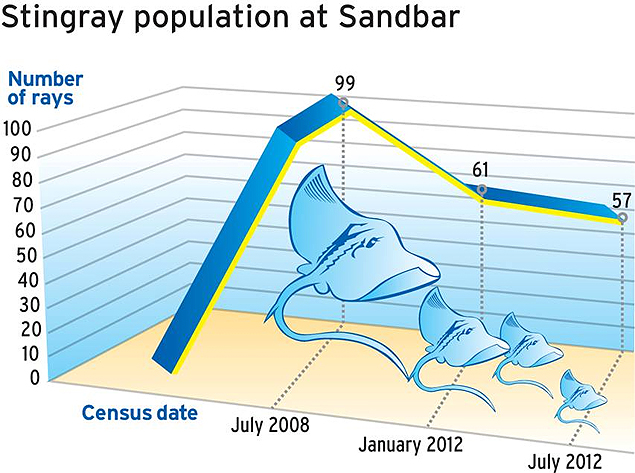
At the moment, the only areas of the Cayman Islands in which stingrays are protected are the Sandbar and Stingray City, which are Wildlife Interaction Zones. Scientists and conservationists who have been tracking the population of rays in those areas report that their numbers have been declining.
A census of the population of rays in January 2012, found 61 rays at the Sandbar, while another census done six months later found 57 stingrays. Censuses in earlier years had found 100 or more stingrays at the Sandbar.
Four rays that had been tagged at the Sandbar during a ray census were returned to the North Sound, but the West Bay dolphinarium kept six other rays, despite urging by the Department of Environment to release them.
Under the amended law, it will be illegal to possess rays taken from the wild.
Gina Ebanks-Petrie, director of the Department of Environment, said she and her staff would be happy to arrange for the release of the remaining six rays, as they did for the release of the tagged four stingrays last year.
While those in the water sports, tourism and conservation fields welcomed the extra protection for stingrays, some argue that the stingrays would have been protected under the long-delayed National Conservation Bill, which successive governments have failed to bring before the Legislative Assembly, despite years of public consultation and feedback.
Conservationist Guy Harvey, who launched a petition to urge the government to pass the National Conservation Law so that stingrays could be better protected, and who has organised the censuses of rays at the Wildlife Interaction Zones, has estimated that a single stingray can generate US$500,000 in revenue per year and in its lifetime, assuming it lives more than 20 years, could generate US$10 million.
Anyone who contravenes the Marine Conservation Law, including its new stingray protection regulatios, is liable to face a fine of up to $500,000 and imprisonment for 12 months.
For more on the upcoming election, please click here.

Related Videos