Marine parks were first established in the Cayman Islands in April 1986. And, just like the latest proposals to expand protection for the marine environment in Cayman, the original legislation also faced some strident opposition and was considered controversial.
When a vote on the second reading of the bill was taken on 22 March, 1985, following a heated debate in the Legislative Assembly, three members – McKeeva Bush, Haig Bodden and John McLean – voted against it, but the majority vote of 10 carried the bill through.
The marine parks were founded under the slogan “Save Our Tomorrow – Today”, a theme the Department of Environment says rings as true in 2013 as it did 27 years ago.
The Marine Parks Regulations created three kinds of protected area zone designations – marine parks, replenishment zones and environmental zones.
The premise behind the creation of these zones was to sustain and protect local marine populations, including conch, whelk and lobster. The parks also serve to protect the our reefs and fish stocks.
At the time the original law was drafted, the main aim was to cut back on overfishing and protect reefs from anchor damage.
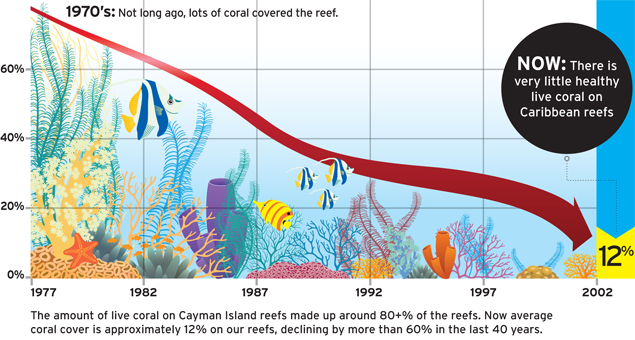
While the need for a beefed-up conservation law shows that more work needs to be done to protect the local waters as the local population increases and pressure on the marine environment mounts due to climate change, continued overfishing and development, scientists who have examined the reefs in Cayman have determined that the protection afforded to Cayman’s reefs are among the strongest in the Caribbean, but that it is time to start addressing existing threats.
Nearly a quarter of a century after the marine parks were introduced in the Cayman Islands, the Department of Environment – funded by a Darwin Initiative grant and working with Bangor University’s School of Ocean Sciences in the UK and The Nature Conservancy in the US – embarked on a three-year review of the protected marine zones. Officials are due to give a final report on that review and the public consultations that followed to the Darwin Initiative at the end of this month.
Speaking at the launch of a three-year-review of the marine parks in 2010, John Bryne, project manager of The Nature Conservancy, said: “There are things happening now that were never imagined 25 years ago.
The research team checked 60 sites in all three of the Cayman Islands, looking for stressors such as coral bleaching, disease and overfishing, and also examined long-term data collected by the Department of Environment to see how the reefs’ health has been impacted over time. The data was input into a software programme specifically developed for marine-protected areas, which maps and gives options to enhance marine parks.
The Department of Environment took those review findings and recommendations for how the marine environment could be better protected on the road, holding a series of public meetings throughout the islands and getting public feedback.
The department has been both lauded and criticised for its proposals. But Gina Ebanks-Petrie, director of the Department of Environment, said feedback has been overwhelmingly positive, with two third of those who attended meetings and filled out response forms supporting the department’s proposals.
For more on the upcoming election, please click here.

Related Videos