

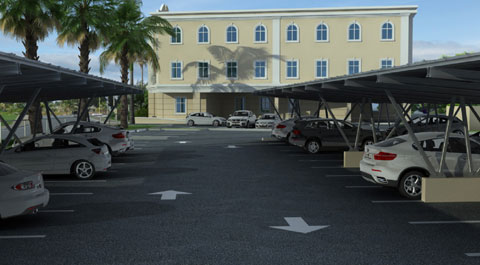
The light of sustainable energy dawned on the people of Cayman Islands after the unveiling of the islands’ largest solar farm was announced last week.
The 528 solar panels erected in the company’s parking lot have the ability to power about half of the 200,000-square-foot bank building.
Caledonian Global Financial Services has accordingly been named the “most forward thinking bank in the Cayman Islands,” by Kurt Tibbetts, Works minister.
“Caledonian is demonstrating that the Cayman Islands has in fact embraced alternative power sources. I welcome this milestone, and I am very pleased to see the recent strides made to introduce renewable energy in the Cayman Islands,” said Mr. Tibbetts, adding that the 528-panelled solar array could serve as “example for all future developments,” to follow suit.
CEO of Caledonian Global Financial Services, Barry McQuain, said the solar powered project sparked because it “just made sense.”
“Think about what Cayman is blessed with, it’s got sunshine, wind, wave, and geothermal… And so, you’ve all this great alternative energy. So we picked solar first because it made the most sense and it was the easiest to do… I would also be surprised if other [companies] aren’t going to try and do the same thing,” said Mr. McQuain.
He said there are two reasons for a company to go green. “[Go] green because you like the environment or green because it makes money. It’s a good thing for the environment – we reduce the amount of carbon dioxide that is released – but it’s also a good investment.”
In 25 years Calendonian estimates it will have saved nearly $2 million.
Solar is the way forward
In the month and a half the solar-panel system has been collecting energy, it has generated more than 28 megawatts of power, according to Jim Knapp, managing director of Endless Energy, the company that built the project.
“That would power so many houses, you couldn’t believe; it’s really an incredible system,” said Knapp.
“This is proof of the pudding. This is a bank who understands the financial aspects of a transaction like this and they are reaping the benefits right now,” he said. Knapp added that consumers in the Cayman Islands are paying more for electricity “than almost anyone in the world.”
Caledonian bank entered into a power purchase agreement with Caribbean Utilities Company under the Owned Renewable Energy program. This agreement allows residential and commercial owners to generate their own power, while CUC remains the sole provider of electricity in Grand Cayman. CUC president Richard Hew touched on some of the facets of this agreement.
“[Caledonian] will generate electricity and sell it back to us. So we have a role in getting all the energy on the grid and ensuring it is reliable and sustainable for customers, and some of that energy will be fossil fuel, some will be firm capacity, and others will be solar.”
Mr. Hew added that solar power can have its disadvantages on a rainy day.
“When the sun is setting there is no output from these solar panels, so we have to have to have firm capacity backing. And even during the day as the clouds go over, the output for this facility will drop and there has to be continuous supply [of electricity] for all our customers, so we have to provide that firm capacity,” he said.
The Cayman Islands government is also planning to tap in to sustainable energy, according to Mr. Tibbetts.
“The government is demonstrating our commitment, such as easing import cost for electric vehicles, and seeking innovative ways to dispose of and perhaps harnessing energy from a mountain of trash,” said Mr. Tibbetts.
He added that while the island is still “dependent to a large extent on fossil fuel,” the government is “very well aware of the resulting impact of that on our environment.”

Related Videos










So why wouldn’t CIG cover the large flat roofs on the schools out in Frank Sound with solar panels?
The schools complex must have electric consumption way in excess of Calendonian House and is used mainly in the day only. The buildings are high and should not suffer shading and wont need significant structures to hold the panels.
See CIG show the way to these savings.
Many county councils in the UK (even though England is not known for excessive sunshine) now require any plans for new commercial buildings to feature solar on at least 25 percent of available roofs and have roofing designed so that it will support retro-fitting for the rest…
Bet the staff and customers love getting into a cooler shaded car too – wonder how much fuel that will save on car AC use over 25 years?
Well done to all involved!