

Video sparks Internet media frenzy
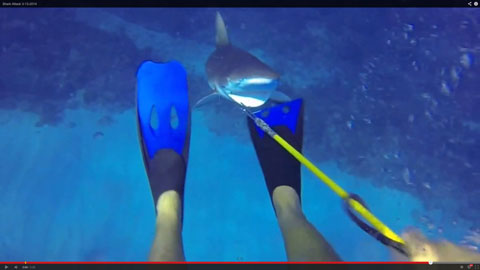
A lionfish culler’s video, filmed as he was fighting off an aggressive reef shark in a dramatic encounter in Grand Cayman’s waters, has been broadcast around the world.
Stay-at-home dad Jason Dimitri says he has been diving only for five months and had never seen a shark in Grand Cayman before Thursday’s frightening encounter.
In the three-minute clip, the Caribbean reef shark repeatedly circles and bumps him, forcing him to smack it on the nose with his culling spear. It eventually swims away after he drops his container filled with lionfish. The clip had attracted more than a half-million views on YouTube by lunchtime Monday.
Mr. Dimitri says the incident has not put him off diving or culling the invasive lionfish. He believes the shark was not trying to attack him, but was acting aggressively in an attempt to take the lionfish.
Environment officers and dive shop owners say the incident may have been the result of reckless divers feeding sharks from spears – teaching them to associate lionfish cullers with food.
The video, posted Thursday evening, has been rebroadcast in the U.S., U.K., Australia and New Zealand. Mr. Dimitri said he was inundated with requests from news outlets and diving enthusiasts, including a Saudi prince who invited him to come shark diving in Dubai.
Mr. Dimitri, a former police officer from North Carolina, said he posted the video so his family and friends back home could see it, and he was shocked by the response. He said any money made from the YouTube clip, which will attract advertising revenue depending on its popularity, will go to shark research and conservation efforts.
He said he regrets labeling the video “shark attack” and did not blame the shark, which was acting naturally in its environment.
“It definitely scared the bejeezus out of me, but once I had watched the video back a few times, I could see that it was going for the lionfish and not for me.
“I wish I had called it shark interaction. I can’t change that now, unfortunately. I wouldn’t want people to go out and try to harm sharks because of this.”
Mr. Dimitri and a buddy were at a rarely dived site near Breakers, culling at around 70 feet when the incident happened. They had seen the shark early in the dive but continued to cull for around 30 minutes without encountering it again.
He was carrying a container filled with lionfish and had just speared another lionfish when the shark “came out of nowhere” and bumped him from the side.
Seconds later, the video shows the shark coming back toward him, snapping at the spear, as Mr. Dimitri retreats toward the surface. He drops his container and the shark comes in once again, turning away only when he fends it off with the spear. “I was just trying to defend myself and get out of there. I just tried to stay calm and make sure I didn’t bolt to the surface.”
Dive leaders in the Cayman Islands have warned that encounters with predators are becoming increasingly common for lionfish cullers. The Department of Environment believes such incidents are caused by irresponsible divers deliberately feeding sharks from spears.
Research officer Bradley Johnson said divers are now being advised to stop culling and end their dives if they see predators in the water.
“What happened here could well be the result of someone having fed that shark from a spear in the past. That is why we are so concerned when people do that. It is illegal to feed sharks in the Cayman Islands for good reason,” Mr. Johnson said.
He added, “It is unfortunate but we are hearing more and more stories of incidents similar to this, though nothing quite as aggressive as this.”
He said incidents like this could become serious if the diver panicked and bolted to the surface, potentially causing decompression sickness or other complications.
He urged cullers to make safety their first priority and not take unnecessary risks to catch lionfish.
Steve Broadbelt of Ocean Frontiers, the East End dive company which used to run interaction dives with Caribbean reef sharks between 2000 and 2002, before the Marine Conservation Law was changed to ban the activity, examined the video for the Caymanian Compass and said the shark was exhibiting normal behavior in the circumstances.
He said it was acting “competitively” toward the diver and was interested only in the lionfish as a source of food.
“The shark’s swim patterns and angle of pectoral fins I observed in the video were displaying curiosity with a competitive nature,” said Mr. Broadbelt, who has logged several hundred hours diving with Caribbean reef sharks.
“The female shark never went into a feeding mode, which you can see in the slow-motion part of the video, the teeth are never extended and the shark is gumming its subject trying to figure out the source. As soon as the shark had deduced that the food source was no longer present at the diver, she returned to the bottom and remained there.”
He said the video highlighted some pointers for cullers of what not to do when a shark approaches.
He advises cullers to abort dives if they see a shark in the area, not to use clear containment devices and to drop their catch immediately if a shark or eel shows an interest.
“The diver held on to his catch for an excessive length of time and led the shark to the surface,” he said.
Neil van Niekerk, manager of Southern Cross Club in Little Cayman, says that cullers in Little Cayman are frequently hassled by reef sharks, and he fears a backlash for Cayman’s dive industry if someone is hurt in a similar incident.
He believes such incidents strengthen the case for a government cull team to take responsibility for lionfish control, instead of volunteer divers.

Related Videos













This diver made a number of errors in judgment in this culling episode that attracted the shark to him. My concern is that people will simply conclude from this video that sharks are the problem and that killing sharks is the solution.
Sharks are not the problem in this video.
Thanks Jack, I gather from what you saying is that encounters with Reef Sharks like this are very rare in Cayman. From what I’ve heard they tend to stay away from recreational divers is that correct? It does look like this one was more interested in the dead lion fish than the diver. It would be great if they started developing a taste for live Lion Fish and started help us get rid of them.
Unfortunately, we’ve already learned that killing lionfish and feeding them to predators only teaches the predators to expect treats from divers. It doesn’t teach them to hunt the lionfish independently. And yes, this diver made several judgment errors. Sadly, the viral uptick in viewing just makes the general public fearful and puts sharks at risk–a very bad combination.
I am not much of a diver but I would appreciate from the previous people who made comments to elaborate on the error judgements that this diver did. Most of the recreational divers would certainly want to know how not to be in his position.
Pierre: You can see some more comments that might answer your questions about this video and the questions it raises at if mavericks like this guy do stupid stuff. No doubt other divers are to blame for feeding the sharks and eels.
http://www.scubadiving.com/article/news/Caribbean-Reef-Shark-Attacked-by-Spearfishing-Diver
If he is really concerned about the negative impact, why not pull down the video.
Great article Mike, I actually like the way they Titled it Caribbean Reef Shark Attacked by Spearfishing Diver because after looking at it several times it really doesn’t look like the shark was interested in him he just wanted his catch. He made some mistakes which he’s seems to be sorry for in his interviews even to the point of saying that any money made would be donated to Save the Sharks Organizations. But in his defense anyone with a spear in their hand that sees a shark swimming at them that way is going to poke him.
Of course he attracted the shark. He was hauling around a bin full of dead or of flapping around fish that were bleeding to death from being speared. This was NOT a shark attack! This was a shark smelling tons of blood and sensing the irregular heart beats and vibrations of dying fish. (A sensory system they have developed over millions of years). I am sure that if the shark wanted to attack him he would not have had a problem.(shark vs. pole with 3 tiny spikes on the end… haha. Really???)
Sharks have no interest in humans, that is why in waters with clear visibility (like Cayman) there are little to no shark attacks. I have been diving in Cayman for over 25 years and the few (and wonderful) times I have seen a shark they have shown absolutely no interest in me. Once one passed by me at a range of 5′ and he just looked at me, and kept going at a slow relaxed pace. Best dive of my life!!! Whereas in places like Florida people get attacked due to simple (and unfortunate) mistaken identity. The shark senses something, can’t see it well, so takes a bite. Or surfers in places like CA where they look like seals when laying on their boards! There is a reason I don’t go in the water off FL or do not surf!!
This shark came up to this diver because he did not have the sense to drop the bin full of bloody fish at the first site of the shark. He is lucky it WAS NOT an attack!! And he came back to reinvestigate the diver because he held the bin so long and maybe the spear still smelled like blood. That was a lucky diver. I also can’t believe the diver did not get bent from coming up so fast (if he dropped the bin full of bloody fish in the first place, the shark would not have messed with him!)
He is one lucky (and bad) diver!! Hope he is never my buddy!!
* To all the lion fish culling divers, a BIG thank you! But if you see a shark and you have a bin full of bloody speared fish flapping around, DROP THE BIN!! Common sense!!