

They may not get to vote in their country’s independence referendum this week, but Cayman’s Scots made sure they had their say in an impassioned debate.
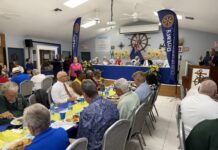
The whisky flowed as freely as the ideas when Scots on both sides of the argument debated whether to end a union with the United Kingdom that has lasted for three centuries, during a gathering at Ristorante Pappagallo in West Bay last week.
Like expatriate Scots all over the world, those living in Cayman will not get to vote in Thursday’s referendum. To be eligible to vote, they must be resident in Scotland.
The debate has gripped Scotland over the past months, with no town hall, school assembly or city pub immune from the conversation.
“To that list we will now add a far-flung tropical island,” said master of ceremonies Steve McIntosh as he introduced the speakers at the debate, organized by the Institute of Chartered Accountants of Scotland and PwC.
In the “yes” corner was business coach Tom McCallum, who said Scotland should believe in itself and its people and move forward in hope rather than fear.
Supporting the “no” corner was visiting lawyer William Frain-Bell, on island as part of former premier McKeeva Bush’s legal team. He warned pro-independence Scots to “be careful what you wish for, because you might just get it,” suggesting that separation from the U.K. would be a disaster for the country.
Mr. McCallum acknowledged there would be short-term economic consequences if Scotland were to go solo – a fact hammered home by revelations this week that several Scottish banks and businesses have outlined plans to move south of the border in the event of a vote for independence.
But he said fear and uncertainty should not stand in the way of the future.
“The idea is coming, and it is an idea called Scotland,” he said. “It is not about what happens in the next six months or whether my tax bill is going to be different next week … It is about an independent nation that gets to discuss, create, apply and iterate its ideas.”
He said Scottish people have fundamentally different political views than people in England, borne out by the fact that the Conservative Party has won U.K. general elections without a single seat north of the border.
He acknowledged there is no clear plan for what happens after independence, but he said he believes it would be an exciting time for Scotland. He suggested the short-term pain would fade into insignificance as the long-term possibilities of self determination became apparent.
Describing himself as a dual national, “a tartan turtle,” who belongs equally to Cayman and to Scotland, Mr. McCallum said he also believes in the principle of independence for the Cayman Islands. He said the territory has some way to go before it is ready to make the move, but he believes Scotland will, on Thursday, set a template for others to follow.
“There is a fairly stunning opportunity in front of the people of Scotland right now and that is to make a choice to break up a 300-year-old union, which is past its purpose, without any aggression or military intervention, simply by modern democracy. That is actually going to cause a seismic change to democracy around the world,” he said.
Mr. Frain-Bell struck a very different note in his arguments for Scotland remaining with the U.K. The lawyer, who said he had been drafted at the last minute to make the case against independence, started with an apology.
A former candidate for the U.K. Conservative party, he stood against Scottish First Minister Alex Salmond in the 1997 general election and lost.
Mr. Salmond, the leader of the Scottish National Party, has gone on to drive the independence issue forward, culminating in Thursday’s ballot.
“I am an ardent unionist,” said Mr. Frain-Bell. “In 1997, I could have stopped all of this, I’d be the First Minister and there would be no referendum. There may not be a Scottish parliament at all.”
He acknowledged that the unionists’ “Better Together” campaign has been badly organized and complacent, and out-matched by the “yes” campaign. “The unionists have been thinking it is never going to happen, but do you know that it might?” he added, referencing polls showing opinion is neck-and-neck.
He said Scotland is stronger as part of the U.K., with the benefits of the Royal Navy, the British army and a “foreign policy that works.”
He added, “If you are thinking that this is a good idea, and the mere fact that you couldn’t get anybody to speak for the ‘no’ campaign (suggests you are), be very careful what you wish for.
“I can assure you this is not a good idea … It would be a disaster because it has not been well thought out.”
Related Videos










Scotland needs to be free to fully manage her own affairs. For too long the Scots have been the less than equal partner in this so-called partnership. I am also very surprised to hear that the PM is on his knees begging for Scotland to stay in the union as most of the English people that you speak to seem to have very little regard for Scotland or her people and are quick to point out that Scotland is little more than a financial burden for England.