

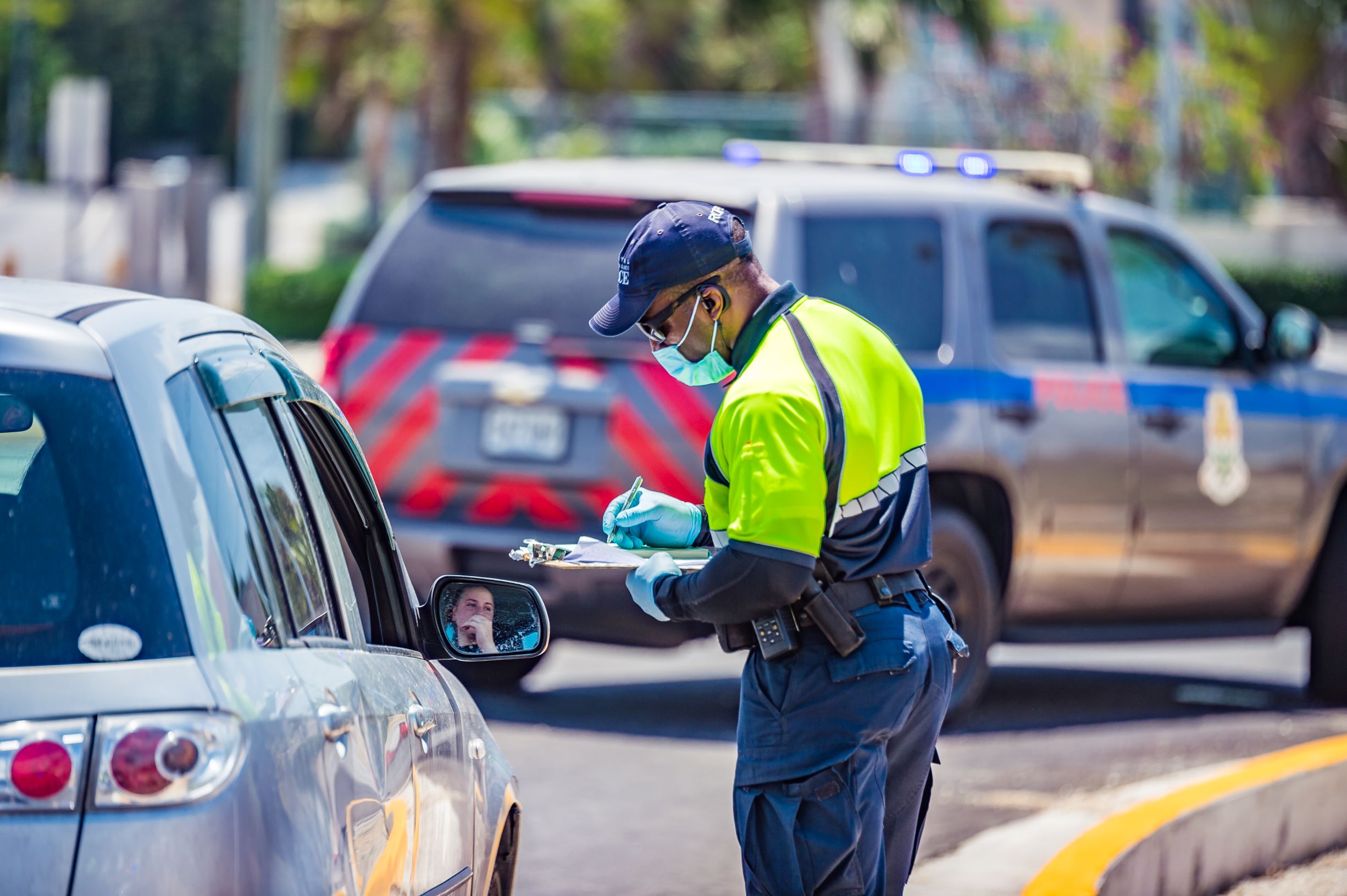
The hard and soft curfew measures have been extended for two weeks in an effort to contain the spread of the coronavirus in the Cayman Islands.
Commissioner of Police Derek Byrne said the hard curfew, which was due to expire Friday, would now run until 1 May at least.
After consultation with the governor and the premier, he said he was using his authority under the Police Law to renew the curfew to help fight the “hazard” of the coronavirus.
The curfew includes a “full lockdown” on Sunday 19 April, and Sunday, 26 April, as well as a continuation of the overnight lockdown which starts every day at 7pm and is lifted at 5am. During those hours only essential workers, with written authority, and emergency services are allowed on the road.
The hard curfew also covers public beaches. The commissioner said that meant there was to be no activity – no snorkelling, no swimming, no walking – on and around public beaches.
Premier Alden McLaughlin said it was clear that curfews were working and would need to be continued.
He announced that Cabinet would extend the ‘soft curfew’ measures with only minor changes to the regulations already in place.
People will no longer be able to drive to exercise under the new measures and are now effectively limited to biking, walking or running from their own homes.
Residents will still be allowed to exercise every day, except Sunday, in an expanded time frame of 5:15am to 6:45pm.
“It is clear that our suppression efforts are working in restricting the transition of the virus through these islands.,” the premier said.
He said it was encouraging that a month into the crisis, Cayman was not seeing large numbers of people presenting with symptoms of COVID-19. He acknowledged the restrictions were “very stringent”.
He added, “The hope and the plan is that over the course of these next two weeks, with the coming on-stream of aggressive testing we should be in a very good place, being able to understand the degree to which the virus has moved through the community.”
Legislative Assembly session planned next week
The premier announced that a meeting of the Legislative Assembly is planned for Wednesday, 22 April. He said that would be a short meeting with a reduced number of parliamentarians designed purely to change the Standing Orders to allow for a virtual meeting.
A substantive meeting of the House will be held the next day with legislators dialling in via video-link. Changes to the Pensions Law, Traffic Law and Immigration Law will be considered and a new deputy speaker elected during the virtual session.
The intention is to allow a ‘payment holiday’ for employee contributions to the pension fund and to allow people to access some portion of their pension savings, McLaughlin said, adding that details were still being worked out.
Changes to the Immigration Law could allow work-permit holders to continue in their roles once their paperwork expires, given the emergency situation.
The Traffic Law changes could allow people to renew their vehicle licences, among other things, without the need for a physical inspection for as long as the crisis continues.
Canada flight
Governor Martyn Roper meanwhile confirmed that a flight to Canada was being organised by that country’s government for next week.
Anyone who wishes to be on the flight must sign up to the Register of Canadians Abroad.
Noone will be allowed on the plane without first registering on that site.
One new case
The Cayman Islands has just one additional case of the coronavirus after 54 new test results were announced Thursday. The new case was a contact of someone who had previously tested positive.
Cayman now has 61 confirmed cases in total. Of those, 19 are symptomatic, including four people who are in hospital, one of whom is on a ventilator but said to be improving.
A total of seven people have been declared fully recovered, meaning they have had two negative tests for the coronavirus. A further five are clinically recovered, which means they no longer have symptoms but have yet to be retested. A total of 690 people have been tested.
Lee said doctors were using a variety of approaches, including, in some cases, the use of hydroxychloroquine, a drug that has shown promising results in dealing with COVID-19 in limited trials.
He clarified that only a handful of cases, of the 61 so far in the Cayman Islands, were not linked in some way to travel.
Related Videos










Let’s assume the government’s strategy works and we don’t have any widespread community infection.
Then what?
Do we keep the borders closed forever?
This virus isn’t going away any time soon.
We bought 200,000 test kits. Half of which are being sold to our neighbors.
But can we please use the kits we are keeping and test extensively. I know it takes time to ramp this up.
Hong Kong is a crowded island but has got a grip on this.
Anyone infected, even with no symptoms, is put in hospital until 2 negative tests.
People who have been in contact with infected people are put in compulsory isolation.
San Francisco now requires masks when outside the home in enclosed spaces.
https://sf.gov/information/masks-and-face-coverings-coronavirus-outbreak
This is only common sense and no hardship for anyone.
The risky places to catch this virus is in a supermarket or bank. Not outdoors.