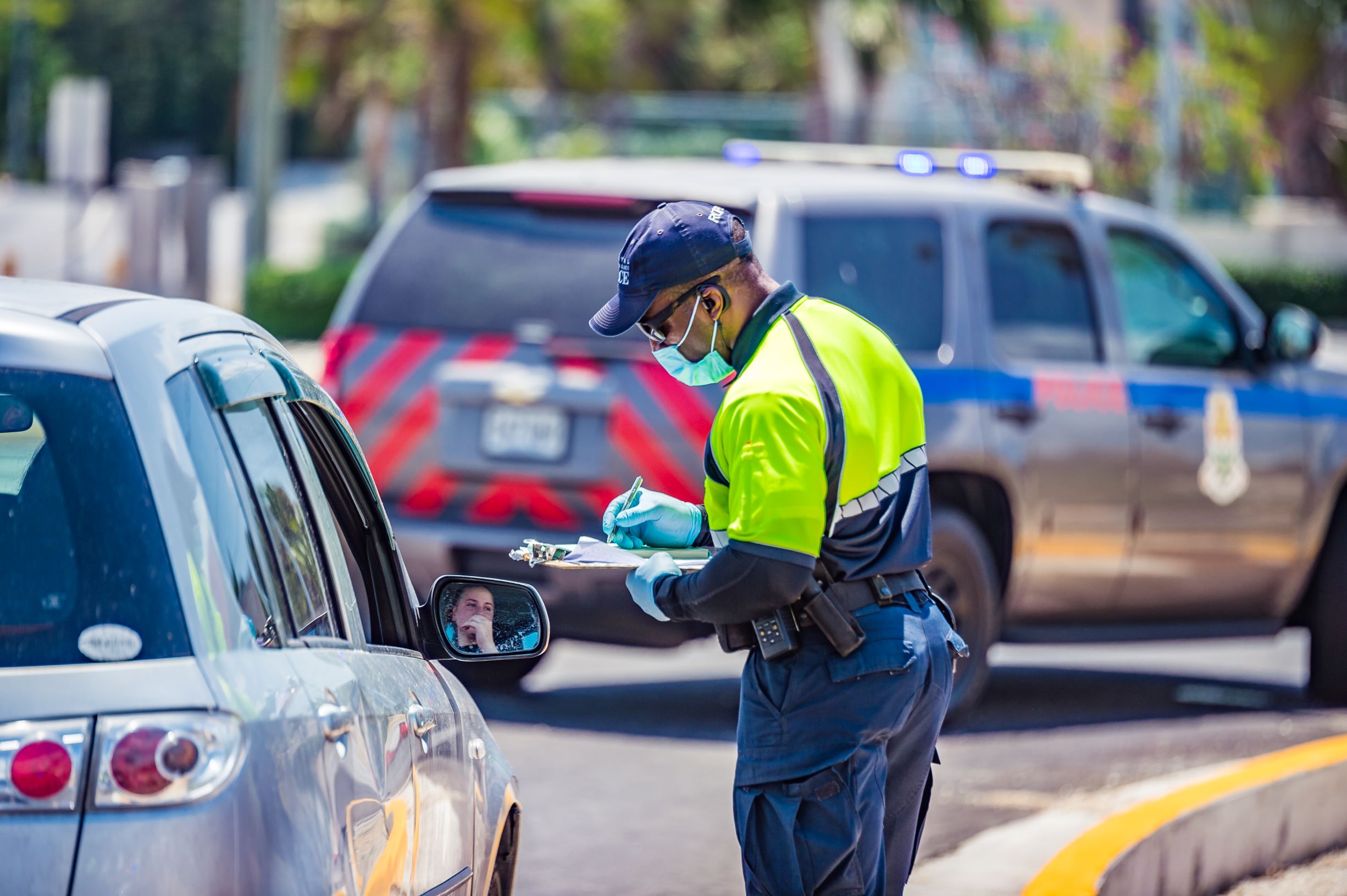
A month into Cayman’s coronavirus suppression measures, only a handful of people have been prosecuted for breaches of curfew.
For now, only cases where the defendant is arrested, usually when other criminal offences are also involved, are being brought to court.
Files on hundreds more defendants, who have been stopped at police road blocks or by officers on patrol, are mounting at the office of the Director of Public Prosecutions.
Those people will be issued a summons to appear in court if and when the DPP decides to pursue charges. More recently, police have moved to a new approach of issuing on-the-spot fines through a new ticketing system for breaches of the soft curfew.
While much of the activity at Grand Court has been suspended because social distancing regulations make it impossible to host jury trials, the Summary Courts are operating via video-link.
Defence attorneys have not been designated as ‘essential personnel’ but they are able to attend hearings and be ‘present’ at police interviews using Zoom.
Prathna Bodden, a partner at Samson Law, said the system was working smoothly for the most part, given the circumstances.
Curfew confusion
There remains some confusion around some of the curfew laws and Bodden believes many of the cases sent to the DPP may ultimately be withdrawn.
She said her firm so far had dealt with a handful of curfew-breach arrests which are still working their way through the system.

Her law firm also has had numerous calls from people who have been stopped by police.
“While there have been some straightforward breaches,” she said, “there have been other cases where people were confused about the regulations or where they believe the police have simply got the rules wrong.”
She said some had complained that they had been stopped for exercising outside of their allotted ‘alphabet day’, although exercise is not restricted under that aspect of the regulations.
Others had indicated they were stopped and warned for prosecution while going out to pick up food, which is also exempt from the alphabet restrictions.
“I think when the DPP reviews some of those cases, there is going to be quite a few that are withdrawn,” she said.
Bodden said there had been plenty of “straightforward breaches”, but there were also some borderline cases where there was genuine confusion or ambiguity in the rules.
For some, including those who don’t speak English as a first language, following the detail of the new laws is a challenge.
And while many people are glued to the daily television briefings, thousands of residents are still working all day and may not be fully up to date.
Bodden said there were some areas where the law was creating genuine difficulties; for example, for essential employees who are working on their allotted shopping days and can’t get out to the supermarket.
While some stores have designated Sundays for their employees to shop, it is not clear that there is any legal exemption to the hard curfew or the Sunday Trading Law that technically allows this.
Poorer end of society more impacted
Amelia Fosuhene, a barrister with Brady Law, said it was right that in most cases people were being warned for prosecution at a later date rather than arrested and brought to court immediately.
“They have got six months to prosecute,” she said, adding that it would defeat the object of the regulations to cram large numbers of people into the detention centre.
She said most people should be aware of the curfew rules by now and warned that ignorance of the law would not be considered a legitimate defence.

“That is not going to hold water,” she said. “Initially, police may have been lenient but we have been at this for a month now.
“It is not rocket science, everybody is telling you, don’t go out.”
She said it would be wise for people to listen to the daily updates so they know the laws and can avoid breaking them by mistake or through lack of knowledge.
Fosuhene acknowledged there were some that would “chance their arm” and put others at risk despite the curfew rules. There are other cases, she believes, where people are simply victims of circumstances and find themselves risking a fine to seek a much-needed meal.
“It is unfortunately the poorer end of society that is finding itself on the receiving end of these measures in some instances,” she said. “If you have no job and no income and someone is offering you a free meal to pick up, you might consider that an emergency – the police may not.”
While in most cases those kind of offences are now punishable by on-the-spot fines, that is not necessarily any comfort.
“In a time when people are not able to work and in a time where people are requiring assistance to pay for food and to pay rent, a large fine is not going to help,” Fosuhene added.
Clarity is vital
Oliver Grimwood, a barrister at Barton Attorneys, said he was seeing similar patterns.
He said the vast majority of cases that involved simple breaches of the soft curfew were being deferred to a later date. He said defendants, in most cases, were being “warned for prosecution” and would receive a summons to appear in court within six months.

“While some breaches may be clear-cut, many others may not. The first time an individual may be aware of exactly what it is they are being accused of is many months later,” he said.
Grimwood added that there were areas of the regulations that he believes are unclear or ambiguous, particularly around the exercise allowances.
“When the population is being asked to comply with these new requirements for the public good, but on pain of possible imprisonment, clarity is vital,” he said, “not only as to what is expected of us, but also what breaches are alleged, and whether or not you will be prosecuted.”
Related Videos