Atlantic hurricane forecasters are maintaining predictions for an above-average 2020 season.
Colorado State University’s Tropical Meteorology Project released its early July forecast on Tuesday, predicting an additional 15 named storms, or 20 total, for the 2020 season. That total includes nine hurricanes and four major hurricanes (category 3, 4 or 5).
An average hurricane season, based on data from 1981-2010, has 12.1 named storms, 6.4 hurricanes and 2.7 major hurricanes.
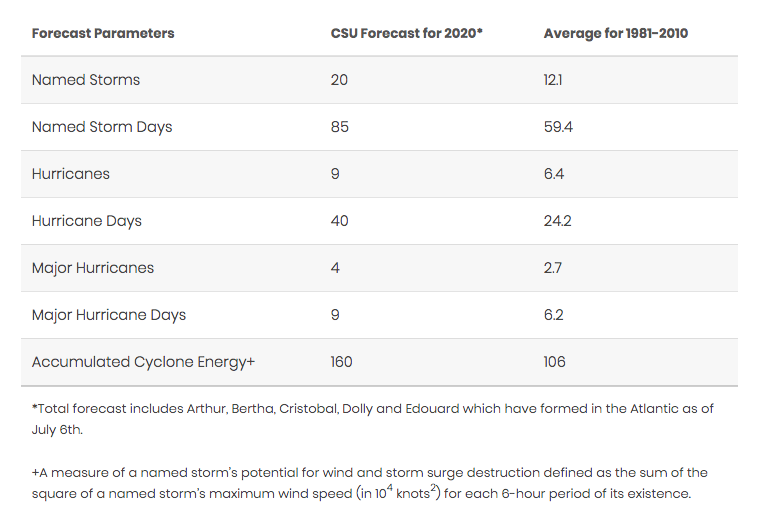
As of 7 July, five named storms had already formed – Arthur, Bertha, Cristobal, Dolly and Edouard.
Environmental conditions appear favourable for further storm formation, including warm Atlantic sea-surface temperatures. A transition to weak La Niña conditions, associated with increased Atlantic storm activity, could form later in the summer.
“We anticipate an above-normal probability for major hurricanes making landfall along the continental United States coastline and in the Caribbean,” the July forecast reads.
“The tropical Atlantic is somewhat warmer than normal, while the subtropical Atlantic is quite warm. Most of the eastern Atlantic is warmer than normal, and anomalously warm temperatures in this region in June have been typically associated with more active Atlantic hurricane seasons.”
The probability of at least one major hurricane (category 3, 4 or 5) tracking into the Caribbean is at 58%, compared to 42% for the last century.
The forecast notes that while it is impossible to fully predict the season’s activity, the early July predictions have relatively good long-term skill compared to real-season outcomes.
CSU’s June and July forecasts were both adjusted above the early season forecast, released 2 April, which called for just 16 names storms.
“As is the case with all hurricane seasons, coastal residents are reminded that it only takes one hurricane making landfall to make it an active season for them,” CSU writes.
“They should prepare the same for every season, regardless of how much activity is predicted.”
For tips on hurricane and disaster preparedness, consult the Compass Media Emergency Guide.
Related Videos