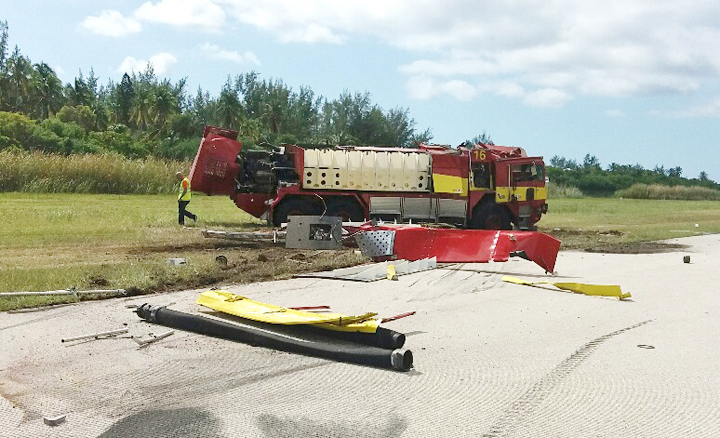
A court has given two fire officers permission to sue government after they were injured when their fire truck overturned on the runway at Cayman Brac’s International Airport in 2017.
Government’s lawyers had sought to block the case claiming firefighters who are injured in the line of duty are legally barred from taking court action.
At the time of the 5 Jan. 2017 accident, Jason Phelan McCoy and Garfield Marcelo Ritch were both employed by the Cayman Islands Fire Service and stationed at the Charles Kirkconnell International Airport.
On 31 Dec. 2019, the men filed an initial civil lawsuit against the Cayman Islands government for an undisclosed sum of money. In that lawsuit, McCoy, 37, and Ritch, 54, said they “suffered personal injury, loss and damage” due to government’s negligence.
According to an accident reconstructionist’s report on the crash, a rusted bolt was to blame for the mechanical failure that caused the truck to tip over.
McCoy, who was the driver, was attempting to turn the vehicle while travelling at 27 miles per hour. The report stated that neither McCoy nor Ritch, who was the passenger, were to blame for the crash.
However, before the lawsuit could proceed, government attorneys filed an application requesting it be dismissed. In that application, which was filed 8 Sept. 2020, government attorneys claimed the fire officers’ lawsuit “had no prospects of success” because the government was protected against these types of legal proceedings.
In the dismissal application, the government claimed Section 9, subsection 5(b), of the Fire Brigade Act prevents a fire officer from suing the Crown.
That clause states, “No action for damages may be brought… in respect of death, injury or loss incurred by any person occasioned in the course of carrying out any other responsibility or duty imposed by this or any other law.”
In their response to the dismissal application, the officers claimed Section 9-5(b) should be interpreted differently.
They claimed that while the legal limitations of the Fire Brigade Act prevent them from suing the government in cases where injury or death results from their own actions, or in the course of carrying out their duty, it does not protect government from litigation where it has provided faulty equipment to the officers, who in turn get injured.
Pointing to the Crown Proceedings Law, the fire officers argued that even though they were not directly employed by the Cayman Islands government, they were still owed a duty of care because the CIFS was acting as an agent of the government.
The officers claim there was a “vicarious liability” imposed on the government by Section 3 subsection 1(b) of the Crown Proceedings Law, which reads in part, “the Crown is subject to all those liabilities in tort… in respect of any breach of those duties which a person owes to his servants or agents at common law by reason of being their employer”.
When returning her decision, Grand Court Judge Margaret Ramsay-Hale said, “The claim cannot be said to have ‘no prospects of success’ in the circumstances.”
She dismissed the government’s application. It’s not clear when the lawsuit will be heard.
Related Videos