Hours before Cayman’s second batch of COVID-19 vaccines was due to arrive at Owen Roberts International Airport on Thursday, the Governor’s Office said it was hopeful that the future supply of vaccines would not be disrupted by an ongoing row between the European Union and the UK over distribution of the inoculations.
In a statement issued to the Cayman Compass in response to queries about the potential impact the EU’s threats to stop exports of the vaccines could have on Cayman, the Governor’s Office said, “The UK takes seriously its responsibilities to the overseas territories and has committed to supply us with a proportionate share of the vaccines that it procures.
“At this time we do not believe, given the small volumes concerned, that that supply chain issues will significantly affect that plan. We remain hopeful that deliveries remain on track and await confirmation of the details.”
Cayman’s first batch of 9,750 Pfizer-BioNTech COVID vaccine doses arrived on 5 Jan. on a British Airways flight from the UK. The second shipment, bringing between 10,000 and 11,000 doses, was scheduled to arrive on the Thursday, 28 Jan., air-bridge flight.
The second batch contains more doses than expected, Governor Martyn Roper stated on social media on Thursday morning. Earlier, it had been announced that a second lot of 9,750 would be arriving.
In his online posting, the governor said, “Vaccine supplies remain challenging across the world. The UK is committed to supplying us with a proportionate amount of the vaccines they are procuring for the UK according to our population size. Our second batch of 10-11,000 doses arrives on the BA flight today.”
The Cayman Islands is currently in the process of vaccinating its over-60s population, healthcare staff and first responders, frontline staff dealing with incoming travellers, residents and staff of institutional facilities, people over 16 who have serious medical conditions, those at high risk of severe illness, and workers essential to government continuity.
As of Wednesday evening, 7,073 people in Cayman had received the vaccination.
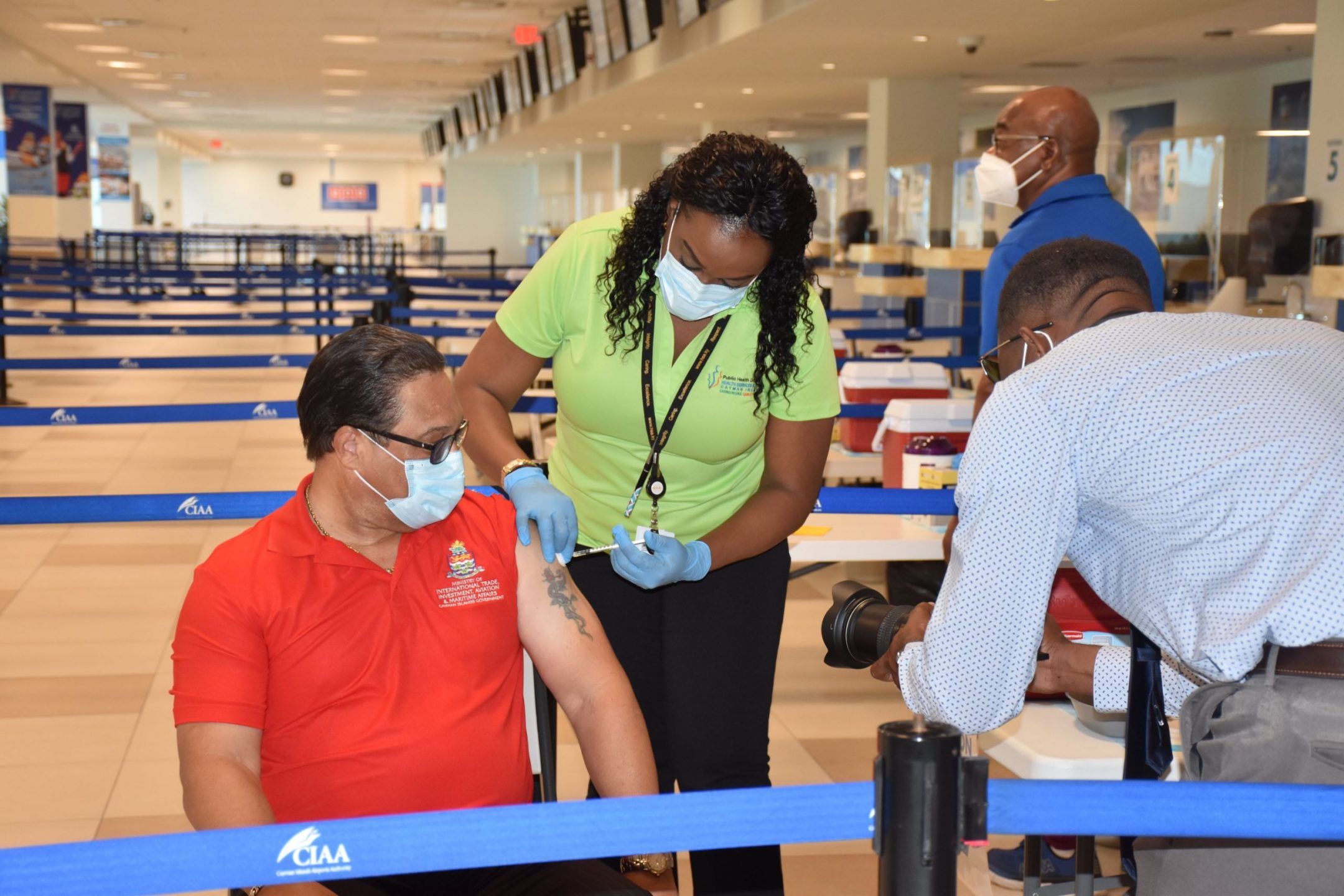
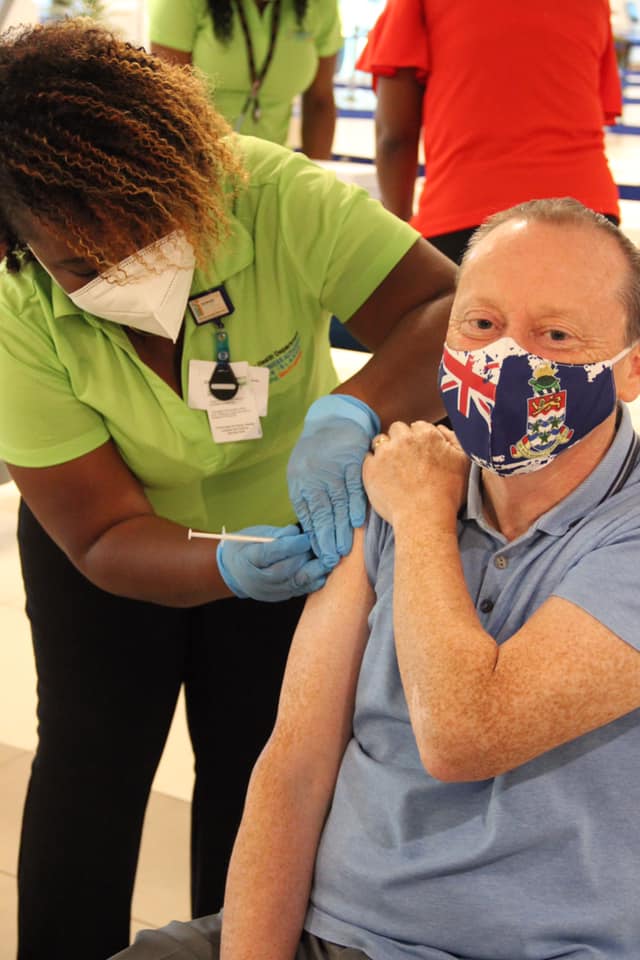
‘Officials, including the governor and Premier Alden McLaughlin, who were among the first to be inoculated earlier this month, received their second dose of the vaccine on Thursday morning at the airport terminal, which is being used as a vaccination centre.
Both Roper and McLaughlin posted on social media about their second shot, and urged everyone to get inoculated when their turn comes.
“I had my second vaccine today and I strongly encourage older and vulnerable persons in our community to get theirs,” the premier said.
Roper, in his posting, described the vaccine as “our way out of this pandemic”.
EU demands more vaccine supplies
(Reuters) Europe’s fight to secure COVID-19 vaccine supplies intensified Thursday when the EU warned drug companies such as AstraZeneca that it would use all legal means or even block exports unless they agreed to deliver shots as promised.
The EU, whose member states are far behind Israel, the United Kingdom and the United States in rolling out vaccines, is scrambling to get supplies just as the West’s biggest drugmakers slow deliveries to the bloc due to production problems.
As vaccination centres in Germany, France and Spain cancelled or delayed appointments, the EU publicly rebuked Anglo-Swedish drugmaker AstraZeneca for failing to deliver and even asked if it could divert supplies from Britain.
European Council President Charles Michel said in a letter to four EU leaders that the EU should explore legal means to ensure supplies of COVID-19 vaccines it contracted to buy if negotiations with companies over delayed deliveries are unsuccessful.
“If no satisfactory solution can be found, I believe we should explore all options and make use of all legal means and enforcement measures at our disposal under the Treaties,” Michel said in the 27 Jan. letter.
EU rules on monitoring and authorising exports of COVID-19 vaccines in the 27-nation bloc could lead to exports being blocked if they violated existing contracts between the vaccine maker and the EU, an EU official said.
The European Commission is to lay out the criteria under which such exports would be evaluated on Friday.
The swiftest mass vaccination drive in history is stoking tensions across the world as big powers buy up doses in bulk and poorer nations try to navigate a financial and diplomatic minefield to collect whatever supplies are left.
Israel is by far the world leader on vaccine rollout per head of population, followed by the United Arab Emirates, the United Kingdom, Bahrain and the United States. Behind them are Italy, Germany, France, China and Russia.
The African Union has secured another 400 million doses of the AstraZeneca COVID-19 vaccine, a regional health leader said on Thursday, in a push to immunise 60% of the continent’s population over three years.
Under fire from the EU, AstraZeneca CEO Pascal Soriot said the EU was late to strike a supply contract so the company did not have enough time to iron out production problems at a vaccine factory run by a partner in Belgium.
Tensions have risen as both New York-based Pfizer and AstraZeneca, headquartered in Cambridge, England, have had production problems.
Britain, which has repeatedly touted its lead in the vaccine rollout race since leaving the EU’s orbit on 1 Jan., said its deliveries must be honoured.
“I think we need to make sure that the vaccine supply that has been bought and paid for, procured for those in the UK, is delivered,” Minister for the Cabinet Office Michael Gove told LBC Radio.
Just a day ahead of a decision by European regulators on whether to approve the drugmaker’s shot, Germany’s vaccine committee said AstraZeneca’s vaccine should only be given to people aged between 18 and 64.
“There are currently insufficient data available to assess the vaccine efficacy from 65 years of age,” the committee, also known as Stiko, said in a draft resolution made available by the health ministry on Thursday.
British Prime Minister Boris Johnson said health authorities in Britain believed the vaccine was safe and worked across all age groups.
Related Videos