In a continuing Cayman Compass Issues series examining the use of technology in the Cayman Islands, this week we look at smart-tech as it relates to environmental and conservation matters.
As Tropical Storm Grace lashed Grand Cayman on 18 Aug., downing power lines and snapping poles in half, electricity across the island went out, leaving most residents to sit out the strong winds and rain in homes with no lights and no air conditioning. Most, but not all.
At a handful of homes across the island, when the CUC power blinked off, Tesla Powerwall batteries snapped into action in a fraction of a second.
For Joannah Bodden Small and her family, the transition from grid power to battery power was so seamless, she said she’s unsure when the electricity actually went out. “There was no flicker, nothing,” she said.
The family installed the battery, supplied by GreenTech Solar, in their home in Crystal Harbour. Part of the decision to get a Tesla battery was to be able to store the unused solar energy from the panels at their home, and partly to deal with power outages, especially during storms.
Grace hammered Grand Cayman for several hours throughout the morning and early afternoon, during which time the Small family was able to feed their children hot food, be cool in the air conditioning, and use their lights and WiFi.

As the day wore on, the Tesla app showed them the percentage of power in the battery ticking down, enabling them to make decisions to turn off the power to certain rooms or appliances.
Eventually, after powering their home for about 13 hours, the battery power died and it was time to rely on candles and flashlights. By then, however, the kids had been fed and bathed and were ready for bed.
Bodden Small says the family learned some lessons from the experience, such as to concentrate power from the battery in certain areas as soon as the grid goes down, rather than making those decisions as the battery power dwindled throughout the day, but she says she was very grateful for light and power during the strong storm, especially for the sake of her three children, ages 8, 10 and 12.
“It was a very traumatic day,” she said, as the family battled to keep a door from blowing in and rainwater from entering.
“We had to secure the door with ropes. … The kids were helping out. … If we lost power on top of all that, it would have been even more traumatising,” she said. “It was a very long day.”
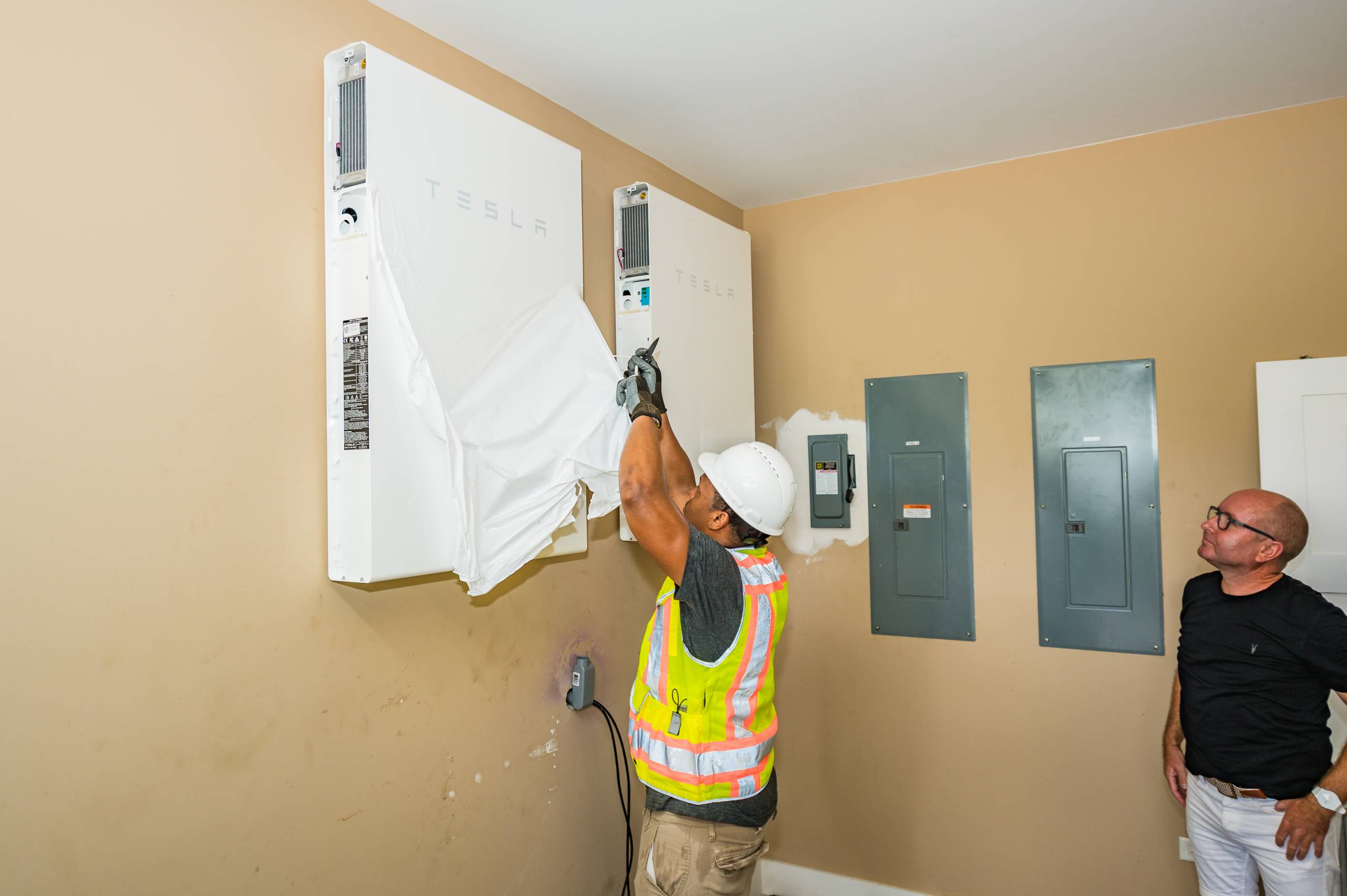
Allan Holdsworth and Javier Bustos, who were the first homeowners in Cayman to install Tesla Powerwall batteries, in their house in Grand Harbour, also found the back-up batteries made their lives a lot easier when Grace passed through – not to mention that they haven’t had a CUC bill since they installed the batteries in 2019.
The two batteries kept the house powered for 17-and-a-half hours during and after the storm, while CUC worked to get the grid back on line.
“The batteries are incredible. We are never without power,” Holdsworth said. Like Bodden Small, when the CUC power went off around dawn on the morning Grace hit, Holdsworth said he barely noticed. “The batteries turn on in a 100th of a second,” he said.
The Tesla app keeps users abreast of what’s happening with the batteries – if they’re pulling power from the electricity grid or from solar panels, which areas of the home the power is going to and whether the grid is down, as well as constantly monitoring how much power is left in the batteries, enabling the users to conserve power as and when they like.
“We didn’t know how long the storm would go on for or how long the grid would be down,” Holdsworth said. Using the app, they were able to switch off power to some appliances and be “frugal” with the electricity left in the batteries.
“By the time CUC came back on, we’d almost depleted the batteries. They were down to 4% or 5%,” he said.
Bustos and Holdsworth have 36 solar panels at their home, and the energy produced from the panels that aren’t stored in the batteries or used in the home is sold to CUC and added to the national grid.
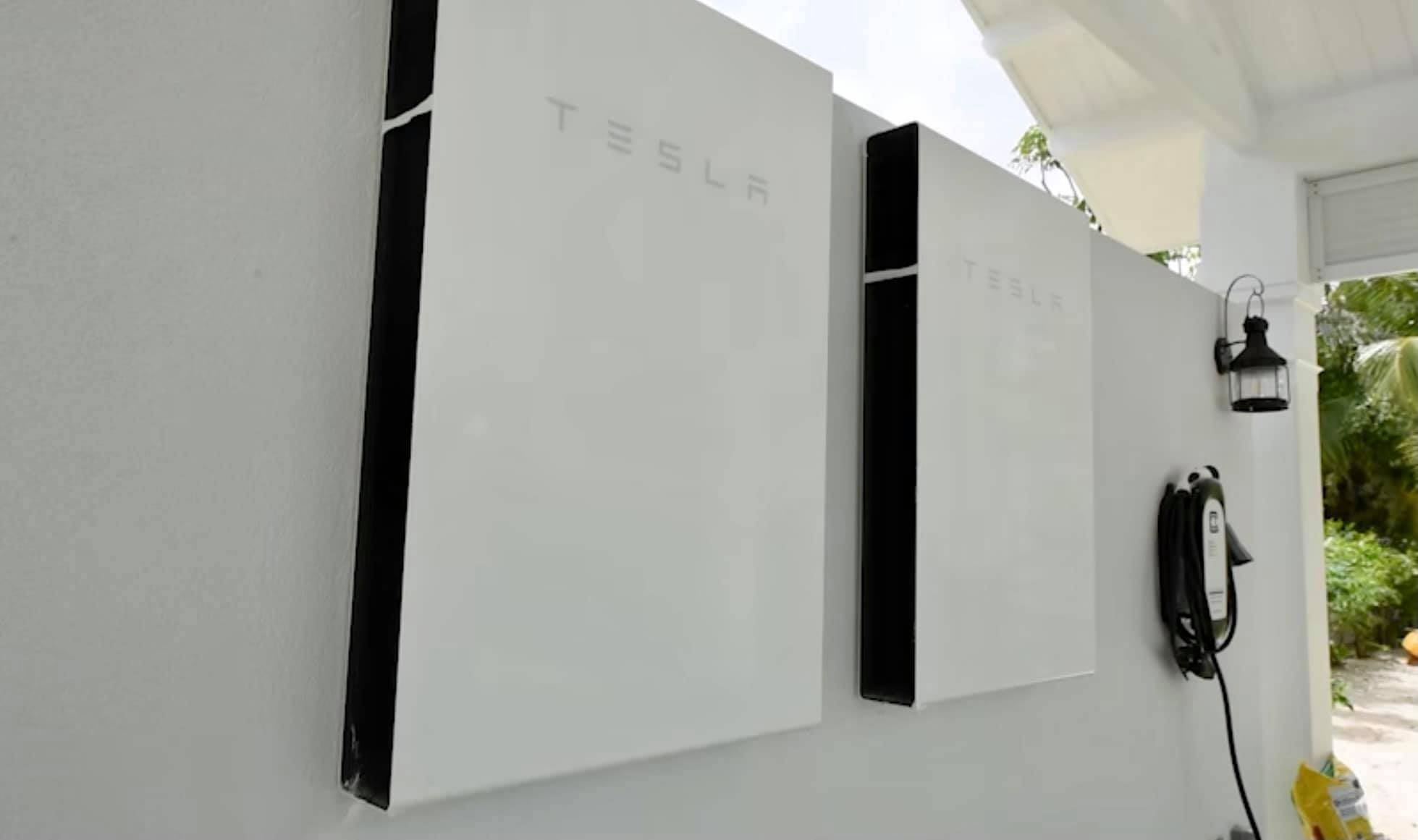
Holdsworth said the batteries cost $10,000 to $12,000 each, but he’s already seen a return on that investment, in that “we have not had an electricity bill since we put the system in. As a matter of fact, CUC owes us $550.”
They are among the 587 customers who, as of 31 Dec. 2020, were connected to CUC’s grid through its Consumer Owned Renewable Energy (CORE) and Distributed Energy Resources (DER) programmes, with the capacity to supply up to 7,735.66 kilowatts of renewable energy.
Under Cayman’s National Energy Policy, the goal is to have 70% of all energy generated from solar by 2037. Currently, the majority of Cayman’s electricity is created by the use of diesel generators at CUC’s plant in George Town.
James Whittaker, founder of GreenTech Solar and president of the Cayman Renewable Energy Association, says he sees a huge future for Tesla and similar batteries, which, unlike generators, can be charged by the grid or by solar power, give a return on investment, require no maintenance or fuel to operate, and have a lifespan of at least 20 years.
When it comes to renewable utilities, it’s not just electricity that new technology is providing for local homes.
Another item GreenTech provides is a fully off-grid, self-contained solar hydropanel system called SOURCE that creates drinking water by harnessing humidity from the air. According to GreenTech, each two-panel array produces an average of 8-20 pints of water each day, depending on sunshine and humidity, and can save more than 75,000 plastic water bottles over its lifespan.
But, Whittaker said, batteries are currently the hot item among customers.
CUC is currently running a residential battery pilot project in 10 homes in Grand Cayman which is testing the efficacy of battery-storage systems in those homes to meet future energy goals.
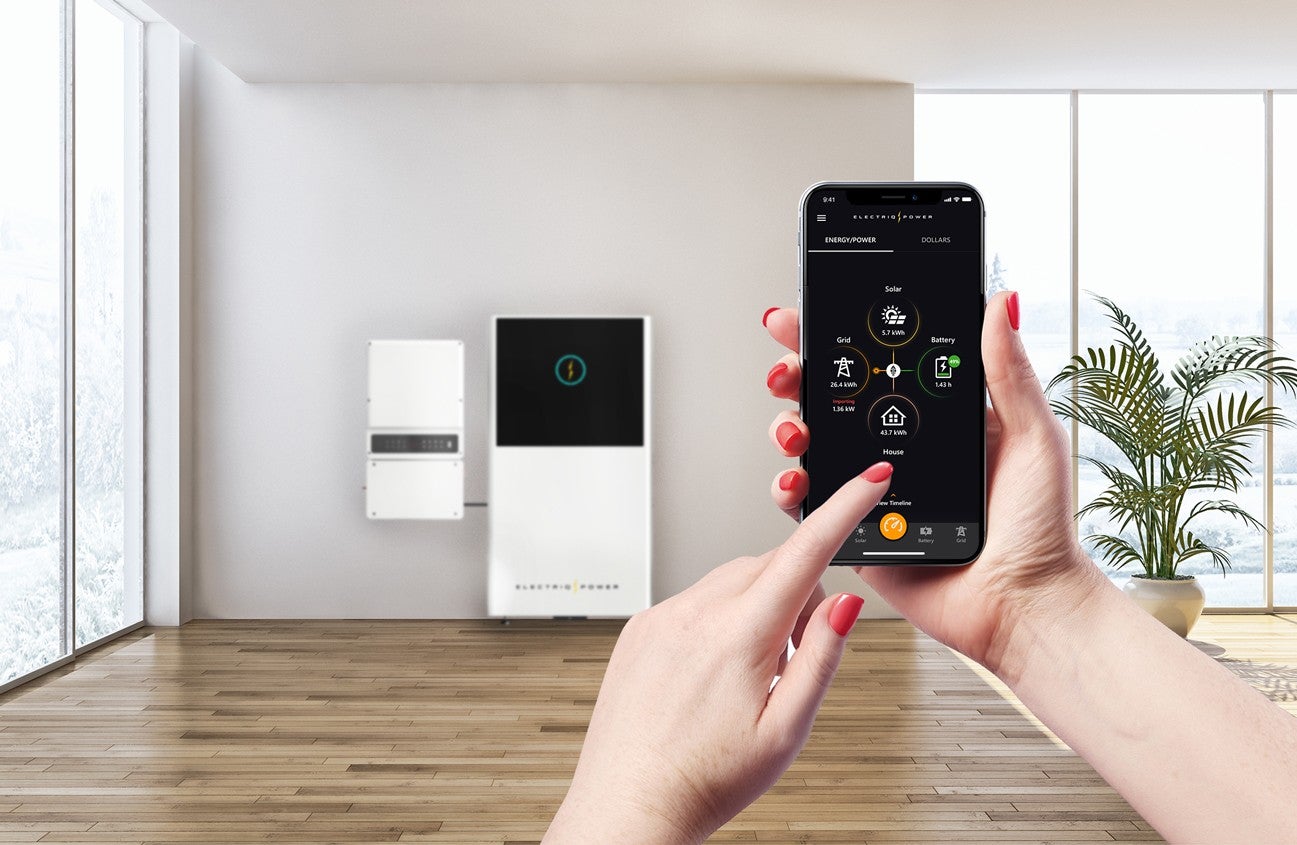
In a press release about the pilot scheme earlier this year, CUC said, “Among the goals of the initiative are to discover best practices for installation and operation, understand capital and operational costs, and demonstrate and measure multiple value propositions for the residential user and CUC.”
Sacha Tibbetts, CUC’s vice president of customer services and technology, said in the release, “Battery storage is foreseen in CUC’s Integrated Resource Plan as an enabling component in a transition to a renewable dominated portfolio.”
To Whittaker, solar batteries are “a game changer”, not just because they serve as back-up power units, but because they can pay for themselves within a relatively short period of time with the sale of solar power to the grid.
He sees solar batteries as the way of the future for businesses, government offices and hospitals, too, and even considers them entirely vital, for instance, in the cases where people are on ventilators or other medical equipment that cannot be turned off.
“Anyone who had been through Hurricane Ivan knows this is a life-saving issue,” he said.
Related Videos