

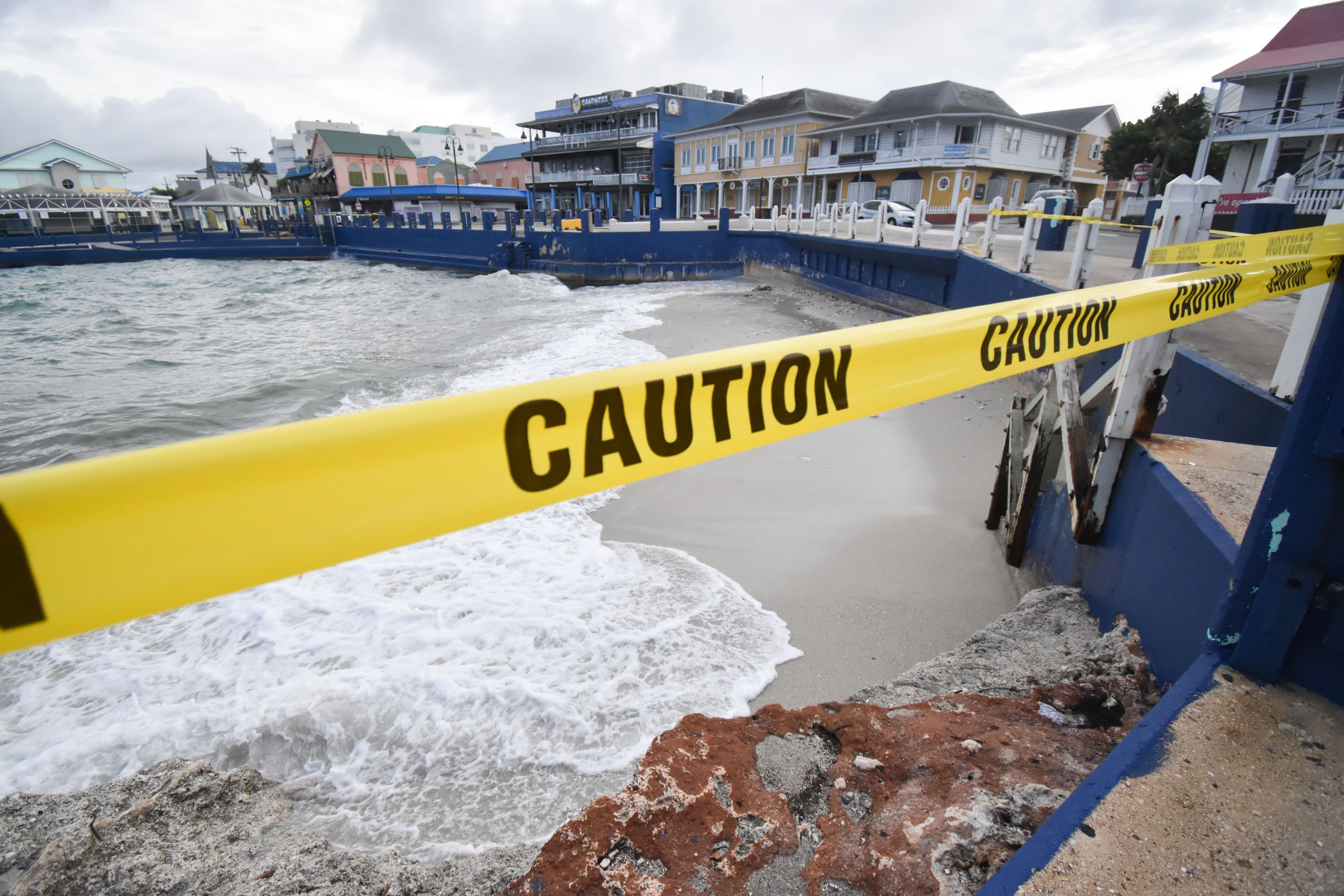
Cayman has signed an agreement for a climate change risk assessment specific to its islands to be carried out, in a first step to review and update a decade-old draft of its National Climate Change Policy and Strategy, the government announced Wednesday.
The announcement comes as world leaders gather in Glasgow, Scotland, for the COP26 climate change summit.
The project, which is fully funded through the Governor’s Office, will be undertaken by the Centre for Environment, Fisheries and Aquaculture Science (Cefas), an executive agency of the British government’s Department for Environment, Food and Rural Affairs, in consultation with relevant local government agencies and other stakeholders.
Governor Martyn Roper said, “As the world meets to discuss climate change on a global scale, I am delighted to be able to facilitate the provision of £110,000 GBP (CI$123,250) in UK government funding towards this extremely important and urgent initiative to help build true climate change resiliency for the Cayman Islands which is supported by informed national policies.
“This forms part of the UK/Cayman Climate Change/ Environment Partnership Agreement which allows for collaboration in areas such as biodiversity, disaster resilience and renewable energy.”
In 2011, Cayman’s National Climate Change Committee drew up a draft policy, titled ‘Achieving a Low Carbon Climate-Resilient Economy’, but that policy was never enacted. Currently, the only official policy that mentions climate change in Cayman is the National Energy Policy, which seeks to limit per capita carbon emissions to 2014 levels and achieve 70% renewable energy in Cayman by 2037.
According to a press release issued Wednesday announcing the new climate change risk assessment for Cayman, the project will “employ a methodology based on the first United Kingdom Climate Change Risk Assessment (CCRA) in 2012 and will identify the highest priority threats and/or opportunities posed by climate change for biodiversity, society and the wider economy”.
The project is expected to produce “a detailed evidence report, a stakeholder prioritisation workshop and a final summary report aimed at policy makers and the general public”.
Over the next few weeks, the release stated, Cefas will begin its review of published evidence on climate change impacts for the Cayman Islands and Caribbean as a whole, and will produce an evidence report in March 2022.
That report will describe “the current available knowledge on climate change impact risks that pose the greatest threats to communities and sectors in the Cayman Islands, such as fisheries, tourism, coastal infrastructure, agriculture, settlements and inland infrastructure, to identify an initial ‘long-list’ of risks and/or opportunities”.
Cefas CEO Neil Hornby, who is attending COP26 in Glasgow, was quoted in the release as saying, “We are delighted to be working with the Cayman Islands to help carry out a risk assessment exercise that will be used to update the national climate change policy and strategy. We have undertaken similar exercises in other parts of the world and are especially pleased to be able to support the Cayman Islands in this important work.
“Cefas scientists will work with experts in the Cayman Islands to prioritise the most important climate change risks. Once these risks have been identified, measures can be taken to reduce impacts on the environment and people of the Cayman Islands.”
In the second quarter of 2022, a workshop will be held with key stakeholders from the Cayman Islands, as well as regional experts on climate change in the Caribbean, who will be asked to score and rank separately the long list of risks and opportunities for each of the three islands, recognising their individual geographies, social and economic contexts, the release stated.
Following the workshop, Cefas will produce an overall prioritisation for the Cayman Islands, essentially a ranked list highlighting the most-important and pressing risks, which can then be used to inform the new Cayman Islands Climate Change Policy and Strategy.
Premier Wayne Panton, who is also Cayman’s minister for sustainability and climate resiliency, said in the release that the agreement is a major step towards building climate change resiliency for Cayman.
“COP26, the meeting that is happening right now in Glasgow with world leaders and scientists, may be one of the most significant gatherings of the century for our entire planet,” he said. “The time for the nations of the world to take action to make meaningful cuts in greenhouse gas emissions is now. The future of our entire planet, but especially small islands like Cayman, depends on this.
“From a local perspective we also need to do our part both in terms of reducing our own emissions and, perhaps more importantly, taking urgent steps to ensure that we are in the best position to adapt to the wide range of impacts across all sectors of our community that will arise as a result of continued warming of the Earth.
“We are therefore very grateful to the Governor’s office for connecting us with Cefas and providing the funding for the risk assessment so we can not only bring our Climate Change Policy and Strategy up to date, but to also do so from the most informed position possible.”
Panton attended the first few days of the climate summit in Glasgow, and was scheduled to return to Cayman Wednesday.
A final report will be produced by Cefas in September 2022 describing the risk-assessment process and containing the prioritised risks. This will be in the form of a short summary, non-technical document that will be made available to the public, the release noted.
Related Videos








Premier Panton, attending COP 26, has said, “The time for nations of the world to take action to make meaningful cuts in greenhouse gas emissions is now.” Quite right, but what is Cayman doing? We lag behind the rest of the world and indeed most Caribbean islands. It is now five years since Winston Connolly’s historic bill for an National Energy policy (NEP) was unanimously passed and four years since the NEP was enshrined into law with a goal of 70% of our energy being renewable energy by 2037. Nothing has changed. Today it remains around 5%
Cayman needs actions not words