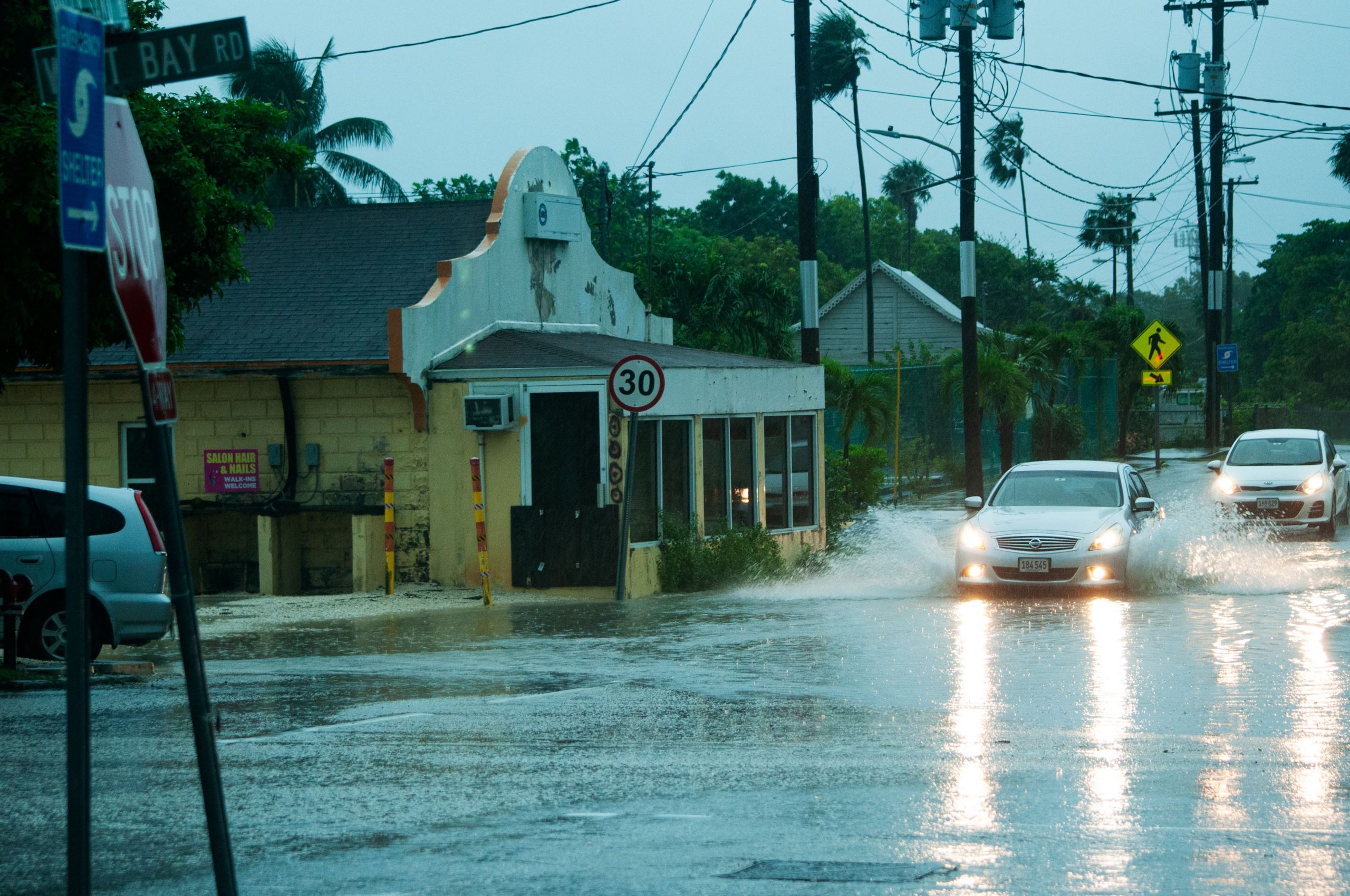
Officials say a draft Climate Change Policy is expected to be approved by Cabinet next month, after all feedback from the public has been considered.
A public consultation process is currently under way, with meetings being held in the districts, and online comments and submissions on the 58-page draft document being accepted.
At a meeting in the Sir John A. Cumber Primary School hall in West Bay on Tuesday night, some attendees queried the effectiveness of the proposed policy, noting that unless rampant development and questionable planning decisions are addressed, a policy that aims to protect Cayman from rising sea levels and flooding is unlikely to have an impact.
Premier Wayne Panton, who leads the Ministry of Sustainability and Climate Resiliency, was unable to attend the meeting as he was preparing for the next day’s parliamentary session. The ministry’s chief officer Jennifer Ahearn led the meeting.
Panton’s ministry has been working to update the 2011 draft Climate Change Policy since last year, after the Governor’s Office funded a climate change risk assessment, which was carried out by the Centre for Environment Fisheries and Aquaculture Science and the UK Centre for Ecology and Hydrology.
Ahearn said the final version of the policy is expected to go before Cabinet and be approved next month. The deadline for submission of feedback from the public is 30 June.
Concerns raised
Members of the audience at the West Bay meeting, which attracted about 30 people, raised several concerns and questions, asking how the policy would address such issues as planning permission given to developments too close to the coastline, general over-development on Grand Cayman, the destruction of mangroves and seagrass, and pollutants from cruise ships.
One audience member said, even at the age of 25, she already feels jaded with governments that undertake policies that are then dropped by the next administration, and asked what could be done to get the public and businesses more involved in the strategies laid out in the policy.
Ahearn responded, “Keep the faith. We are all going to do the best that we can, but we need everybody on board.” She added that it was vital that policymakers hear from the public and from their constituents that they want these policies in place.
Another attendee pointed out that Cayman has a “poor history” of enforcing some of its existing laws and policies, on issues like dumping and littering, and questioned whether resources are in place to enforce elements of the Climate Change Policy.
Betty Ebanks, who was among a group who legally challenged the closure of West Bay Road which was part of a land-swap deal with Dart and the construction of the Esterley Tibbetts Highway extension, queried the meaning of a line in the draft policy which says that one of its short-term priorities is to “incentivise enhanced coastal setbacks and nature-positive adaptation measures for coastal developments”.
“I don’t like much talk about incentives, with the experience we’ve had already,” Ebanks said.
Director of the Department of Environment Gina Ebanks-Petrie responded that no incentives had yet been developed in relation to the Climate Change Policy, but government is thinking about ways it can incentivise people to respect nature in terms of coastal setbacks.
She said, “At the moment, without changing our planning laws, the setbacks that are already there are minimum setbacks… [People] already have the ability to increase their setbacks… but what we see is everybody comes forward with either the minimum setback or a request to vary that so it can actually be less, and, unfortunately, our planning authority approves that variation.
“We need to find a way to incentivise people through reduced fees or something like that, so if they put in an application with an increased setback, perhaps they could get a break in their planning fees. That’s what we were envisaging.”
Alanna Warwick-Smith, pointing out that with each change of government comes a change of ministry names and responsibilities, queried if the policy will continue if the Ministry of Sustainability and Climate Resiliency disappears under a future administration, as she said had happened with the Ministry of Gender Affairs after the last election.
Ahearn responded that while ministry names may change and gender affairs has disappeared from the title, it still exists within this administration.
She said every government ministry and department had a role to play in moving the Climate Change Policy forward, and meetings and presentations had been held throughout the various departments and with civil servants.
“If everybody who thinks this is important is telling everybody that this is important, the chances are it will straddle the election divide and … continue on,” she said.
Ahearn was also asked, if one of the aims of the policy is to reduce Cayman’s carbon footprint, why was there a plan to dredge the North Sound to extend the airport runway, which would involve the removal of seagrass – a major carbon-catching and harvesting plant.
She admitted she did not know the answer to how that would contribute to reducing the carbon footprint, but said there would be public consultation around the airport development project. Airport and tourism officials have said that project will involve an environmental impact assessment.
Asked if the Department of Planning and Central Planning Authority were involved in drawing up the policy, Ahearn said the department was among the stakeholders that had been consulted.
“These are ongoing discussions,” she said. “We have some more willing partners and some less willing partners when we have these conversations, but we are moving in the general direction.”
She also confirmed that there had not been a meeting about the policy with the Central Planning Authority, but said she hoped the Department of Planning was sharing updates with the CPA and the Sister Islands Development Control Board.
Billy Adam, speaking near the end of the meeting, said the biggest obstacle Cayman had to tackling climate change and its impacts was its own politicians, stating that the “vast majority” of government members did not support environmental-protection measures, such as “proper planning” and the National Conservation Act.
Public consultation
Public meetings are being held across the various districts.
On Thursday, at 6pm, there will be a meeting in Bodden Town, at the Theoline L. McCoy Primary School. On Tuesday, 13 June, at 6pm, a meeting will be held at the William Allen McLaughlin Civic Centre in East End, and the final meeting will be at the Craddock Ebanks Civic Centre in North Side, at 6pm on Thursday, 15 June.
To find out more about the policy and how to submit feedback, visit https://www.gov.ky/climatechangepolicy.
Read the draft Climate Change Policy here.
- Editor’s note: This story has been amended from the original to correct the date of the East End meeting.
Related Videos