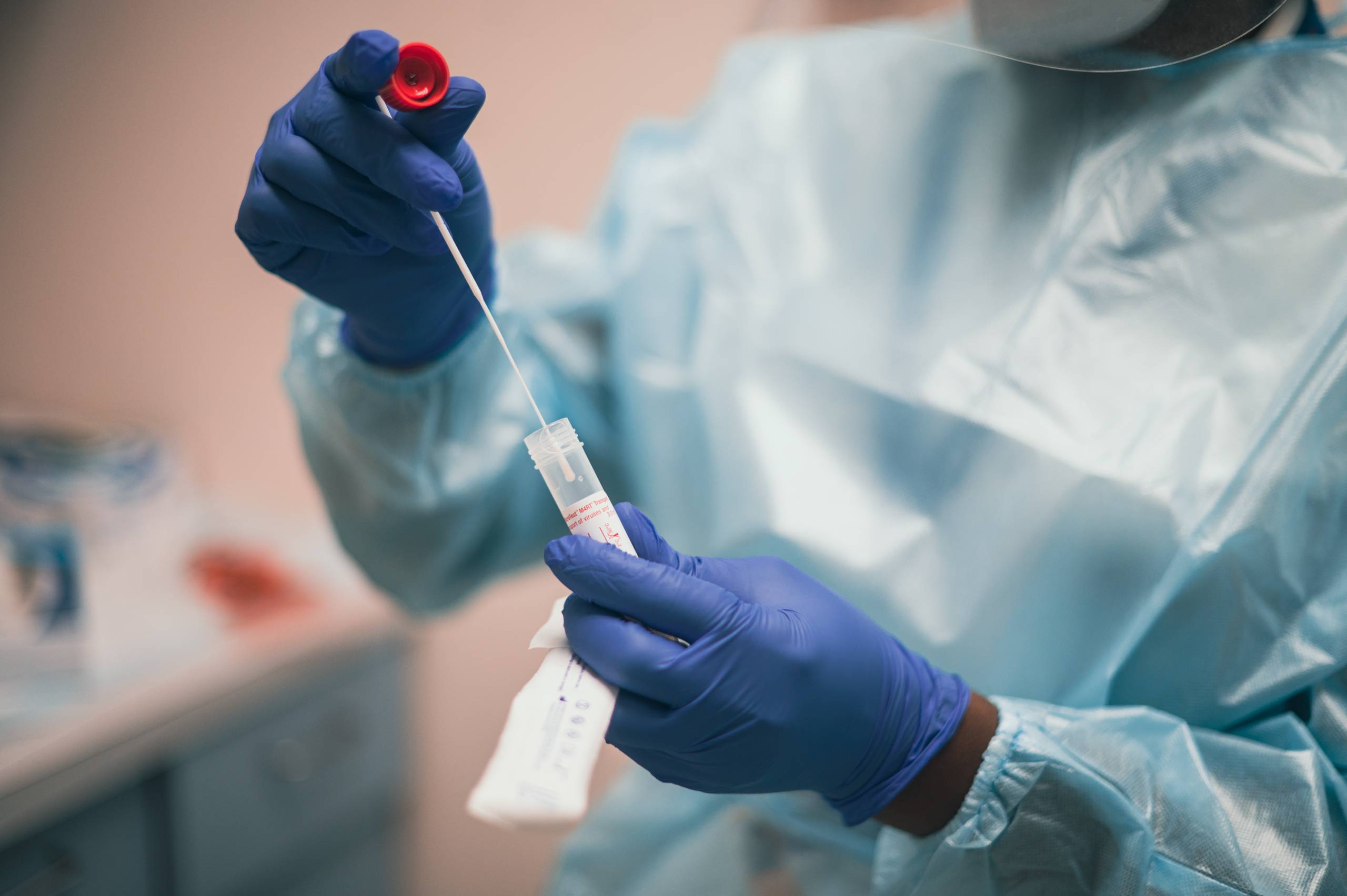
A combination of PCR and rapid antigen (lateral flow) testing is being used across Cayman to identify and isolate people with COVID-19 as the virus continues to spread throughout the islands.
Today we investigate the differences between the two tests and the results they produce.
What are the main differences between PCR and lateral flow tests?
The PCR test swab is taken by a medic and analysed in a laboratory using sophisticated technology. It is considered highly sensitive and highly specific. False negative tests are extremely uncommon and false positives are rare.
Lateral flow tests are less accurate, though claims and opinions vary as to just how much. Their advantage is that they are widely available and can be carried out at home, producing a result in 15 minutes.
Advocates argue that they are very accurate at picking up cases where the viral load is high – and therefore when the person is likely to be contagious. Those who question their utility, contend that they are much less accurate at lower viral loads and could leave many asymptomatic cases undetected.
How accurate are the FlowFlex lateral flow tests used in Cayman?
The guidance leaflet for the tests indicates that they are designed to detect antigens associated with COVID infection from individuals suspected of having the virus, within seven days of the onset of symptoms.
Government information on the tests states, “Although LFTs do not tend to perform as well as the more sensitive PCR tests when viral loads are low, they do perform well with higher viral loads (when someone is most infectious) or when used repeatedly.”
A study in Germany of 122 different types of lateral flow tests found the ones being used in Cayman to be 94% accurate at detecting COVID in patients with a higher viral load at CT Values of 25 or less. At lower viral loads, indicated by a CT value of 25 or higher, the tests were only 4% effective according to the study.
What is a CT value?
The CT value stands for ‘cycle threshold’ in a PCR test and reflects the amount of times the sample had to be multiplied before COVID could be detected.
The PCR machine is effectively a molecular copying machine. It works by doubling – and doubling again – material from the swab sample.
The test goes through 40 ‘cycles’ of this exponential duplication. The CT number reflects the number of cycles before COVID was detected.
So a CT Value in the low single digits would represent an extremely high viral load, whereas a higher CT value of 30 or over, would reflect a low viral load.
Because the increase is exponential, a test that registers a positive result after 12 rounds, for a CT value of 12, starts out with more than 10 million times as much viral genetic material as a sample with a CT value of 35.
How can those values be used?
There is a school of thought that those values can and should be used to determine how contagious a person is likely to be.
Until recently, Public Health used a CT value of 35 or higher alongside a combination of other factors, including the number of days in quarantine and whether or not a person is symptomatic, to consider people for release from isolation – even if they test positive on a PCR test.
On Thursday, 25 Nov., Dr. Samuel Williams-Rodriguez, the medical officer of health, told the Cayman Compass that has now been reduced to 32. Anyone in a range of 30-32 can also be considered for release.
Dr. Frank Koentgen, who designed the Doctors Hospital testing regime, said at those higher CT levels a person is considered unlikely to be contagious.
“The idea is that somebody who is at 30 or higher is not deemed to be infectious. You have to make so many copies that the viral burden is so low that it would be difficult to pass it on to somebody else.”
He cautions that this is not an exact science and it would be a matter of assessing the relative risk of such people being in the community.
Is it possible to be negative on lateral flow and positive on PCR?
This is absolutely possible and has happened on numerous occasions. Many people in quarantine in Cayman have self-tested at home with lateral flow kits that have shown up as negative and been frustrated to find that their PCR exit test returned as positive, meaning they had to stay in isolation.
That’s because the lateral flow tests are much more accurate at picking up high viral loads and less accurate at detecting lingering cases.
The PCR test will pick up evidence of COVID at much lower levels.
“You can remain positive in PCR for a very long time but not necessarily contagious,” says Koentgen.
Should people in quarantine still be required to test negative on PCR?
There is some concern that the sensitivity of the PCR test means that people can test positive for as long as 90 days after infection.
Balancing the risk posed by that person to public health, versus the impact of keeping them confined for so long is an important consideration.
The Public Health department has been flexible in cases where a person has a higher CT threshold but there have still been cases of people being isolated for more than a month.
The US and UK use 10-14 days as the window at which a person is likely to be contagious and release them from isolation at that point without the need for an exit test.
Paediatrician Dr. Sara Watkin said Cayman could follow suit or allow a negative lateral flow test to be used as a means to be released from isolation.
Koentgen said the CT threshold on the PCR test could be set at a lower level; he suggests a CT value of 30.
He adds that there are people who would be testing negative on a lateral flow test that would be walking around in the community with higher viral loads.
It is possible that Thursday’s announcement of a decision to consider people for release with a CT value of 32, addresses some, if not all, of those concerns.
Related Videos