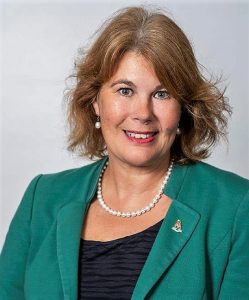
Government must address a wide range of issues before an unqualified audit opinion for the entire public sector can be given, according to Auditor General Sue Winspear.
A new report on the financial reporting by government in 2020, released by her office on 10 Dec., shows that while 37 government entities received unqualified audit opinions, the University College of the Cayman Islands received a qualified audit opinion, and five government entities and the consolidated entire public service account have their 2020 audits outstanding.
“Public sector entity financial reporting continues to be good,” Winspear said.
“However, the government needs to focus on addressing the issues that are resulting in the adverse audit opinion on the EPS [entire public service] account.”
The EPS account includes the consolidation of 17 ministries, portfolios and offices; 26 statutory authorities and government companies; as well as executive transactions, including transfer payments, coercive revenues, executive assets, and liabilities of the government.
An adverse audit opinion means that there are such deficiencies in the financial statements that they should be considered unreliable and untrustworthy.
The entire public sector account has already received an adverse opinion for the financial years 2016/17 and 2018 (when the financial year transitioned to align with the calendar year).
A qualified opinion, on the other hand, indicates that only a portion of the financial statements cannot be relied upon.
Winspear said the 2019 and 2020 EPS audits are still in progress, but there are many issues needing resolution to move to a qualified and then an unqualified audit opinion.
“This is possible, but it will take time and concerted effort,” the auditor general said.
Adverse audit opinion for entire public sector
The adverse opinion regarding the entire public sector’s consolidated financial reporting arises from a wide range of issues.
The auditor general believes that the Public Service Pensions Board, as an entity that government has control over, should be included in the consolidated financial statements.
There were “pervasive inaccuracies” from subsequent adjustments in subsidiaries that had not been included in the audits.
The valuation of government assets, such as the road network, was at times not substantiated and the accounting policies were inconsistent. The consolidated figure for property, plant and equipment and the depreciation and amortisation expenses were materially misstated, the report said.
This, in turn, meant that government’s net worth figures were inaccurate.
Liabilities from retirement and retirement healthcare benefits, and therefore personnel costs, were understated.
And revenue figures were also incomplete.
“Due to poor controls, management was unable to provide sufficient, appropriate audit evidence and could not assert the completeness of its coercive revenue,” the report found.
Pervasive inaccuracies in the opening balances of the consolidated statements meant the auditor general was unable to assess government’s cash flows.
In addition, the financial statements omitted certain disclosures such as employee benefits and regarding related-party transactions.
Qualified audit opinion for UCCI
Under the Public Management and Finance Act, the auditor general must carry out audits of all government units and report any issues to Parliament.
Although the opinions issued by the auditor general have improved significantly over the past 10 years, the qualified opinion for UCCI means a slight regression from 2019, when all SAGCs received an unqualified audit.
The report said the university college’s financial statements included other income and supplies and materials items which, taken together, resulted in a $34,616 deficit for canteen operations, but this operating deficit was not disclosed separately in the financial statements.
The auditor general’s office said it was unable to obtain sufficient, appropriate evidence of the revenue and cost of sales related to the canteen operations and therefore could not determine if they were fairly stated.
The auditor general’s audit also highlighted irregular expenditure amounting to $59,249 in 2020.
“Further investigations by UCCI management revealed that at least an additional $20,000 incurred between July 2014 and December 2018, could be irregular expenditure. This matter has been reported to and is currently being handled by the Royal Cayman Islands Police Service,” the report said.
A senior UCCI employee was fired earlier this year following allegations that funds had been misappropriated from the higher education facility.
In addition, the auditor general emphasised issues in the financial statements of nine other government bodies, which in most cases had already been highlighted by previous audits.
These include, for instance, five entities that have not standardised their salaries and benefits, which was required by 1 June 2019. Another issue was the heavy reliance on government support by the Cayman Islands Development Bank and the Cayman Turtle Centre to continue operations, along with the worsening liability position of the Health Services Authority.
Recommendations
In addition to government addressing these issues, the auditor general made two specific recommendations.
The report questioned the need for the Sister islands Affordable Housing Development Corporation to exist as a separate entity, given the lack of value it provides to the public purse.
“The Sister islands Affordable Housing Development Corporation has not built or sold any homes in the last two years, yet the costs of maintaining the entity as a separate structure, including a full audit, continue,” Winspear said. “This does not provide value for money to the Caymanian public purse when its functions could be discharged through another entity and overhead costs reduced.”
Winspear also recommended that the Standards in Public Life Act be amended from its 2014 version to make 31 Dec. the annual reporting date.
“If the annual reporting date were 31st December, the final day of the financial year, rather than 30th June it would avoid unnecessary work to provide year end assurances,” she noted.
Financial performance
Based on the 15 core government audits completed, the financial results of ministries, portfolios and offices show that all but two – the Ministry of Community Affairs and the Office of the Commissioner of Police – recorded surpluses in 2020.
Of 22 audits completed for statutory authorities and government companies, 15 had a surplus, six were in deficit and one broke even.
“A considerable proportion of [the SAGCs] continue to show signs of being under financial strain,” the report said.
In 2020, the Health Services Authority and the Port Authority of the Cayman Islands recorded the largest deficits and, together with the National Housing Development Trust and the Turtle Centre, had year-on-year deficits in 2019 and 2020.
The deficits for HSA and the Port Authority are mainly due to the re-measurement of the post-retirement employee health care liability.
To date, 37 out of 42 public sector entity audits for 2020 have been completed.
The five audits outstanding are for the Ministry of Health, Environment, Culture & Housing; Cayman Islands Airports Authority; Cayman Airways Limited; Cayman Turtle Conservation and Education Centre (of which the Turtle Centre is the tourism arm); and the Maritime Authority of the Cayman Islands.
Related Videos