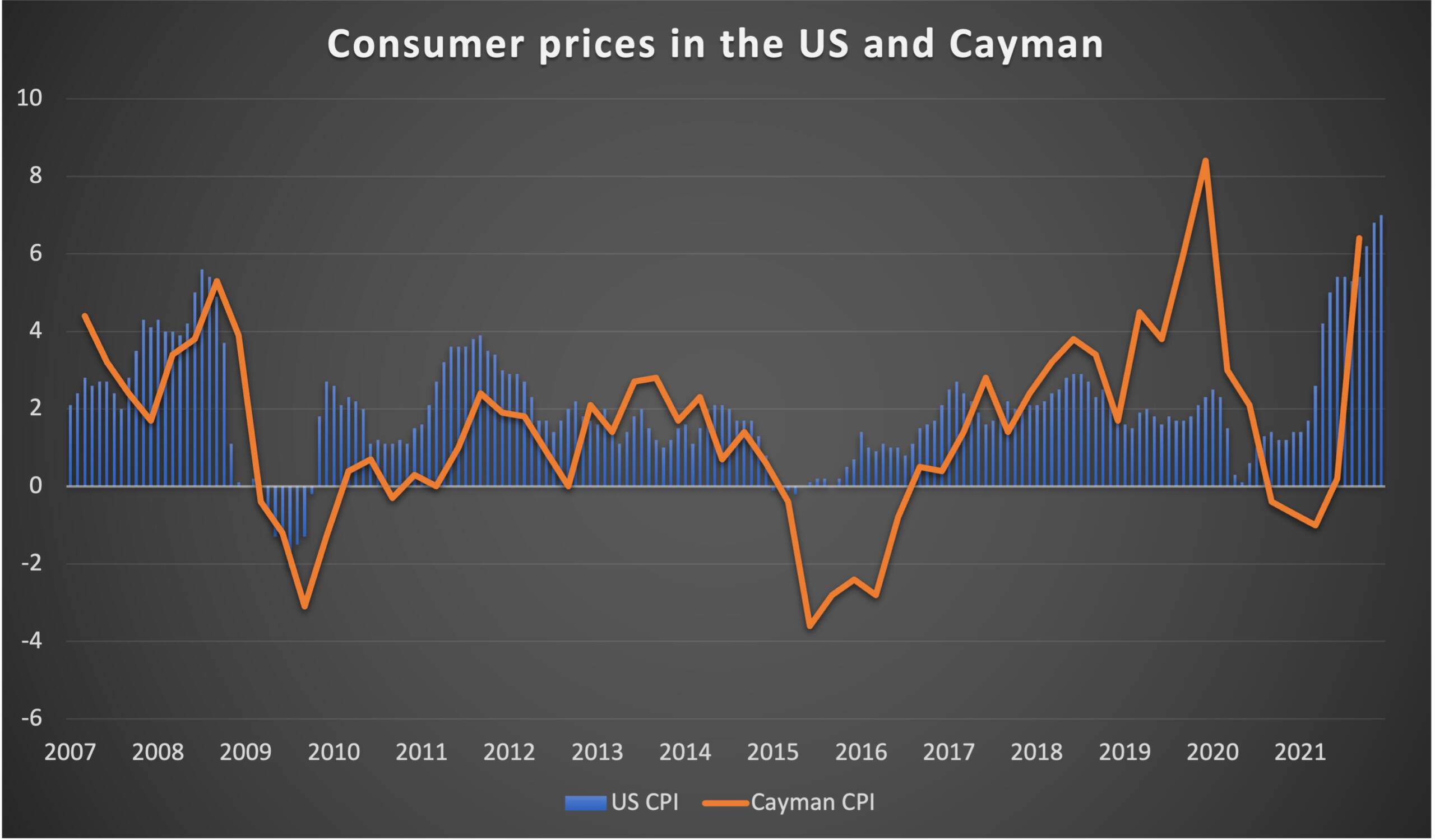
US consumer prices increased by 7% in December 2021, in comparison to the previous year. It was the highest rate of inflation since 1982. The core CPI, which excludes food and energy, was up by 5.5%.
America’s consumer prices are a bellwether for Cayman, as more than 80% of the islands’ imports are coming from the US.
The latest available data from the third quarter of 2021 showed that prices in Cayman last year were on average 6.4% higher than 12 months earlier.
High inflation in the US is also expected to prompt the Federal Reserve to increase interest rates this year.
This would make flexible rate loans, including consumer loans and commercial loans, as well as mortgages on island, more expensive because their interest rates are typically tied to US base rates.
Speaking at his confirmation hearing before the Senate banking panel on Tuesday, Fed Chairman Jerome Powell, warned high inflation was a “severe threat” to the labour market recovery and reiterated that the era of the central bank’s monetary policy support was over.
“To get the very strong labour market we want with high participation, it is going to take a long expansion. [And] to get a long expansion, we are going to need price stability,” Powell said. “High inflation is a severe threat to achieving maximum employment and to achieve the long expansion that could give us that.”
December’s CPI data, although largely in line with economists’ expectation, indicates that inflation is affecting most of the economy and may be much longer lasting than initially thought.
The data from the US Bureau of Labor Statistics, released on Wednesday, shows that prices have been rising fast over the past 12 months for food (6.3%), cars (37.3%), energy (29.3%), which includes gasoline (49.6%), and housing (4.1%), among other items in the basket of goods and services.
So far, price increases have been mainly ascribed to supply chain bottlenecks, labour shortages and businesses struggling after the COVID pandemic slump to ramp up production to keep up with consumer demand.
With COVID cases and hospitalisations reaching a record high in the US this month, the pressure on supply chains and labour shortages may well persist, keeping price growth high.
Most projections indicate moderating levels of inflation throughout the year.
Given that the US unemployment rate has dropped below 4%, market expectations are for three Federal Reserve interest rate hikes this year beginning in March.
OECD area inflation
Although high inflation is particularly marked in the US, rising consumer prices are a global phenomenon. In the OECD area, annual price increases reached 5.8% in November 2021, compared with just 1.2% a year earlier.
Specifically, energy prices increased by 27.7% in the OECD area in the year to November, up from 24.3% in October and the highest rate since June 1980.
In the euro area, annual inflation jumped to 4.9%, after -0.3%, or deflation, in November 2020. And among the G7, consumer prices were 5.4% higher, albeit with a wide range of inflation rates, including just 0.6% in Japan.
Non-food and energy items were the main contributors to overall inflation in the United States, the United Kingdom, and Germany where they added 4.3, 3.3 and 2.7 percentage points to the respective annual November inflation rates of 6.8%, 5.2% and 4.6%.
Related Videos