For many, getting a new car licence plate is a bit of a chore, involving paperwork, a visit to the vehicle licensing office and a likely boring wait in a room filled with others going through similar drudgery.
But for John Ferguson and Ronald Forbes, getting hold of a new plate is filled with a frisson of excitement and thrill.
Well, technically, the plates are usually old and vintage, just new to them. Both men are licence plate collectors. Olympic athlete Forbes started collecting over the past five years or so, while Ferguson, a mechanic, keen cyclist and occasional Santa, has been building his impressive collection since 2005.
On a recent sunny January day, the two met up to make an exchange – a Florida plate with a quirky phonetic link to Cayman for a hand-painted dealer’s plate that’s at least five decades old.
The plate Ferguson presented to Forbes – CI 8670 – started life as a private vehicle plate, with silver lettering on a black background (at the time of issue, government licence plates had black lettering on a silver background). Ferguson explained that unissued private vehicle plates were hand-painted red and issued as first-dealer, or trade, plates.
Ferguson had planned to mail the rare red dealer plate – one of three he owns – to Forbes in Florida, but since the former hurdler was on island over the festive season, the pair were able to meet and make their exchange in person.
In return for the red plate, Forbes presented Ferguson with a Sunshine State plate – T3F 45V – he had taken off his own vehicle just a few months ago. Phonetically, when read out in a Cayman accent, Forbes says, it sounds like 345 – Cayman’s area code.
“It’s been on my car for 10 years,” said Forbes, who has represented the Cayman Islands in three summer Olympics, and now lives in Florida. “I just took it off six months ago.”
“It’s been home for a couple of months, and it’s a plate that I wanted you to have,” he told Ferguson, as a means to thank him for all he has taught him about local licence plates.
Ferguson, a font of knowledge on all things licence plate, explained that between 1958 and 1975, Jamaica minted all of Cayman’s licence plates, as well as those for Turks and Caicos. After that, the plate sizes changed to be in line with the size of US plates.
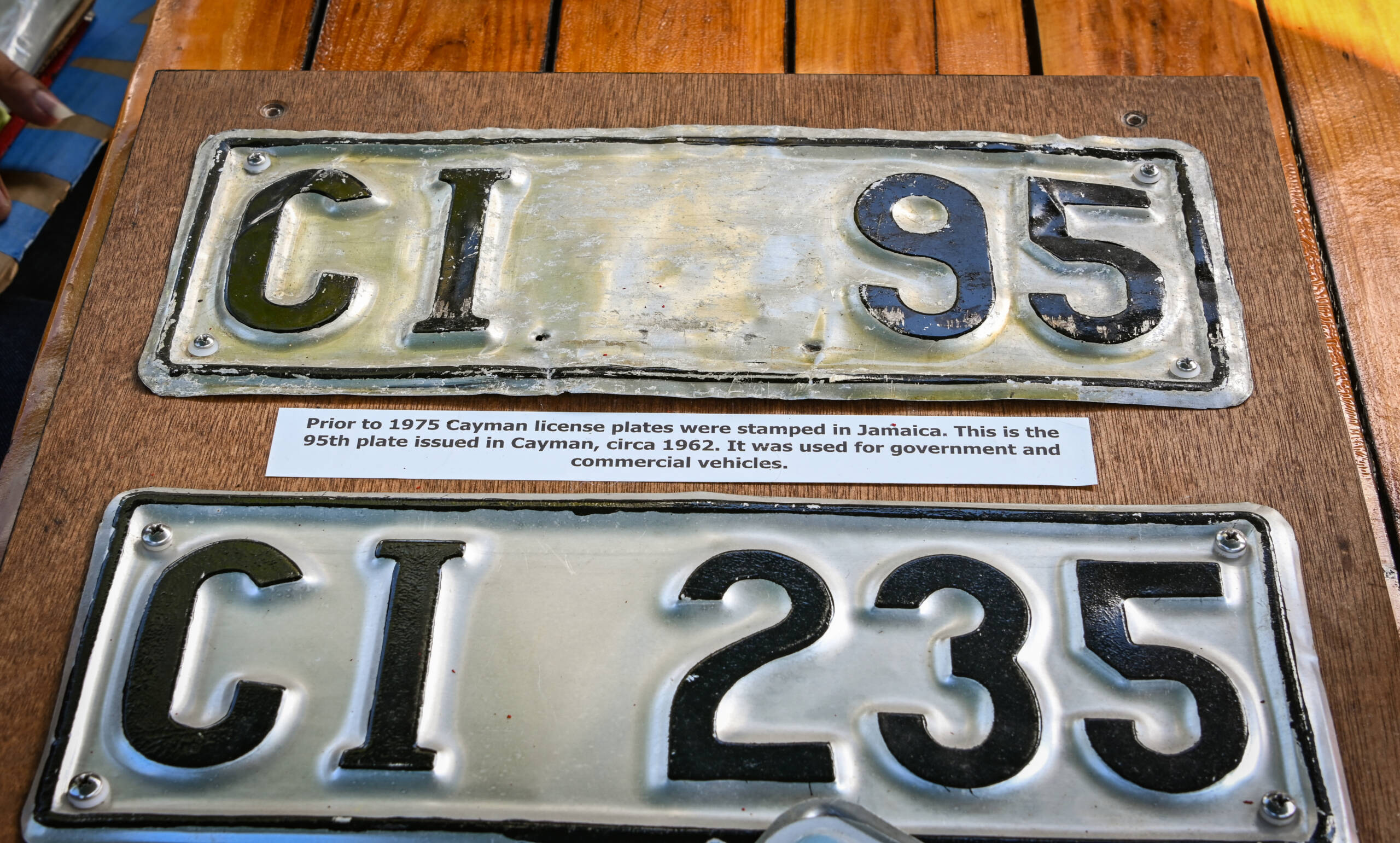
Among his extensive collection, Ferguson has a rare two-digit plate – CI 95 – from 1960, the 95th plate issued in the Cayman Islands.
“I happen to know where CI 2 resides. It’s hanging on a nail in a carport in the state of Delaware,” he said, adding that the man who owns it isn’t willing to sell it. “Number 1 has never been seen or found or heard of.”
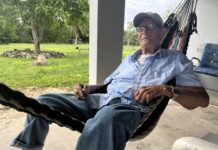
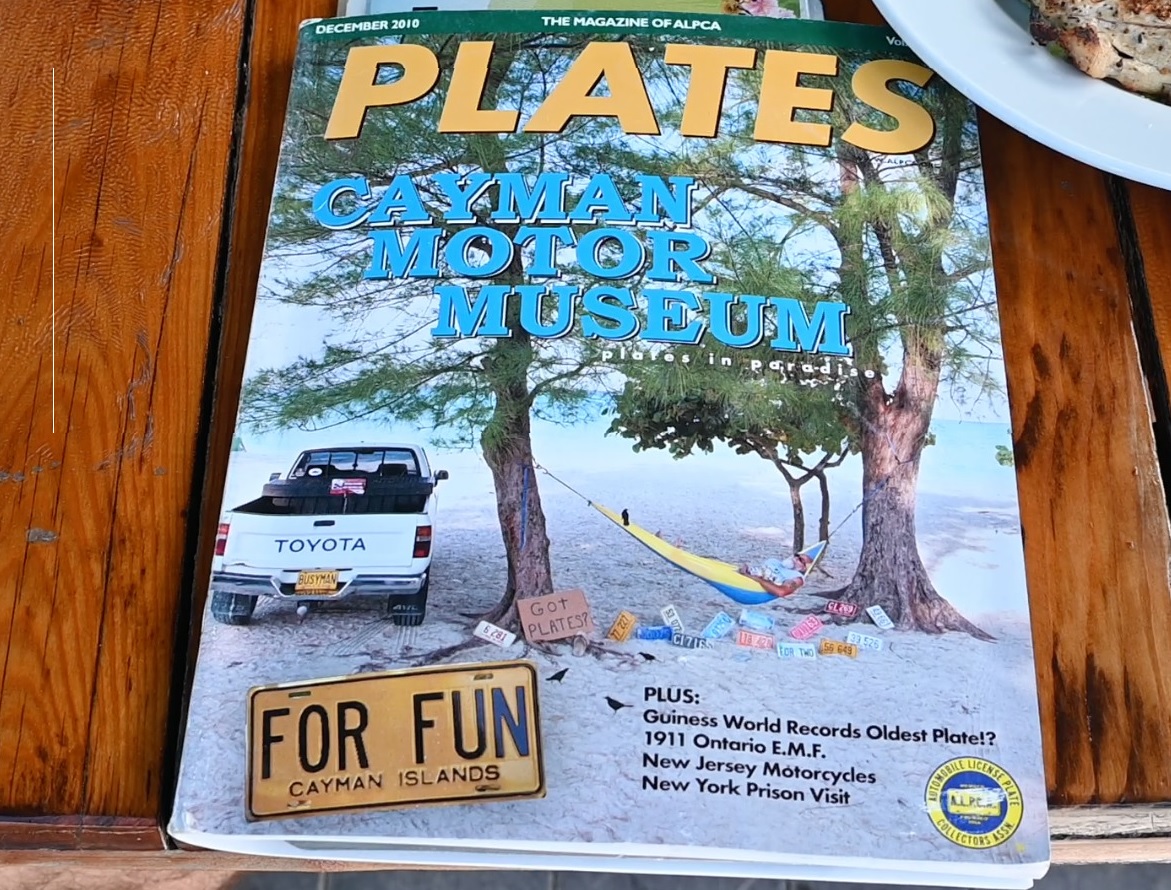
Ferguson’s wide-ranging knowledge of Cayman plates was acknowledged and celebrated back in 2010 when he was featured on the cover of Automobile License Plate Collectors Association’s magazine ‘Plates’, relaxing on a hammock, surrounding by an array of local number plates.
Forbes said he considers himself more of a hobbyist than a collector at this stage, after getting interested in licence plates about five years ago, when his father gave him an old plate that he’d found attached to an old car bumper that had been thrown in the bushes. His dad also showed him an old photo of his car that used to be Mostyn’s gas station, which whetted Forbes’ appetite and curiosity for vintage plates.
“How many of these licence plates exist out there?” he wondered. “I started looking online and I saw one or two that were up for auction. I bought them. And then I started doing a little bit more digging, I started seeing these links.”
Checking out two-digit Cayman plates, he spotted Ferguson’s CI 95 plate on a Google search, and after a bit more searching, discovered that the owner of the plate also lived in Grand Cayman. He contacted him over Facebook Messenger and later met him in person at Ferguson’s West Bay home.
History on a plate
Both Ferguson and Forbes say licence plates are a vital part of Caymanian history and are well worth preserving for future generations.
“There aren’t a tremendous amount of these left. But I think … that this is a very important part of our history,” Forbes said, and he thanked Ferguson for continuing to collect and highlight these little metal pieces of local history.
“Automotive wise and as part of our history, it’s important to keep these plates here. Obviously, some have been on cars here locally and have travelled overseas somehow, whether in a package or in someone’s suitcase, and it’s important to preserve them for as long as possible,” Forbes added.
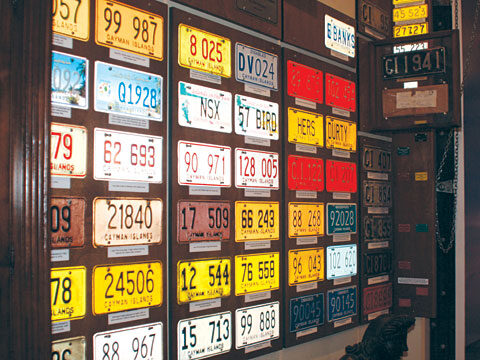
For several years, a display of some of Ferguson’s plates had been on show at the Cayman Islands Motor Museum, which is now closed.
Ferguson, holding up the plate he gave to Forbes, explained, “You can see the plate used to be black and Melrose Whitelock hand painted it. She went down to Parker’s and bought red paint and painted all the extra plates and made these dealer plates by hand. She still works at Licensing today.”
‘Be careful with this hobby’
Currently, Forbes says, he has nine plates – including the one given to him by Ferguson. “I have four-digit plates, I have some three-digit plates, but John is the only one that has the two digits – the only one I’ve seen.”
However, Forbes does have a single-digit Jamaican plate – TG 6.
On his wish list for his burgeoning collection are a single-digit or two-digit plate from Cayman.
But Ferguson warned Forbes, “Be careful with this hobby,” explaining that when he moved into his home in West Bay in 2005, he was finally able to mount and display his collection, at the time, of 37 plates, along the rafters of his car port.
Now, 17 years later, he has “just shy of 6,000 plates”.
And the collection continues to grow. Ferguson will be visiting the US soon to attend a licence plate convention, and to pick up 50 more plates which he has already bought.
Related Videos