


Researchers at the University of South Florida are warning of a massive sargassum bloom this year after satellite imagery detected 4 million metric tons of the seaweed blossoming in the western Atlantic Ocean.
Initial predictions suggest little to no sargassum is expected to arrive on Cayman’s coasts and the rest of the central and western Caribbean within the next two months. However, the university has warned that could change during the summer.
In its January 2022 sargassum bulletin, the university said the sargassum seaweed had increased from approximately 1.7 million tons in December 2021, to 4 million tons in January.
“Compared to all previous Sargassum years, what is unusual is the large increasing rate from December to January, suggesting that 2022 is possibly another major Sargassum year,” according to the bulletin.
The National Oceanic and Atmospheric Administration, based in Florida, defines sargassum seaweed as a brown type of algae that “floats in island-like masses and never attaches to the seafloor”.
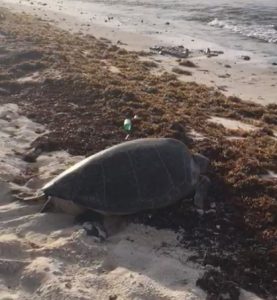
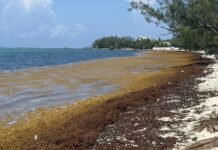
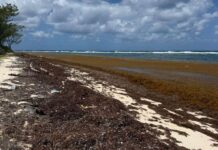
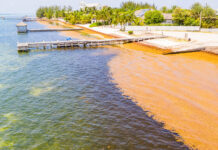
Since 2018, the seaweed has been swept into the Caribbean on prevailing ocean currents where it has clogged the beaches and waterfronts of scores of Caribbean and Central American countries – while wreaking havoc on tourism and local wildlife.
The University of South Florida has partnered with NASA since 2011 to monitor and track sargassum blooms. According to the university, the recent sargassum bloom is the fourth largest blossoming on record.
“Sargassum will likely continue to increase in the [central western Atlantic] and [Caribbean Sea] as well as in the Central Atlantic,” the bulletin said. “As Sargassum is transported from the [central western Atlantic] to the [Caribbean Sea], the latter is likely to have moderate amount of Sargassum in February 2022 while the [Gulf of Mexico] may still be largely free of Sargassum.”
Related Videos






Lots of it coming in this morning after the cold front passed.
Has anyone determined if this can be ground up and used for animal feed or landscaping mulch or any of a variety of organic material uses? Anybody heard of turning lemons into lemonade?