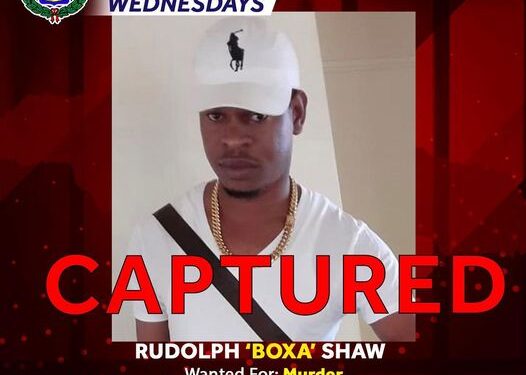
Anti-gang police are working to bring a suspected triple murderer back from the Cayman Islands to face trial in Jamaica.
Rudolph ‘Boxa’ Shaw, described as a leading member of the Wildlife Gang, is a prime suspect in at least three killings, according to senior officers in Jamaica.
He was arrested in the Cayman Islands on 8 July when the car he was travelling in rammed a police vehicle during a chase in George Town.
Fitz Bailey, Jamaica’s assistant commissioner of police, counter-terrorism and organised crime, told the Cayman Compass Shaw is considered a dangerous fugitive.
He said, “He is a vicious criminal and a person who is not afraid to use violence if the need arises.
“We want him to face justice. There are victims of crime that are anticipating closure for the crimes that have been committed against their family members.”
Bailey said Interpol officers in Jamaica were working with Cayman authorities to bring Shaw back to the island.
The suspected gangster was previously highlighted by police in Jamaica at the top of a ‘most wanted’ list in the parish of St Catherine’s.
He was charged in 2019 with the shooting of Romaine ‘Pancho’ Robinson in a bar in the town of Old Harbour. Shaw was captured after a police chase and shoot-out following that incident. But he was subsequently released on bail and absconded.
He is separately wanted in connection with incidents of murder and shooting with intent in St Catherine’s parish in September 2021 and May 2022. He is also reported to be a person of interest in the 2020 shooting of the mother of a police officer.
Bailey said police in Jamaica had been actively pursuing Shaw since he absconded bail on the first murder charge and are hopeful he can be quickly deported to face justice.
Cayman authorities quiet
The path to extradition of the wanted criminal from Cayman is less clear.
Chanel Ammon, a Royal Cayman Islands Police Service spokesperson, said police were not involved in this process, which she said “sits separately from the police” and referred the Compass to Customs and Border Control.
She added, the police were involved in “locating [Shaw] and arresting him” before officers “processed him and handed him over to CBC, as he is an illegal immigrant”.
Martha Connolly, a Government Information Services spokesperson with responsibility for CBC, said the agency had no comment.
The office of the Director of Public Prosecutions did not immediately respond to requests for comment.
Lawyers for Shaw say they have received no information about any extradition process. He was brought to court last week, 12 July, on immigration charges, but no mention was made during that hearing of any efforts to return him to Jamaica to face trial.
Shaw’s lawyers point out that confirming his nationality could be a challenge in any deportation hearing.
After his initial arrest, police said he had arrived in Cayman by boat.
Detective Superintendent Peter Lansdown stated in a press release, “The Cayman Islands is not a safe haven for criminals. We are working with our colleagues in Jamaica on this case and believe the man arrived on island by boat.”
Another man who was with Shaw when he was arrested evaded capture.
The Old Harbour News reported that Shaw is considered one of the leading figures in the Wildlife Gang. He is also implicated in the shooting murder of the mother of a police officer in the town in February 2020.
The paper reports that the Wildlife Gang is considered to be one of the main groups involved in a recent flare-up of gun violence in Spanish Town.
A crime reporter, who spoke to the Compass, said the gang was an off-shoot of the notorious One Order criminal organisation.
He said ‘Boxa’ was considered to be one of the leaders of the smaller Wildlife Gang and had been on the police radar for at least four years.
“He has a track record over several years and has served time for possession of firearms and drugs. Why he was given bail on the murder charge is a question that still boggles the mind,” he said.
The reporter said gang crime was rife in parts of Jamaica, though it is mainly concentrated within the criminal economy. He said murder cases were often difficult to prove because witnesses were reluctant to come forward.
Related Videos