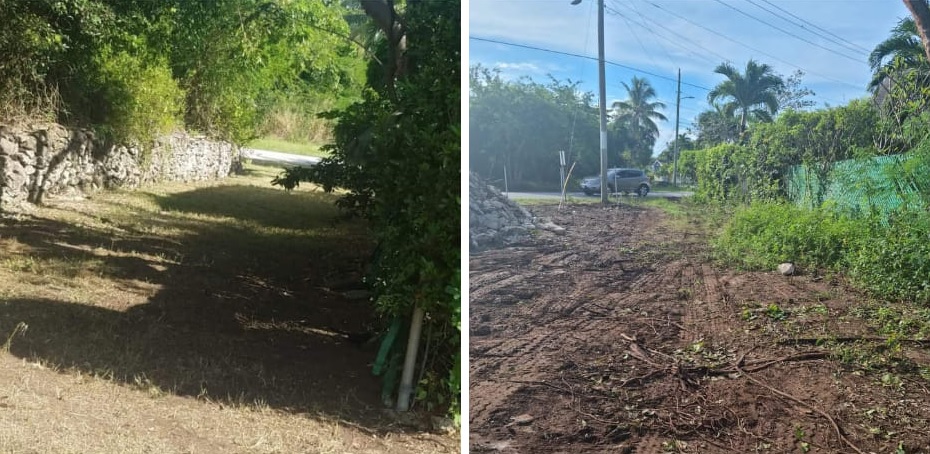
The National Trust for the Cayman Islands says the recent demolition of an historic stone wall built by slaves has again highlighted the need for legal protections for heritage sites on island.
It said it had not been informed of the planned bulldozing of the wall in George Town, which is listed on the Trust’s National Heritage Register.
In a statement issued on Thursday, 25 Aug., the Trust said, “It is unfortunate that not only was the National Trust not made aware of any plans for the demolition of this old stonewall, but we understand that it also came as a shock to members of the neighbourhood and wider community.
“Once again, this has brought to the forefront the need for community educational awareness to encourage respect for, and build pride in, Cayman’s built heritage and sites, and which, along with the legislation to protect such heritage sites, is becoming increasingly crucial.”
Land dispute
The ownership of the land on which the demolished section of wall had stood is in dispute, with two neighbours both claiming it was on their property.
Sandra Clyatt Meekins, on social media posts, has said it was on her land, which her grandfather purchased in 1920, and it had been destroyed without her permission or knowledge. She has declined to be interviewed by the Compass, saying the matter is now in the hands of lawyers.
Leslie Harvey, the adjoining property owner, who confirmed the dispute is now subject to legal action, told the Compass Thursday, that the boundary markers on the properties are clear, and the wall was within his family’s property line.
Harvey acknowledged the controversy over the wall’s destruction and said his family did not know it was a registered heritage symbol.
“We believe in conservation, obviously,” he said. “If we had known it was actually designated of historical significance, I don’t think it would have been touched.”
‘Just a pile of rocks’
He added, “But if you look at the wall, it’s maybe one and a half feet tall, two feet tall, and it’s really just a pile of rocks. It doesn’t look like it has any significance. So, unless you’re told, you wouldn’t know if it’s 20 years old, or 500 years old, there’s no way to tell. So that’s an issue there. It’s on our property, we didn’t know [about it] having significance. There are no laws protecting it.”
But, he said, the controversy shows that a serious conversation about the preservation of certain sites in the Cayman Islands must be had, and decisions must be on what is, or is not, considered an item of heritage that should be protected.
“There should be a debate about what we conserve and what we consider something of historical significance. If there’s just a wall that was a boundary put by slaves, what significance would that have? Was it used for our defence?… No. Did a meeting happen there or something else of historical significance? Did anything happen there?” he said.
He argued that making a case to protect everything that ever been built would mean “you can’t have any kind of progress whatsoever”.
Trust: Check the register
The National Trust is urging land and home owners to check its National Heritage Register on its website www.nationaltrust.org.ky to find out if their sites or structures are on the list.
It also wants them to “engage the National Trust about any relocation or demolition plans owners may have for heritage homes and historic landmarks, even if they are not shown on the Register.”
The Trust acknowledged that “unfortunately, under the current Development and Planning Act (2021 Revision), land owners and home owners are not legally bound to do so, but dialogue would allow them and the National Trust to determine possible solutions other than demolition”.
It noted that although there are some provisions regarding built heritage, especially in historic overlay zones, in the Development and Planning Act, and its associated regulations, they require “significant strengthening and specificity”.
The Trust added, “Our hope is that the upcoming submission by the National Trust with recommendations to update the statutory framework for protecting built heritage in our islands, will help to strengthen the limited protections that exist presently, while adding new provisions that will be fit for purpose going forward.”
Related Videos