
 Secret trials covering classified information that impacts national security should not be considered in the Cayman Islands without specific enabling legislation, the jurisdiction’s highest court of appeal was told Friday.
The latest chapter in a five-year court battle involving two brothers accused of plotting an armed jail break from HMP Northward reached the Judicial Committee of the Privy Council in Cayman last week.
The five-man bench – the highest court of appeal for the territory and multiple other British affiliated countries – is being asked to consider whether a behind-closed-door trial can be held to settle the case.
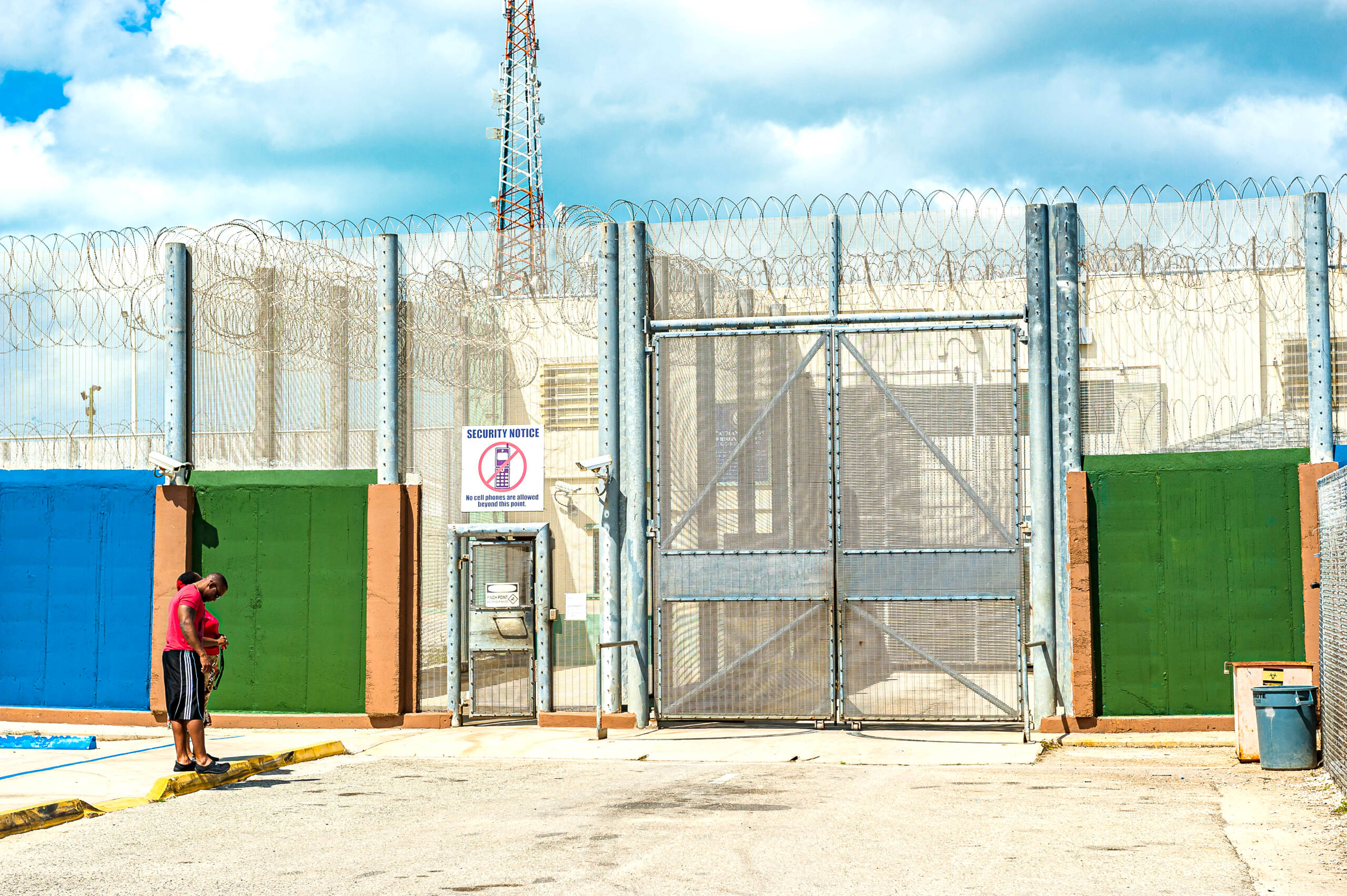
Brothers Justin Ramoon and Osbourne Douglas, jailed for life for the execution-style murder of a gang rival, were deemed too dangerous to be imprisoned in Cayman.
On the signature of former Governor Helen Kilpatrick, they were transferred without warning to maximum security facilities in the UK.
Since then they have been battling to be allowed to return to Cayman.
The brothers deny allegations that they are gang kingpins who were orchestrating the importation of drugs, weapons and hit-men from Jamaica from behind bars.
Low-level killers or a national security threat?
The transfer – under an obscure 19th century act – has effectively severed their links with their families in breach of basic human rights guaranteed by the Cayman Islands Constitution, according to arguments made by their legal teams.
So far the brothers have not been shown any of the evidence against them.

The basis for the transfer comes from police and prison intelligence, including from informants. And lawyers for the governor have successfully argued that it should be kept from the men and their legal representatives under a Public Interest Immunity Certificate.
Against that backdrop, the courts have been struggling to find the best means to hear the brothers’ case, which seeks to have the transfer ruling overturned.
Secret hearings
Cayman’s Court of Appeal had ruled that a special trial – known as a Closed Material Procedure – could be used to assess the validity of the decision to transfer the two killers off island. Under that process – sometimes used in terror trials in the UK – a judge would have access to all the information. But neither the two men nor their lawyers would be involved in the trial.
Ramoon’s legal team appealed that ruling to the Privy Council.
The governor should only be allowed to rely on evidence that can be produced in open court, Hugh Southey KC insisted in his submission Friday.
Southey, instructed by Prathna Bodden of Samson Law, said his client had a right to see the case against him and to challenge it.
Anything else, Southey argued, would be a breach of natural justice as well as the right under ‘common law’ to a fair hearing.
He said if government wanted to have closed hearings, as proposed in this case, it should have set legislation detailing how they would occur and in what circumstances.
The UK government introduced the Judicial and Security Act to deal with such cases.
And Southey suggested something similar – approved by elected officials – would need to be in place before Cayman could consider holding closed proceedings.
“We shouldn’t assume that Parliament are unable or unwilling to grapple with this in the Cayman Islands,” he said.
“This litigation has been going on for five years, it is relatively high profile, but no legislation has been enacted. That’s an indication in one sense that Parliament has, for whatever reason, decided not to interfere with the common law position.”
He acknowledged that European courts had established that Closed Material Procedures were not automatically in breach of human rights. But he said counterbalancing measures, including appropriate safeguards, were needed to ensure justice for the plaintiffs.
Questions over threat posed
Southey said there were serious questions about the conclusions reached that his client was a threat to national security. Ramoon denies he is a gang member and claims, in affidavits submitted to the court, to be baffled by the accusations against him.
Southey said there was no evidence that had been produced to support the claims.
And he insisted that Ramoon’s appeal would likely be successful if the governor is not allowed to rely on untested information from classified documents.
“The solution, if that is regarded as unacceptable, is for the Cayman Parliament to legislate,” he said.
‘The best bad solution’
Lawyers for the governor also expressed doubts about the appropriateness of closed hearings.
Paul Bowen, KC, said there was no way to decide the case without a Closed Material Procedure.
Quoting Winston Churchill, he said it was the “best bad solution.”
He added, “It is the worst solution, apart from all the other ones.”
Bowen said the case inevitably involved classified information that had to be kept from the prisoners.
“The appellant and his half-brother are extremely dangerous individuals convicted of a gangland killing… information from informants indicates that there were smuggling automatic weapons and hit men from Jamaica.”
He said there was also evidence that they were planning an escape and police and prison officials had advised they could not be safely held at Cayman’s category B prison facilities.
Bowen said the decision was approved through the UK Secretary of State, the Lord Chancellor and the governor.
He argued that it was impossible for the governor to produce the evidence, on which that decision was based, in open court. A judge has already ruled that it must be excluded on public interest grounds, including to protect the safety of the informants.
He insisted it would be unfair to the governor for the courts to consider the case without that information.
An ‘untriable’ case?
Without a closed-door hearing he said the issue at stake was “functionally untriable“.
The two options open to the courts, said Bowen, were to dismiss the case or order a special Closed Material Procedure.

He said the court could not, as Ramoon’s lawyers argue, make a decision based purely on the information that is in the public domain.
Privy Council President Lord Reed of Allermuir questioned this approach, asking, “Is the argument that you have something up your sleeve that you are not going to show us but we should assume it supports your case?”
Bowen argued that deciding in Ramoon’s favour – simply considering the publicly-available information – would be a non-solution.
If Ramoon was successful in a hearing – where the classified material was not considered – he said the inmate’s return to HMP Northward would still be contingent on a fresh decision from the governor on the national security threat that they pose.
He would be duty bound, because of his constitutional remit for internal security, to consider all the information, including the classified documents, and he would inevitably make the same decision as his predecessor – that the men can’t be held in Cayman.
In this scenario, Bowen said, the whole process could go on endlessly with no result.
“It leads us inexorably into an inextricable circle,” he said.
Family ties
Ramoon’s lawyers also asked the Privy Council judges to overturn the lower court’s ruling that the men’s family rights had been fully considered before they were removed from Cayman.
Southey said evidence showed that Ramoon had not seen his young son, who no longer recognises him, since the transfer.
He said the European courts had already held that long-distance transfers of inmates were a violation of rights to a family life and that maintaining family ties was fundamental to the concept of rehabilitation.
A decision is expected from the Privy Council in the coming months.
Read the Compass’ full investigative ‘Prison Papers’ series here.
Related Videos