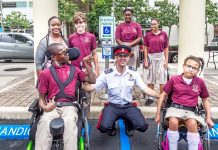
The National Council for Persons with Disabilities and the government have launched a grassroots campaign to help the community better understand who can and can’t use the blue parking spots designated for people with disabilities.
The campaign not only tackles the challenge of people illegally parking in those spots, but also aims to highlight the prevalence in Cayman of people with ‘invisible’ disabilities who often face abuse from individuals who see them parking in the spots and don’t believe they have any health problems.
To help illustrate the issue, the National Council for Persons with Disabilities has posted a video featuring local resident Renee Howell, a council member who suffers from multiple sclerosis.

In the video, she says, “I know, I don’t look sick, but did you know that globally one in seven of us live with a disability?”
She explained that excessive walking or prolonged exposure to heat can be “devastating for people like me”, therefore she needs to park as close to her destination as possible.
“I’m so thankful for the blue spots, which help me save energy and avoid the heat, allowing me to live a better quality of life and keeping my illness invisible,” she said.
Howell added that the blue spots are not “a convenience”, they are “a necessity for those with obvious disabilities, as well as hidden illnesses”.
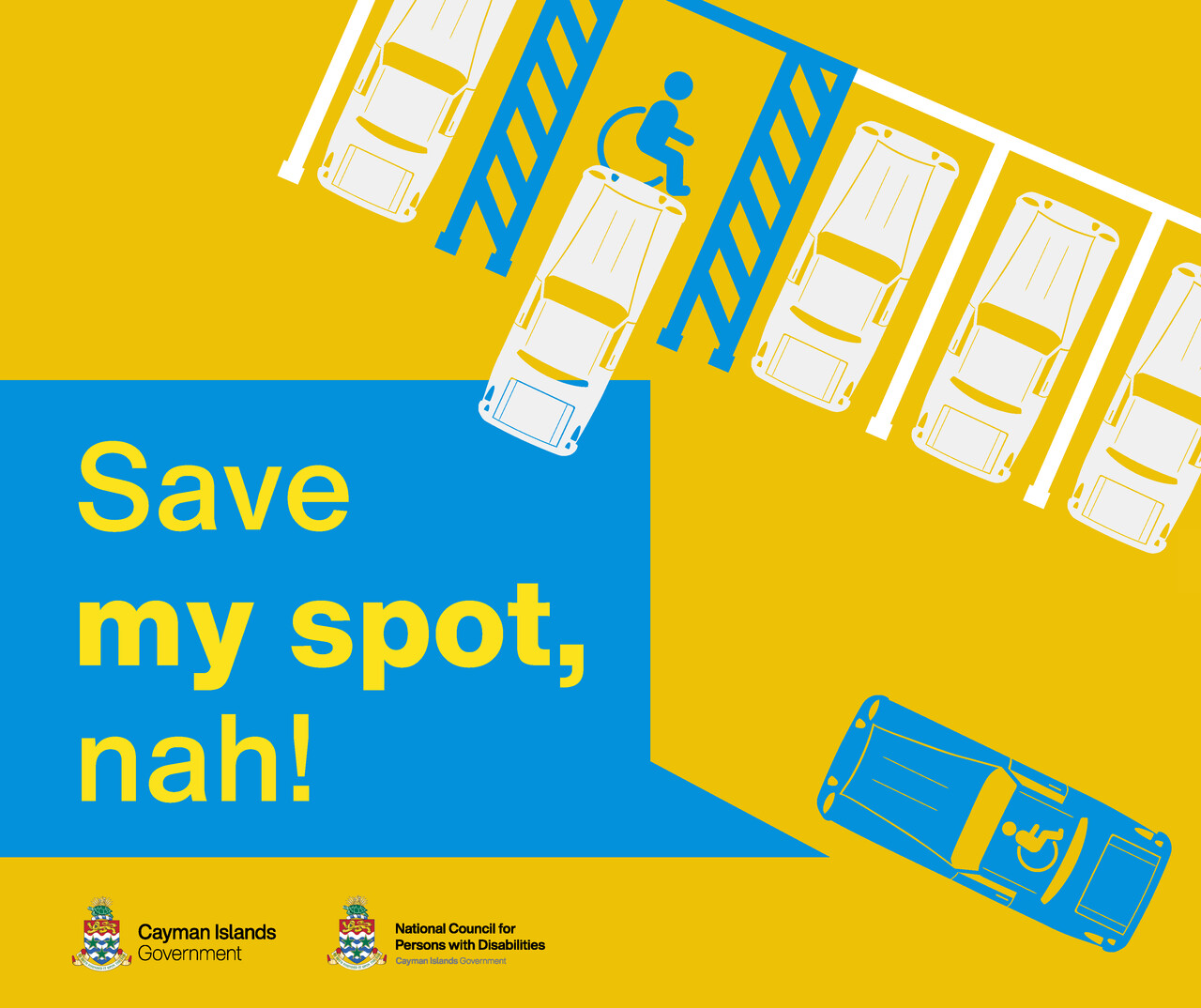
According to a press release about the new initiative, the ‘Save my spot, nah!‘ campaign was developed “to encourage compassion and advocacy for members of the community with visible and invisible disabilities who rely on accessible parking for a better quality of life. It also aims to rally the community to protect accessible parking areas and better understand the rules of use.”
The council noted that disabilities are defined as any physical, mental, or neurological condition that may affect an individual’s movements or senses, regardless of outward appearances.
“For example,” it said, “someone may legally have a disability parking permit or licence plate without having a visible mobility assistance device, like a wheelchair, scooter, or cane. Invisible conditions, such as chronic fatigue syndrome, heart conditions, asthma, epilepsy, multiple sclerosis, etc., may qualify someone to park in a blue spot.
“Therefore, the public is encouraged not to judge appearances or make assumptions about people they see using accessible parking – but do be alert to vehicles that park in these spots without the approved permits or licence plates.”
National Council for Persons with Disabilities chairperson Magda Embury said in the release, “Often, well-meaning onlookers may shame individuals for using the blue spots without knowing that they suffer from an invisible condition, and they are qualified to use the designated spaces for a better quality of life.”
She added that it was also important to remember that the additional space next to the blue spots, known as the ‘crosshatch area’, is not an extra parking space, but rather an essential exit/entry space needed for motorists with disabilities who use wheelchairs or other devices.
“Unfortunately, sometimes these crosshatched spaces are often occupied or partially blocked by able-bodied drivers,” she said.
‘Blue Spot Heroes’
She added, “The NCPD is grateful to the Cayman Islands Government and the Royal Cayman Islands Police Service for its continued support and efforts thus far, and we now look forward to creating a community of ‘Blue Spot Heroes’ who work along with us to protect those with disabilities by ensuring that accessible parking spots are saved for those who need them most.”
According to the World Health Organization, nearly one in seven people live with a disability that impacts major life activities. As people age, the proportion with disabilities increases – and of those who have a chronic illness, 80% are considered to have an invisible or hidden disability. That equates to approximately 1 billion people who are living with an invisible disability.
National Council for Persons with Disabilities stated that locally there are many people who need to use the accessible parking spaces.
“It is our goal to always protect the most vulnerable in our society and to inspire a new wave of advocates to further the goal of protecting ‘blue spots’ for those that really need them,” Acting Cabinet Secretary Jason Webster said in the release.
“As we have entered the busy holiday season, we encourage the community to be ‘Blue Spot Heroes’ and leave the blue accessible parking spots for those who need them the most.”
Watch the ‘Save my spot, nah!’ campaign here.
Related Videos