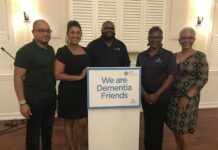
A regional campaign by Alzheimer’s Disease International is calling attention to a lack of resources and funding to tackle growing cases of dementia across the Caribbean, including in the Cayman Islands.
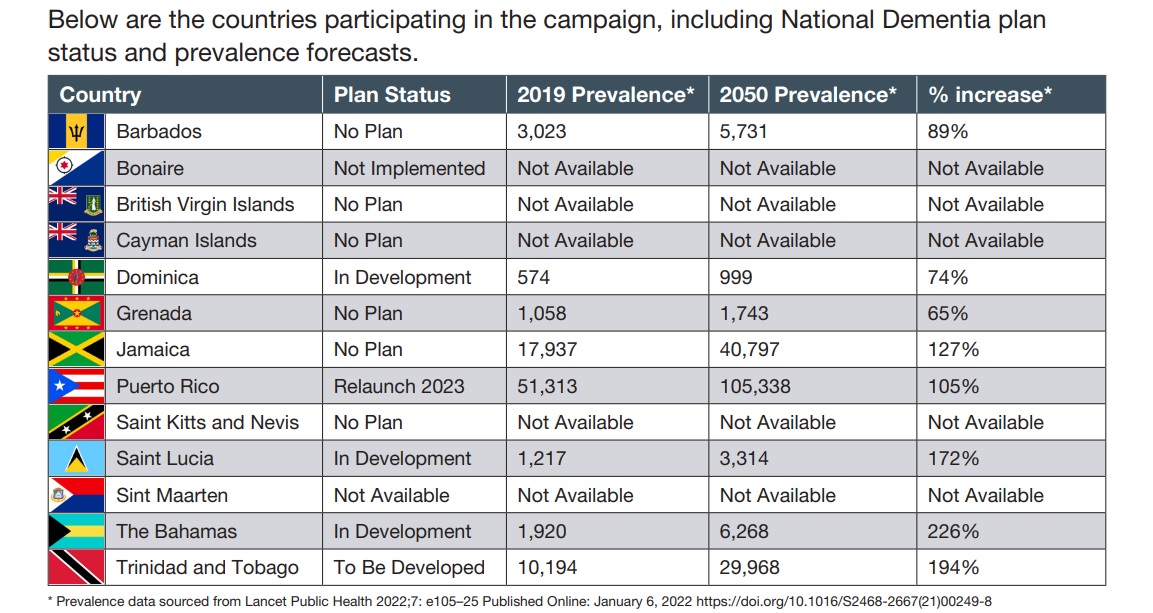
The organisation, quoting a study published in The Lancet health magazine, says cases of dementia in the Caribbean are forecast to increase by 155% – from 300,000 cases today to 750,000 – by 2050.
The exact number of people in Cayman living with Alzheimer’s or some form of dementia is unknown.
“We basically don’t have a lot of data in Cayman regarding the prevalence of dementia,” said Dorothy Davis, who chairs the Alzheimer’s and Dementia Association of the Cayman Islands. She added that while statistics are collected from the Health Services Authority and some local clinics, not every medical provider supplies data regarding patients with dementia.
According to the HSA statistics released by the Ministry of Health in 2021, there were 1,053 people in Cayman diagnosed with dementia, the majority of whom had Alzheimer’s.
Davis said there has been an uptick in diagnoses locally, and around the world, since the start of the COVID pandemic, which she suspects could be related to people spending more time at home with family members during lockdowns and noticing their behaviour, and taking them to the doctor to be checked.
Need for care facility
She and her organisation have been calling for a day-care facility to be set up in Cayman to help care for individuals suffering from dementia.
One local family who would benefit from such a facility is Ian Haughton, who has Alzheimer’s, and his wife and sole caregiver Jaysee Taylor Downs.
Haughton was diagnosed with early onset Alzheimer’s at the age of 55, the press release from the ADI noted. The former project manager of a large construction company, he was the main breadwinner for his family while he could still work.
“Now due to him not being able to work, I am now working two jobs to make ends meet,” his wife said in the release.
“At times I have to leave Ian alone as I do not have and cannot afford a caregiver for him. From time to time, I have the help of my brothers who themselves have their own work. Ian is just so bored and frustrated about being left alone and not being able to come outdoors as we live on the third floor of an apartment building.
“The Cayman Islands is in need of day-care facilities that persons with dementia can go to engage in activities and meet other persons who are going through the same issues as themselves.”
More education
Davis acknowledged that while Cayman has made great strides in educating the community that dementia does not only affect older people, but says much more needs to be done.
“Many activities are centred around seniors; that, of course, excludes many persons like Ian living with dementia,” she said. “One of the long-term goals of ADACI is to have a facility that will provide activities for persons with early to moderate dementia. We will only be able to achieve this with the help of corporate sponsorship or our government and a National Dementia Plan.”
She added that her organisation currently has more people seeking help and support from ADCAI that it can provide, as it has limited funding available.
There is also a shortage of medical staff specifically trained to deal with patients with dementia in Cayman, Davis said.
Training is also needed by police and first responders, so they can recognise typical symptoms of the illness and know how to de-escalate situations and calm down sufferers who may be acting violently or irrationally, she said.
A call for national dementia plans
Alzheimer’s Disease International and its members in the region are organising the ‘What’s Your Plan’ campaign to raise awareness of dementia and the need for national dementia plans to improve the lives of those living with the condition, and their carers.
According to data collected by Alzheimer’s Disease International, only 16% of Caribbean countries and territories have so far implemented a national dementia plan. Cayman does not have such a plan.
Davis said that in 2017 the Cayman Islands committed to a World Health Organization initiative to develop national dementia plans across the Caribbean by 2025, but it does not appear as though any work on these initiatives have gone ahead locally.
The Compass has reached out to the Ministry for Health and Wellness for comment and is awaiting a response.
 According to the World Health Organization, dementia is the seventh leading cause of death globally, and the third in the Americas.
In a press release issued this week, Alzheimer’s Disease International called for members of the public across the Caribbean “to urge their governments to take urgent action on dementia”.
It has teamed up with Alzheimer’s associations in Bahamas, Barbados, Bonaire, British Virgin Islands, Cayman Islands, Dominica, Grenada, Jamaica, Puerto Rico, Saint Kitts and Nevis, Sint Maarten, St Lucia, and Trinidad and Tobago to launch its campaign.
The organisation noted that while a few countries in the region, such as the Dominican Republic and Cuba, have implemented national dementia plans, most are without adequate funding.
Paola Barbarino, CEO of the organisation, says developing, funding, and implementing these plans is essential to improving health outcomes for people living in the Caribbean with dementia.
Access to support
“A National Dementia Plan is a vital step in helping those living with dementia to have access to the support and services they need to live well, for longer,” Barbarino said in the press release. “Access to support and a care plan, including care at home and in community settings, at-home adaptations, and respite for carers, alongside medical treatments, are vital for people living with dementia, as well as their carers and family.”
She added, “All people living with dementia in the Caribbean deserve access to the kinds of support and services a National Dementia Plan makes available. It’s their human right.”
Barbarino said the organisation had talked to various government ministries dealing with health, age and social support in the Caribbean, and “while in some cases it can lead to progress, it is often too slow”.
She added, “For a condition like dementia, time is of the absolute essence. People cannot wait. We need people from all over the Caribbean to speak up for people with dementia so that their governments might actually listen and act.”
While some progress has been made in developing national dementia plans in the Caribbean, Barbarino says that a lack of funding for these plans means many communities are missing out.
“A National Dementia Plan is a government’s best tool for preparing for this looming global health crisis,” she said. “Despite some progress to develop plans in a few Caribbean nations, without adequate funding to implement them, these plans are laying unused on the desks of bureaucracy across the region – more empty promises, and blunt tools.”
Alzheimer’s Disease International notes that research has found that the greatest risk factors for dementia in the Caribbean include cardiovascular health, diabetes, family history and older age.
Related Videos