

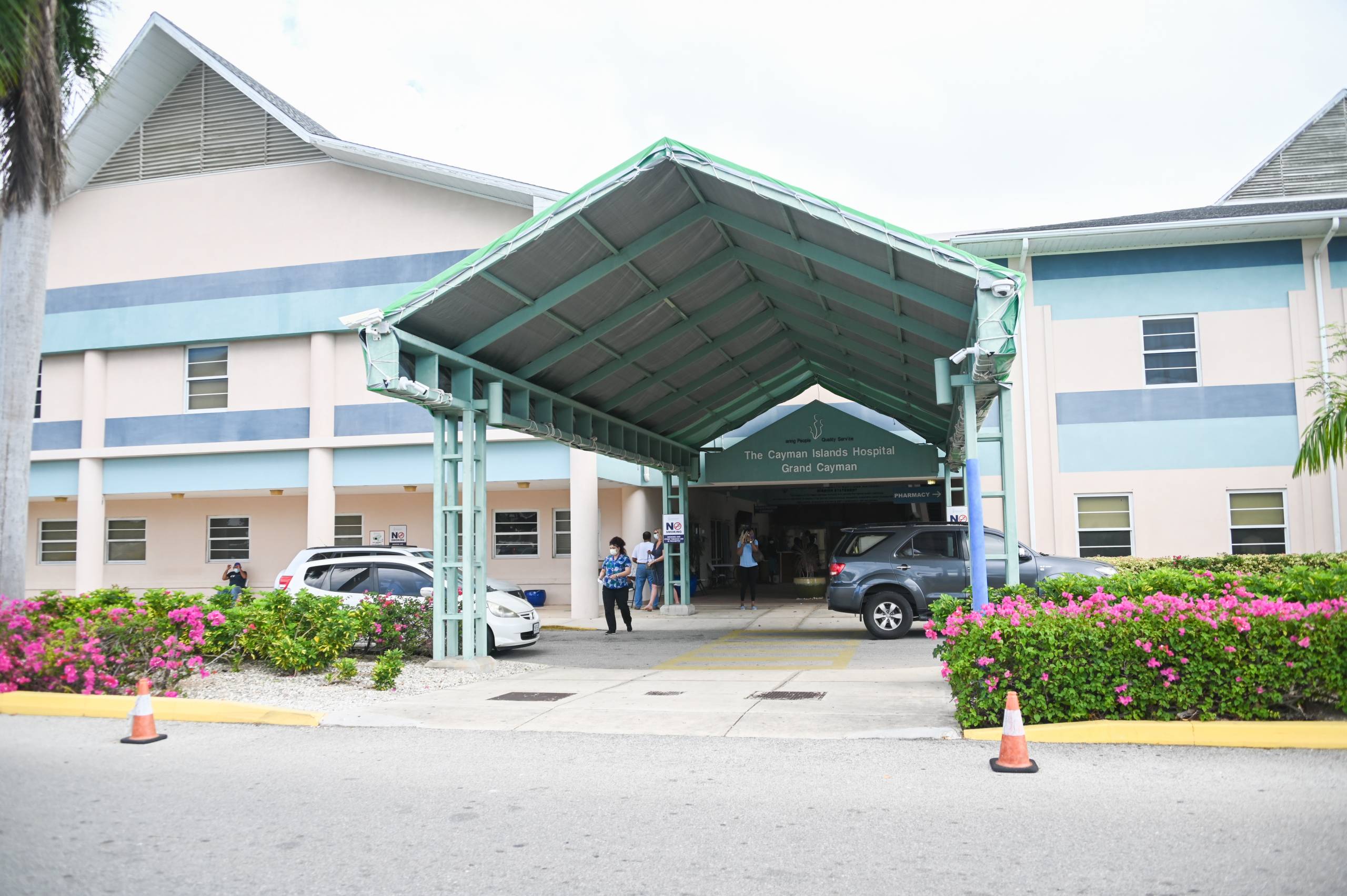
The Health Services Authority and the police this week ran a drill of a scene no one would ever want to experience – a mass shooting inside a hospital.
For 15 minutes on Tuesday, patients, medical staff, visitors, contractors and police were engaged in an active-shooter drill inside the surgical and medical wards of the Cayman Islands Hospital, in a bid to prepare for a scenario that is almost unheard of in Cayman but is all too common in the United States.
Natalie Harvey-Caum, a HSA health and safety manager as well as a registered nurse, told the Compass in an interview following the drill – the first of its kind at the hospital – that the authority is “mindful that violence is increasing”.
She said a recent local increase in gun-related crimes, such as armed robberies, was not the impetus for this week’s active-shooter drill; rather, concerns raised following mass shootings in the US had prompted it.
By mid-April, there had been more than 160 mass shootings in the US, according to media reports. “That’s more shootings this year in the US than there have been days,” Harvey-Caum said.
“With that prevalence and increase in gun violence,” she said, “we decided we have to start thinking actively about this. We are very close to the US. We have to be vigilant and aware of what is happening. … We decided we needed to be proactive and we needed to start preparing.”
Five ‘victims’ in shooting drill
In the scenario of Tuesday’s drill, the ‘shooter’ was not a stranger or an intruder – it was an HSA employee.
“We had a perpetrator, an attacker, who was a member of staff. We have to think about all aspects. It’s not just visitors or patients that can be aggressive,” Harvey-Caum said, adding that anyone can be dealing with mental health issues.
She added, “We decided to use staff. That is where the training part came in. Most people taking part were not expecting a member of staff to be the perpetrator. That threw them off.”
During the drill, five people were ‘shot’, though on the advice of the RCIPS, no gun was used nor fake shots fired. Instead, the ‘gunman’ shouted “bang bang” when he ‘fired’, she explained.
To ensure patients on the wards knew what was happening and would not be alarmed, Patient Services visited them beforehand to explain about the drill, and the hospital’s PA system was used to alert everyone of the exercise 30 minutes and 15 minutes beforehand.
“The objectives of the drill was to test response time for the RCIPS, our internal responses, and the trauma call-out system. All three objectives were met,” Harvey-Caum said.
“It was a success,” she added, though admitted, “We had a few hiccups or, should I say, opportunities. We are working on them to streamline it.”
As part of the training to prepare for a potential shooting incident at the hospital, staff have been told to familiarise themselves with possible hiding places in their respective departments.
“People think this could never happen here,” said Harvey-Caum. “We’ve started to sensitise people that even though we have never had this happen, it could happen.”
Though not a mass shooting, there has previously been gun violence at the Cayman Islands Hospital. Amidst gang-related violence in March 2005, a man was shot and killed at the hospital. The shooter was arrested by police following a pursuit, during which the gunman shot at an officer, but did not hit him.
Harvey-Caum noted that the HSA training in how to respond to violent episodes in the hospital is not limited to guns, as incidents elsewhere have shown that items in hospital rooms, such as IV stands and even bed frames, can be used as weapons.
Run, hide, fight
She added, “We thought we needed this training for our staff, visitors and patients, as safety is paramount.”
In preparing for the active-shooter exercise, she said, participants were trained to “run, hide or fight”.
Harvey-Caum said staff are told to run as far away from the building as possible and let their manager know they are safe, while those in hiding should remain in a secure area. If fighting, which she called a last resort, they should only do so as part as a team.
The drill ended for the hospital staff with the arrival of the RCIPS Firearms Response Unit.
Similar drills are expected to be carried out at different areas of the hospital at later dates, and possibly at district clinics and Faith Hospital on Cayman Brac.
Related Videos









This raises the quetion that although guns in Cayman are allowed to permit holders I sincerely hope permits are not given for “assault rifles”. How the U.S can allow citizens to hold these weapons of mass destruction is absolutely mind boggling to citizens of civilised countries.