The opening of the new Cayman Islands Football Association season descended into chaos this week amid confusion over a controversial new transfer policy.
The annual Charity Shield curtain raiser was postponed again on Sunday and the league could be at risk of losing players or clubs.
In the worst-case scenario, some of the leagues risk being cancelled following major complications involving recently imposed transfer regulations.
Disgruntled players and coaches claim the transfer fees and restrictions mean they are “chained to clubs” with no freedom of movement in an amateur league.
The new rules governing transfers have twice delayed two senior CIFA Charity Shield matches originally scheduled for end of September and reset for this past Sunday, 8 Oct. The association on Monday announced 22 Oct. as the new date for the games.
The regulations proposed by CIFA on 31 Aug. – 38 days before the first match of the season would have been played – have gone into full effect for the 2023-24 season.
The new rules require clubs acquiring players from other teams to pay a fixed administration fee of $300 to CIFA for every transfer and an additional $200 to clubs for every season a player has been with their now former squad.
This means players are now priced anywhere from $500 to over $1,000, depending on the number of seasons they played or the number of footballers coming to the club.
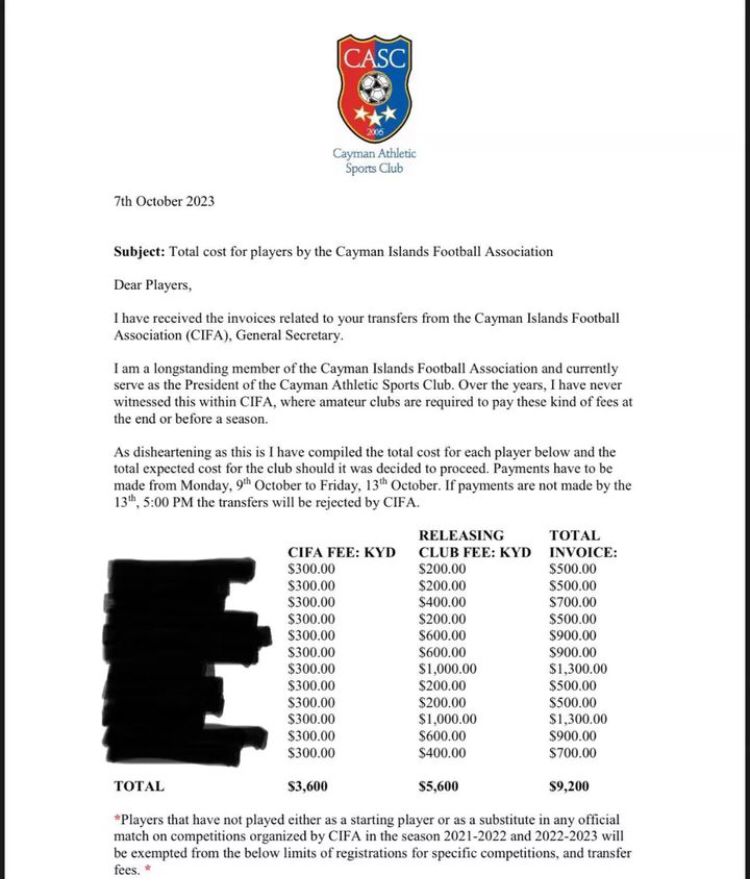
For example, Cayman Athletic Sports Club posted on social media an invoice dated 7 Oct. for $9,200 for 12 players wanting to join from various teams – and $3,600 of that sum would go to CIFA.
The new rules also state that only five players competing in the senior leagues are allowed to be transferred from a single club and if they all choose to go to the same acquiring club, only three will be eligible to play, meaning the other two will have to sit out for an entire season.
Transfer situation delayed Charity Shield
Elite SC and Academy SC women’s teams were last month set to play the first match of the senior season in the CIFA Charity Shield, but undisclosed “circumstances”, according to CIFA, prevented that from happening.
The Compass reached out to Academy to explain those ‘circumstances’ and the club admitted that the withdrawal was due to the transfer situation.
“Player transfers for the new season were not scheduled to take place until October 9th which would have meant that some clubs, including Academy, would not have had the chance to effect their player transfers before the Charity Shield,” Academy officials said.
Clubs will have under a week to make transfers, as the window opened on 9 Oct., and will close on 14 Oct.
Initially, CIFA had invited clubs to discuss and make suggestions on the proposed transfer rules. However, at the 57th annual general meeting last month, the 18 clubs in attendance were not given a chance to vote on the new rule; instead, CIFA executives went against protocol and unilaterally approved the change.
The regulation and the timeline for transfers have received a mixed reaction from the clubs.
Players discouraged
Several clubs have refused to pay transfers fees and, to make matters worse, players are threatening to stop playing football under the CIFA banner all together.
The delayed Charity Shield matches come on the heels of eight female players with Elite signing a letter issued via email to CIFA’s general secretary Marcos Tinoco last week, on which the Compass was copied. The letter outlined their grievance with the club and how the recent transfer regulations takes away their freedom to switch teams.
“Unfortunately, the present conditions within the Elite Sports Club Women’s team have left many of them feeling burdened by mental stress and discouraged,” the letter stated.
“The recently released transfer and registration rules by the Executive Committee has further fueled their reluctance to continue with Elite.”
The letter noted several issues, including personal tension with coaching staff, and the players feeling like they are not welcomed and unable to speak freely without fear of retribution.
The situation is linked to the release of Dion La Foucade, who was hired by CIFA as the head coach of the national women’s team, only to be fired in August, fewer than three months later.
That caused division among dozens of players, including women on the same squad – between those who sided with CIFA releasing the coach and others who thought La Foucade was let go unjustly.
Since then, there has been a rise in tension among female players – mostly seniors – who compete in the CIFA women’s premier league and with the national team.
In the letter, the Elite players said those who are “unhappy”, and feel “unwelcome” and like “outcasts” within their own club will only be able to leave if the acquiring team pays for the transfer. They added that this situation has left them “discouraged about their future in the sport”.
“We strongly request that [CIFA] takes steps to ensure that appropriate measures are implemented to address these concerns and create an environment conducive to player growth, skill enhancement, and mental well-being,” the letter said.
No freedom of movement
One CIFA First Division club, which asked not to be named, echoed the concerns voiced by the Elite players, noting that amateur players, who once enjoyed the freedom to choose their team, are now bound by contracts that offer them no financial benefits.
“Financially stable clubs have the means to outbid smaller clubs, further exacerbating the disparities within the [CIFA],” the club wrote in a statement to the Compass.
“This alarming transformation has shattered the dreams and aspirations of young footballers… leaving them chained to clubs and devoid of the fundamental right to choose their footballing destiny.”
CIFA defends policy
While they are many upset with the regulations, CIFA’s intention with the rules change was purportedly to protect clubs from losing its players, which in the past has caused clubs to suffer.
The Compass reached out to Tinoco regarding the transfer issues, to which he responded by email: “This decision was made because FIFA came up with a resolution that amateur players cannot be held by clubs without a valid reason, as all clubs want some sort of protection, CIFA Executives decided to propose limitations for specific competitions to avoid a massive movement of players that would disrupt the competitions.
“Only one club came up with a proposal which was very similar to what the Executive was proposing and, as it was not a representation from a significant group of clubs”, the executive “decided to adjust the regulations”, he said.
Football fees have always existed in Cayman, within the January transfer window, which were previously set at $250 – with a portion of that going to CIFA and the rest to the club – aligning with the FIFA rules, which states should a player want to leave, “fees shall be paid by the acquiring club”.
However, those FIFA rules do not apply to amateur players. Instead, FIFA states clubs need compensation for developing players from the youth level up to the age of 21.
‘Fees cover costs of developing players’
Last November, the Compass reported on compensation fees as Academy SC’s technical director Virgil Seymour noted that players needed to be held accountable.
He said at the time, “If you spend 16 years developing a player, sometimes using your own resources… doing everything for them outside of paying the player – we take them on trips and invest thousands of dollars,” the players should be grateful, “but no, there is no loyalty”.
Seymour added, “The clubs that don’t have youth programmes don’t understand the [loss]. We want to hold those kids responsible for all the development we have done for them.”
Tinoco said that a few clubs may take issue with the new regulations but he believes CIFA has taken the right stance in protecting its clubs.
He blames “one or two clubs” which are trying “to pull the strings” for their benefit and in detriment to the majority. “We live in a democratic society and as it stands now, I have not received anything official from any club except the mentioned proposal from one club,” he said, noting that CIFA won’t decide regulations in favour of “one or two clubs that have a big megaphone and talk a lot”.
Not surprisingly, the unnamed First Division club said of the controversy: “CIFA now stands at a crossroads.”
Related Videos