The government has a $116 million surplus, net assets of $2.2 billion and a bank balance of $582 million, according to the recently released financial results for the third quarter.
The figures indicated that there has been a $50 million drop in surplus since the last quarterly results.
Speaking to the Compass prior to last week’s change of government leadership, Opposition MP Chris Saunders said the then PACT government’s spending was “out of control”, and it will be a challenge to balance the budget for 2023.
“One of the things that we were pushing for this year was to get down the expenses back to $950 million, and at least by 2025, to get it back below $900 million,” he said.
He said the government’s forecast expenditure for this year of $1.03 billion means it is looking to spend $80 million above what is budgeted is for this year.
“Right now, in this cost of living environment, the country cannot afford any new taxes at this point.
“So rather than try to go and raise taxes, the government needs to take a strong hard look [at its finances],” Saunders said.
The ‘Unaudited Quarterly Financial Report’ for the nine-month period ending 30 Sept. was published in the Gazette within six weeks on 10 Nov., as required by law.
It details both the statistics for the core government, and statutory authorities and government owned companies (SAGCs). Together they are the ‘entire public sector’.
The information is based on the general ledger of the government’s financial management system, and from chief financial officers, portfolios, offices and SAGCs.
Revenue
Coercive revenue recorded for the period was $791.1 million – $26.7 million more than budgeted expectations and $14.8 million higher than the prior year-to-date actual results.
According to the report, the positive variance to budget, was mainly attributable to:
Motor vehicle charges ($7.8 million) surpassed the expected budget due to a higher-than-expected volume of vehicles being imported.
Mutual fund administrators’ fees ($3.5 million) performed better than anticipated due an increase in the volume of funds registered.
Other/miscellaneous stamp duty ($3.6 million) was due to the continued high demand in the real estate market.
Tourism accommodation fees ($15 million) are higher than budget expectation due the increase in stayover tourism following the reopening of the borders in 2022.
Work permit fees ($14.5 million) increased by $4 million over the prior period. This is due to the continued increased demand for workers and a strong economic performance.
Stamp duty land transfers ($6.3 million) are higher due to higher property value transactions.
There were also areas that fell short of projections: Other import duty ($11.4 million negative variance) and other company fees – exempt ($7.7 million negative variance).
Revenue forgone, such as stamp duty waivers, within the Ministry of Finance and Economic Development totalled $4.2 million.
Sales of goods and services of $32.6 million was $1.9 million more than the 2023 projections and $0.3 million more than the prior year-to-date results.
And total investment revenue produced $21.2 million, which was $19.9 million more than the initial budgeted revenue for the nine-month period.
Expenses and overspends
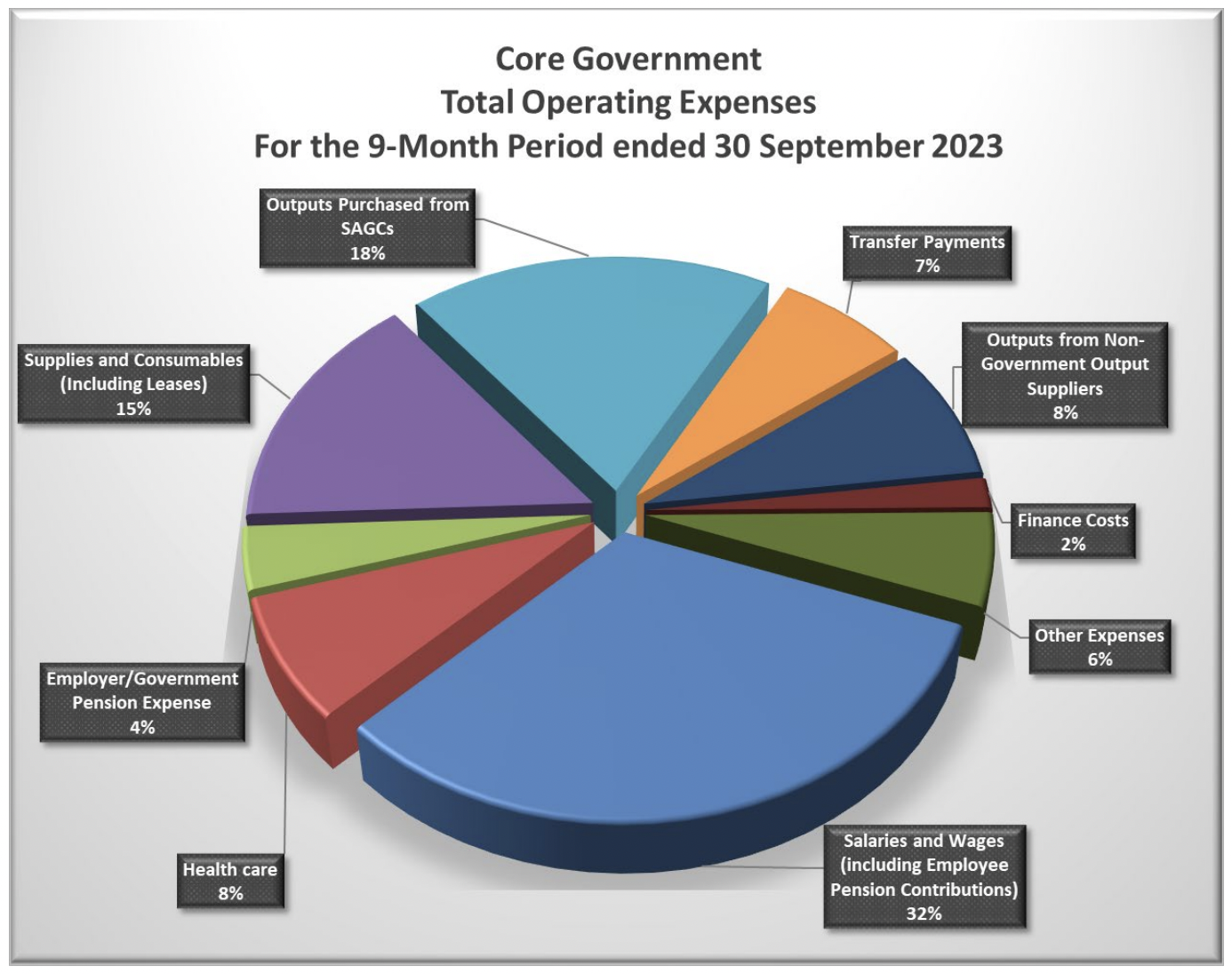
Personnel costs for the first nine months of 2023 amounted to $323.6 million, resulting in a savings of $20.7 million when compared to a budget of $344.3 million.
“This favourable variance is the result of vacant posts across several ministries, portfolios and offices,” the report says.
Expenses for supplies and consumables excluding leases were $102 million, creating an underspend of $2.6 million compared to budgeted costs of $104.6 million.
The report also details numerous overspends to date this year.
Outputs from SAGCs of $136.2 million were $12.6 million more than the anticipated year-to-date budget of $123.6 million.
Payments to the Cayman Islands National Insurance Company and the Health Services Authority exceeded their year-to-date budgets by $3.8 million and $8.6 million.
“The variance with respect to CINICO is due to higher than expected actual costs for the health insurance for civil service pensioners,” the report says.
Meanwhile, the Health Services Authority overspend was due to actual costs for the care of indigents exceeding the budget ($8.8 million negative variance) for this category.
Outputs from non-governmental suppliers of $60 million were $21.7 million more than the year-to-date budget and $4.9 million more than the same period last year.
The increase is mainly due to expenditure on tertiary health care at local and overseas institutions being $24.5 million more than its year-to-date budget, the report says.
Transfer payments of $50 million were $10.3 million more than budgeted for the nine-month period.
This variance was mainly due to the overages in spending on scholarships and bursaries ($10.5 million negative variance) and financial assistance ($4.1 million negative variance).
A very positive result was seen with SAGCs, which recorded a combined net operating surplus of $5.4 million for the first nine months of 2023.
This was $19.7 million more favourable than budgeted operating deficit for this period of $14.3 million.
This favourable variance was mainly attributed to results being better than expected at the Cayman Islands Monetary Authority, CINICO, the Civil Aviation Authority, the Maritime Authority, the National Roads Authority, and the Utility Regulation and Competition Office.
But it was partially offset by the unfavourable performance of the Cayman Islands Airports Authority, the Cayman Islands Development Bank, the Health Services Authority and the Water Authority.
SAGCs’ overall performance when compared to the prior year-to-date, was $20.6 million better.
Conclusion
The entire public sector surplus of $116.6 million was 68% or $47.1 million greater than the projected year-to-date operating surplus of $69.6 million, the report says.
This favourable position was due to actual revenues being higher than budgeted revenues by $49.5 million for the period.
Additionally, SAGCs contributed $5.4 million to the overall surplus for the entire public sector.
This exceeded their estimated results for the first three quarters of 2023 by $19.7 million, when compared to an expected deficit of $14.3 million.
Meanwhile, the government’s cash position ended at $582.1 million as of 30 Sept.
Cash and cash equivalents were $321.7 million more than anticipated in the 2022-2023 Plan and Estimates.
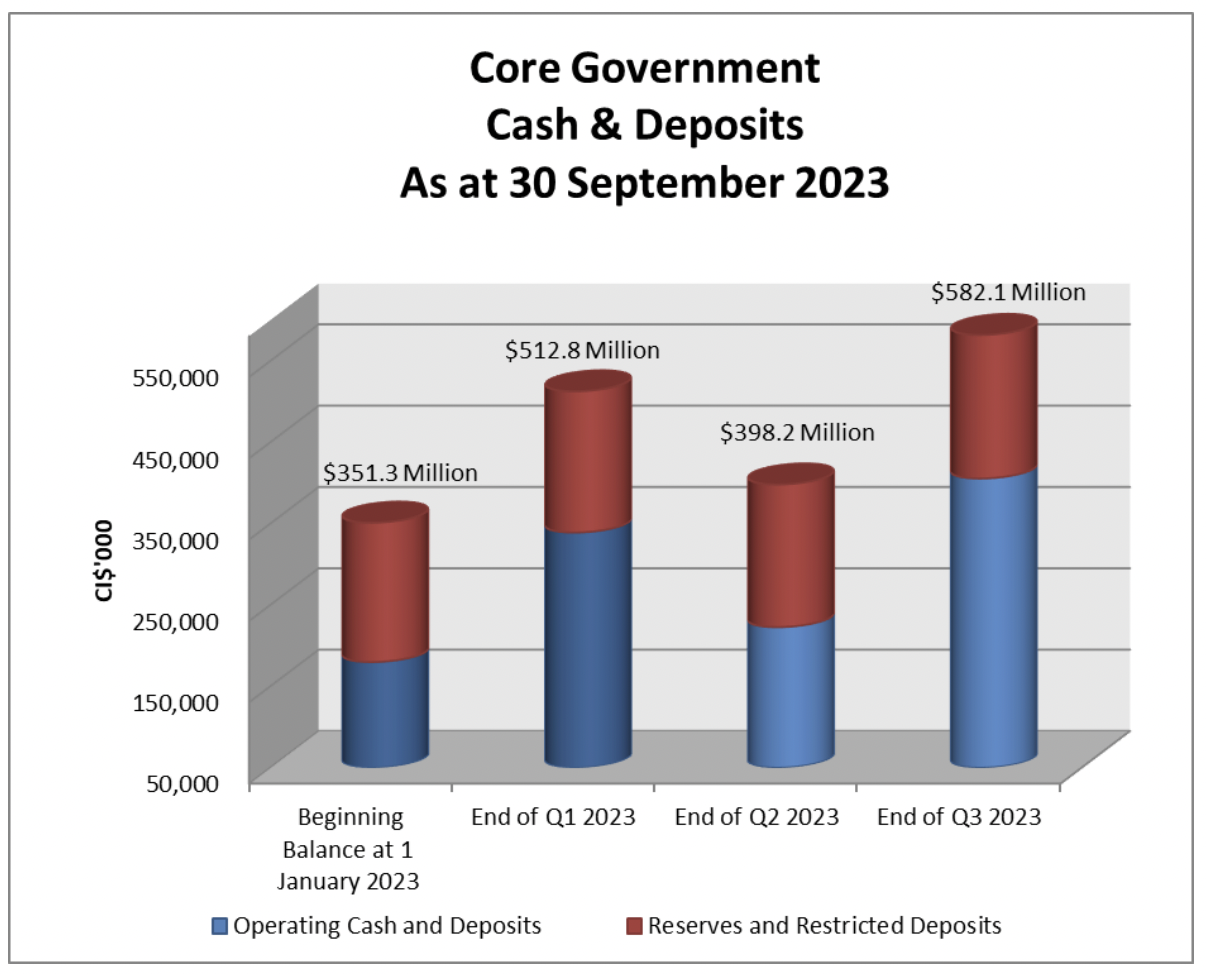
This was mainly due to the maturity of US government treasury notes, higher than expected revenues, and delays in capital projects in the prior year.
The report says the third quarter’s performance “has positioned the government to be optimistic about its financial performance for 2023”.
However, during the final quarter ministries, portfolios, offices and statutory authorities will all have to make a final push to meet planned 2023 objectives and deliverables.
“Should planned increases in activity materialise during the remaining months of 2023, the current surplus will be significantly reduced,” the report says.
“These costs will have to be diligently monitored to ensure spending is not incurred unnecessarily.”
Revenues must exceed the performance of $978.1 million for core government set-out in the original 2023 budget, it says.
This will enable it to reach the revised target of $1.037 billion detailed in the Strategic Policy Statement tabled in Parliament on 26 April 2023, the report noted.
Related Videos