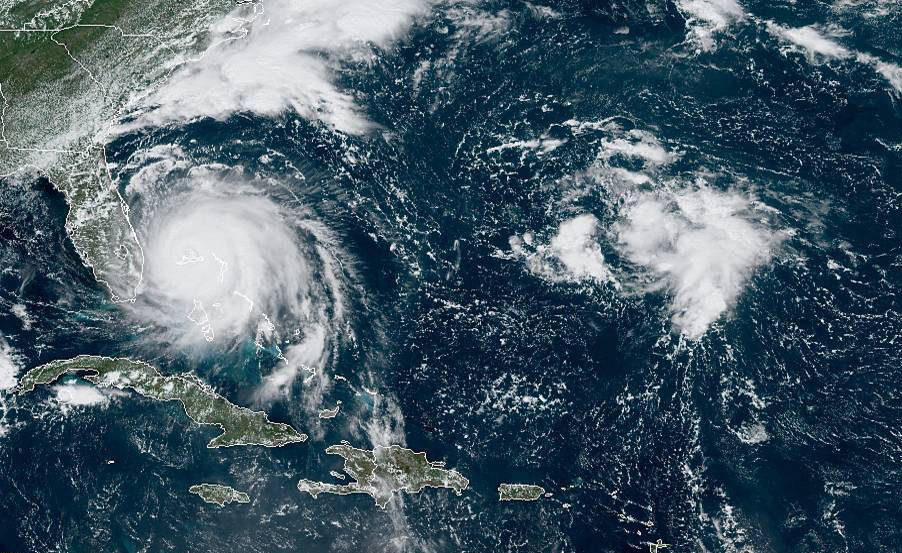
A newly published scientific paper has found that artificial intelligence could help to better predict hurricane landfall.
According to researchers, Google’s machine-learning tool GraphCast creates quicker and more accurate global weather forecasts than were previously possible.
“This ability has the potential to save lives through greater preparedness,” author Remi Lam said in a research article, adding the code is open sourced and available for free.
GraphCast joins other AI weather prediction systems from Google DeepMind and Google Research, along with regional forecasters Nowcasting and MetNet-3.
Simon Boxall, of Hazard Management Cayman Islands, which is responsible for Cayman’s disaster management programme, told the Compass he welcomed the new technology.
“While we strive to continuously evolve and improve, we rely, primarily, on official government sources for hurricane-related weather forecasts,” he explained.
The US-based National Hurricane Center is the World Meteorological Organization-approved centre of excellence for tropical cyclone forecasting for the Caribbean Sea region, including Cayman, Boxall said.
The WMO also recognises the Cayman Islands National Weather Service as the official forecaster for the jurisdiction, he noted.
“Obviously these official sources do not produce their work in a vacuum,” Boxall added.
“If artificial intelligence is proven to assist the forecasting capacity of the National Hurricane Center, it is almost certain they will incorporate this tool in their products.”
Deep learning
GraphCast delivers 10-day weather predictions of unprecedented accuracy in under one minute, according to the research paper published in Science on 14 Nov.
This surpasses the industry gold-standard weather simulation system – the High-Resolution Forecast produced by the European Centre for Medium-Range Weather Forecasts (ECMWF).
A 10-day forecast using this approach can take hours of computation on a supercomputer with hundreds of machines.
The AI model can also offer earlier warnings of extreme weather events and predict the tracks of cyclones with great accuracy further into the future.
“In a world of increasingly extreme weather, fast and accurate forecasts have never been more important,” Lam wrote in his research article.
He explained that medium-range predictions are important to support decision-making across sectors, but are difficult to do accurately and efficiently.
Forecasts typically rely on Numerical Weather Prediction, which begins with physics equations that are then translated into computer algorithms that run on supercomputers.
This is time-consuming, requires deep expertise and is costly, Lam said.
“Deep learning offers a different approach: using data instead of physical equations to create a weather forecast system,” he added.
Boxall told the Compass that, from HMCI’s perspective, “anything that gives us more lead time to prepare the population for a possible hurricane impact is, of course, welcome”.
But the predictive capacity of AI for weather forecasting is based on past model data, he said.
“To a certain extent, in the context of climate change, we are witnessing a new ‘normal’, especially relating to the speed of tropical cyclone intensification.
“As the traditional models improve – so will AI’s ability to accurately anticipate things like landfall location.”
Weather agencies are already using GraphCast, including ECMWF, which is running a live experiment of the model’s forecasts on its website.
The Atlantic hurricane season runs from 1 June to 30 Nov.
Related Videos