


Cayman’s temperatures have been soaring near record levels in recent weeks, and it appears the scorching heat will not let up any time soon as rainfall projections remain relatively low for the coming weeks.

National Weather Service Chief Meteorologist Kerry Powery Linwood, speaking with the Cayman Compass on Tuesday, said the community can expect the heat to continue.
“We haven’t had any good showers,” Powery Linwood said. “Unfortunately, although we see the models are hinting that all the parameters are there [for rain], they’re just not lining up together to give us the break that we need. That plus the sea temperatures around the area are still running kind of high from last year.”
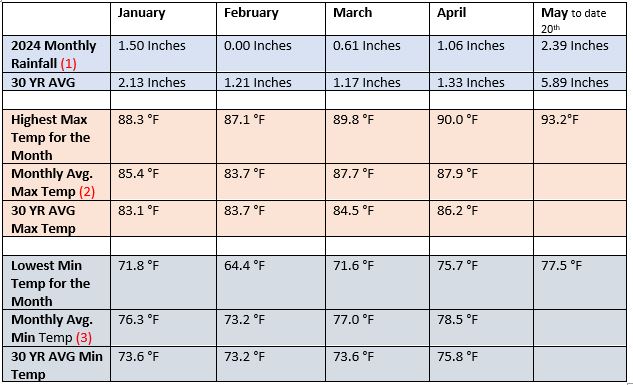
So far, May has recorded the highest temperature for the year at 93°F, with April coming in second at 90.0°F, based on the latest National Weather Service climate data shared with the Compass.
Three of four months this year have had monthly average maximum temperatures that exceeded the climatological average with the remaining month matching the average.
A weather report indicates, “we are having hotter days and hotter nights”.
It said the inability to effectively cool down at night is contributing to the hot temperatures during the day.
“One possible cause of this inefficient cooling at night may be the warm sea surface temperatures which have been rather warm since last year,” the report added.
As for rainfall, only 2.39 inches of rain was recorded this month as at 20 May. This low figure still represents the highest monthly volume collected year to date.
“Rainfall so far this year is below the climatological average expected for the month,” the report added.
No let up for heat conditions
May temperatures have been sweltering with heat indexes of 103°F almost daily.
Temperatures for the rest of this week are forecast to reach 90°F during the day with a slight chance of isolated showers.
Powery Linwood said the National Weather Service is working on metrics to better advise the community on extreme heat conditions and has started including heat index projections with daily local forecasts.
Temperatures in April, he said, surpassed the recorded average, based on 1981 to 2020 data, and May has continued with the high temperatures.
“Our lowest temperature [in April] was higher than the 30-year average. Even our lowest maximum temperature is like half a degree lower than our climatological average,” he said. 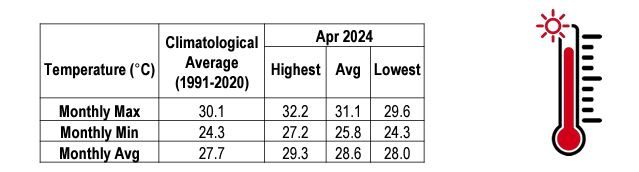
The average temperature recorded for February, March and April at Owen Roberts International Airport was 26.9°C or 80.4°F.
April’s average temperature was 28.6°C or 83.5°F. That’s 1.6°C above the climatological average.
The National Weather Service Climate Bulletin projects a 30% chance of experiencing heat waves in May and an 80% probability of above-average temperatures.
Powery Linwood said conditions will be transitioning from El Niño to La Niña later on in the year and it is during these transition periods that temperatures tend to be higher and rainfall tends to fluctuate.
The climatological outlook through July, he said, projects that rainfall should be up to about 60% above the climatological average.
Until then, however, the dry conditions should continue.
The Caribbean Climate Outlook Forum, in its Heat Outlook for May to October 2024, stated that near-record heat can be expected until October, particularly in August and September.
It said the heat impact potential from May to July 2024 was moderate for the Cayman Islands with 20-50% of the time spent in heatwaves.
Protect against the heat
Powery Linwood urged residents to take steps to protect their well-being when outdoors, whether for work or leisure. He said residents should keep properly hydrated.
“We are dealing with the heat but we also have the sun rays, so you need UV protection and also ventilation,” he said.
Powery Linwood urged workers toiling in the hot sun to ensure they take steps to keep cool and take breaks when the heat becomes too much.
“If you feel faint or anything, take a break and try to gradually cool yourself down because even quick cooling down could have a severe effect. You could have heatstroke or even fainting because of the changes in the body temperature. You won’t be able to regulate that change, so you’ve got to be careful,” he said.
Related Videos












With an extra active hurricane season this year hopefully we will get plenty of rain in Oct/Nov.