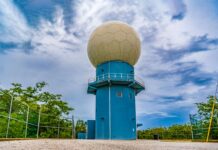
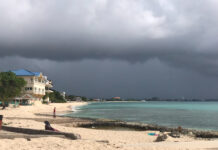
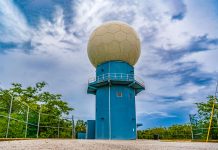
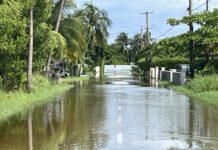
With the hurricane season now winding down, the Cayman Islands National Weather Service has embarked on a mission to upgrade a number of its capabilities, including upgrading the ageing Kearney Gomez Doppler Radar in East End.
The radar, a key infrastructure in the National Weather Service arsenal, has suffered several breakdowns over the past couple of years, the most recent of which occurred late last year and lasted a few months due to the challenge of securing the needed parts for repairs.
In October 2021, the radar was damaged in Tropical Storm Grace and was out of service for nine months before being restored in July 2022. It was also inoperable from March to May last year due to a hardware failure.
Experts from German-based company LEONARDO worked with the weather service team on the Doppler’s recent repairs.
LEONARDO also originally installed the radar, located at High Rock, East End.
Long road for radar
The radar, now nearing 12 years old, was repaired in May, just in time for the start of the 2024 Atlantic hurricane season.
The weather service has issued a request for proposals on government’s Bonfire procurement portal to secure a project management agency to oversee the comprehensive execution of the radar upgrade project.
The weather service, in response to Cayman Compass queries on the RFP, said that the planned upgrade to the Doppler radar “is a key component of our ongoing efforts to enhance the Cayman Islands’ meteorological services”.
The Doppler radar first became operational in 2013 and has a lifespan of 15 years.
The system was built by LEONARDO and funded through a grant provided by the European Union in 2012.
“This upgrade will significantly improve our ability to monitor weather conditions, leading to more accurate and timely weather data. Such advancements are vital for increasing public safety and enhancing our proactive response capabilities during weather-related emergencies. We will provide more details on this critical project as the procurement process concludes and approvals are obtained,” it said via emailed comment.
Earlier this month, a government statement said that Cayman’s radar provided vital information locally and to the US National Hurricane Center as Hurricane Rafael battered the Sister Islands.
The government statement said that the Doppler radar data offered valuable, real-time insights into Rafael’s “intensity, wind patterns, and precipitation, allowing meteorologists to track its structure and evolution closely”.
“In support of the critical information reported by the National Hurricane Center, data reported from the doppler radar in conjunction with findings made by the Hurricane Hunters improve the accuracy of projected storm paths and intensity forecasts. This is especially crucial when forecasting for a developing system such as Tropical Storm Rafael and Hurricane Beryl, the first storm to impact the Cayman Islands this season,” the statement had said.
The Doppler radar can detect moisture and water droplets up to 250 miles away from the Cayman Islands and the encircling sea.
Additional upgrades planned
Apart from the radar, the National Weather Service is also seeking additional advancements for its weather-predicting tools.
It is seeking to “procure and configure a state-of-the-art Centralized Weather Data Integration Platform that integrates diverse meteorological data sources to enhance forecasting and emergency response capabilities across the Cayman Islands”.
The platform, it said, will be pivotal for real-time decision-making and strategic planning.
It is also seeking proposals for the project management of the Cayman Islands Weather Sensor Network Project.
“This project aims to establish a comprehensive and integrated weather sensor network across the Cayman Islands, enhancing meteorological data accuracy and emergency response capabilities,” the RFP for the project stated.
It said that the objective is to “implement and manage a phased deployment for the sensor network, ensuring alignment with the Government’s strategic goals for improving public safety, resilience, and infrastructure modernization.”
The weather service is also seeking proposals to supply and install storm surge sensors at strategic coastal locations throughout the Cayman Islands.
“The enhancements will substantially improve our framework for monitoring weather conditions, leading to more precise and timely weather data for the Cayman Islands. This is crucial for enhancing public safety and our capacity to respond proactively to weather-related emergencies. Further details on the project will be provided once the procurements are finalised and approved,” an emailed comment from the weather service said.
All of the RFPs for the varying upgrades to the National Weather Service systems have been posted to government portal Bonfire.
The costs of these upgrades have not been made public as they are out for tender.
Related Videos