


While Cayman Airways President and CEO Fabian Whorms has confirmed that 70% of the revenue has been collected from the soon-to-be-discontinued Cayman-Barbados route, he has declined to publicly release the amount received due to “commercial sensitivity”.
Instead, Whorms, appearing before the Public Accounts Committee on Thursday, offered to share the number with legislators in an in-camera session after the hearing.
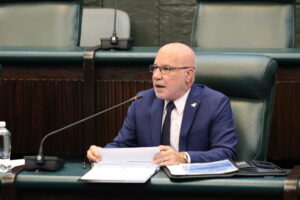
PAC member McKeeva Bush, when the issue was raised, also cautioned against divulging the commercial agreement.
Whorms, addressing questions on the route from PAC chair Roy McTaggart, said that CAL has made a “level of profit” from the venture.
Whorms said the revenue from the route has given the airline some assurance that should it need to go to government or shareholders to bridge a shortfall in revenue for this fiscal year, “we know that number is now going to be so much smaller because we can apply the profits that was earned from this”.
Whorms, speaking on Thursday on the Auditor General’s recent performance report on Cayman Airways, also sought to address “misconceptions” about the route.
He said he was pleased that Barbados’ route revenue, generated partially from ticket sales and a Barbados Tourism Marketing Inc. subsidy, has been collected for the route, but making the figure public could have implications due to the competitive nature of the aviation business.
“I’m not going to say that we have made good money, but if we did, that’s not something for us to boast about.
“It doesn’t suit us, because tomorrow there may be another jurisdiction that would like us to work strategically with them, because there are many jurisdictions that don’t have the benefit of their own national airline that can be used strategically, but we do,” Whorms said.
He said if Cayman Airways can partner with another another country that would like to share some of its load and “some of the government’s load with Cayman Airways, I don’t see that as a bad thing”.
A ‘good deal’
Last month the Barbados Tourism Marketing Inc. pulled the plug on the gateway that had been operating since October last year.
The twice-weekly flights, which were billed as a milestone for inter-Caribbean travel and a service that would open up new connections for Cayman travellers to Europe, has been reduced to once weekly and will end on 3 July.
The announcement of the end of the route came weeks after Cayman Compass revealed that just 34 passengers per flight were using the service – enough to fill only six rows of Cayman Airways’ 176-seater jets.
Whorms said the national flag carrier ensured the contract it entered into with the Barbados government was “bulletproof” and that the costs were covered for the route.
“We did not go into it blind. It was not a decision to address a request from BTMI to start this service that was agreed to by any singular person. We have a board of directors with 12 very capable minds. Everybody was able to analyse it. We went into it with five or six key objectives [and] that those criteria had to be met,” he said.
Among the objectives, he said, was the route would not be at the detriment of the rest of the airline service, there should be “no opportunity costs” and that it should not hinder any current service or future plans.
“You will find that these flights were scheduled on days of the week and times of the day when it had no impact. There’s nothing else we would have done with the aircraft or our crews,” he said.
The aircraft and crews, he said, were put to use in a scenario where there was guaranteed coverage of variable costs to operate the route and fully allocated costs.
“Many of our routes do not cover their fully allocated costs, so they operate profitably when you look at the direct variable coverage, but not profitably when it’s fully allocated,” he explained.
Whorms said the national airline often faces unfair criticism, but he said the objective remains to provide quality service to the islands.
He took aim at critics who had challenged the lease agreements that the airline entered into for the Max 8 aircrafts, saying that both the Barbados route and the existing lease agreements are “good deals for the people of the Cayman Islands”.
He said the airline enjoys a “preferential” market rate for its aircrafts.
With the Barbados route, he said, the airline built into the contract a margin of profit that was consistent with the margins that are built into any charter service it does.
“Although it was not officially called a charter, in essence, the application of it was no different from a charter with respect to payment; there is a quarterly payment schedule. When we look at the duration of time that the service will operate, we have already collected 70% of the revenues that are to be generated from the route,” he said.
The Barbados government through BTMI, he said, actually contributed to Cayman Airways to a degree that relieved some of the burden that the Cayman Islands government was solely carrying.
“There’s a persistent perception that this is not the case, and I would like it to stop. Again when we went into it, this was my only concern – that there would be this perception. But we have come out before, and we have said that our costs are covered,” he said.
Barbados made the call
Whorms also clarified that it was a decision of the BTMI to end the route and not the national airline.
He commended the Barbados government for putting their money where their mouth was and “put some skin in the game” to explore an arrangement that would create Eastern-Western Caribbean connectivity.
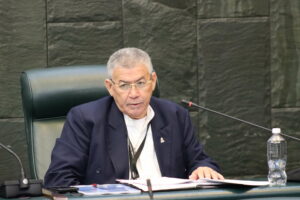
Whorms said from the beginning, the loads were not what had been expected, and the airline anticipated this, “but we knew we were protected.”
The BTMI, he said, stuck with its strategy for connectivity until they did a reassessment recently of their airlift, which has also “considerably improved”.
“There are now other entities like inter-Caribbean that’s providing direct service from Kingston to Barbados four times a week, which was not happening when we were there and we fly to Kingston, and we actually connect with those flights. So now their objective of having that east-west connectivity all the way through to Grand Cayman is being achieved,” he said.
Whorms said BTMI gave two months notice, which was a feature of the contract, and “during that notice period we agreed that we would reduce the service to reduce their exposure, which is totally reasonable”.
He said a similar two-month notice option was open to Cayman Airways if shareholders wanted to utilise the aircraft for another service.
“We did not engage into something, neither did they, where we were overly committed and could not get out if it didn’t work. So, they choose to give the notice for financial reasons,” he said.
Related Videos










Was the Barbados route all that was discussed, what about the humongous loss the airline incurred last year when you add the large annual subsidy to the even larger Govt equity contribution?.
We know this was a bad idea and despite assurances on “profit” the full revenue and costs are not being presented. This makes it very hard to take as being correct. Also, CAL and CIG have failed to factor in the opportunity costs incurred on this route. Cayman as a whole could have benefited from more convenient travel times and higher stay-over tourist numbers if the aircraft had been used on flights into Miami or another hub in the USA, or perhaps even Canada.