

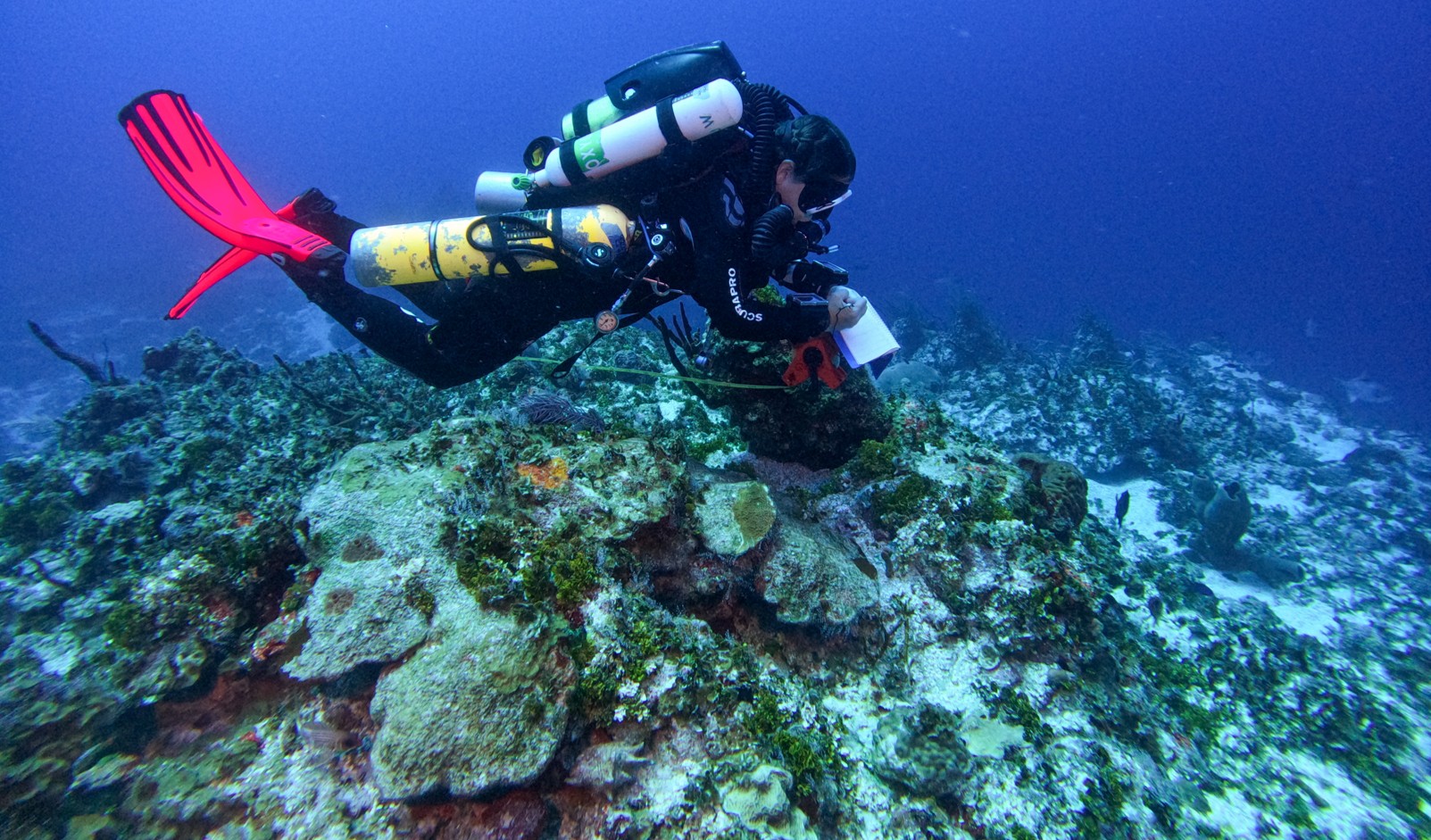
Dotting Cayman’s sea floor are a series of underwater mountains, known as seamounts, and yet, other than fishermen, not many people in the Cayman Islands know about them, and even fewer have visited.
Jack Johnson, a scientist from the Central Caribbean Marine Institute in Little Cayman, is part of an expedition, led by CCMI’s director of research Gretchen Goodbody-Gringley, to explore two of these seamounts, which rise up at least 3,000 feet from the sea floor, at Pickle Bank and the 12-Mile Bank.
The scientists, Johnson said, are conducting their research in the 100- to 150-foot depth range.
“This is the first time that either of these two seamounts have been researched by scientists using scuba gear,” Johnson said, referring to CCMI’s ongoing work.
“We used closed circuit rebreathers and other specialist technical diving equipment, because this is below the safe recreational diving limit.”
Exploring untouched coral formations
Coral reefs are in serious decline worldwide, and these isolated undersea mountains provide hope that they are far enough away from land-based sources of pollution, such as pesticides, fertilisers and other chemicals that are killing corals and making them more vulnerable to disease.
“Coral reefs cover less than 0.1% of the world’s sea floor and yet they are home to 25% of all marine life,” Johnson said.
“The world’s reefs are in trouble. … Significant global bleaching events linked to warming sea-surface temperatures occurred in 1998, 2010 and 2015 and unfortunately, Cayman’s reefs were not spared. In the shallow marine environment in Little Cayman, live coral coverage decreased from 25% in 2023 and dropped to just 9% in 2024.”
On one of the research dives on the banks, the researchers were excited to come across a healthy pillar coral. According to the scientists, there are only two or three known specimens of this type of coral left alive in Grand Cayman.
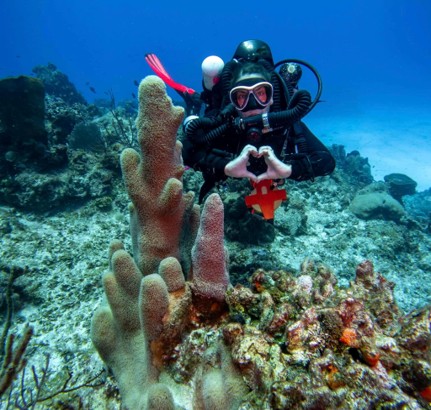
“It was a cause for great celebration for the dive team when they came across this example of a healthy pillar coral,” he said.
“They didn’t see any signs of the stony coral tissue loss disease (SCTLD) on the banks.
“This disease has been decimating the hard corals, especially in Grand Cayman and throughout the Caribbean region, and we know that pillar corals are particularly sensitive and vulnerable to this disease, so it made us feel hopeful that these offshore banks are providing a safe refuge for genetic diversity.”
What they found in the 100- to 150-foot range at 12-Mile Bank and the Pickle Bank is that these seamounts are primarily covered in marine algae with coral representing just 3% to 4% of the sea floor.
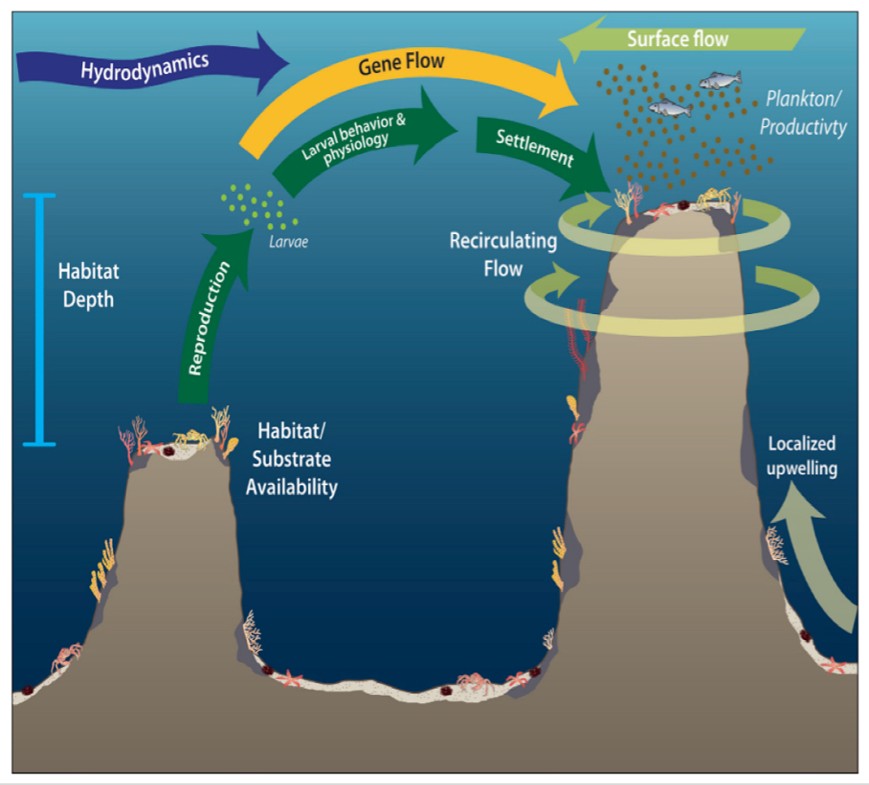
“The seamounts are typically affected by strong currents, which makes it hard for juvenile corals to secure a foothold on the seabed and, in fact, the currents were so strong that the researchers ended up using underwater scooters to enable the scientific studies,” Johnson said.
Mapping efforts and DNA analysis
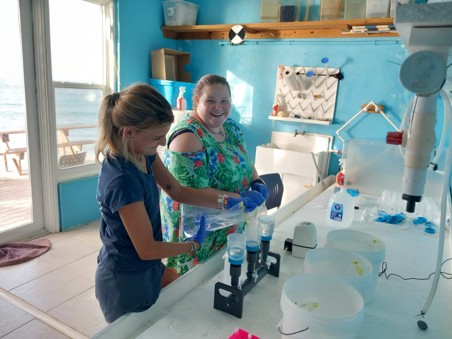
In addition to exploring the coral coverage on the seamounts and recording the different species of fish they encountered, researchers also took water samples.
“We can take these water samples back to the laboratory, and it is possible to extract the DNA and actually identify the different species of fish that have recently been swimming in the water column on the bank,” Johnson said.
“The Smithsonian Tropical Research Institute will be processing this information from the environmental DNA.
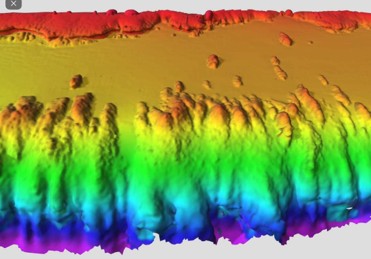
“Additionally we were joined by a mapping team from the University of Delaware, and they used sonar technology to create three-dimensional maps of the banks, at less than 3-foot resolution.”
“The Cayman Islands wouldn’t exist without the coral because the reef crest helps to break the waves,” he said.
“In addition to providing protection from storms, the reefs also have important recreational and economic benefits from things like fishing and snorkelling, which are activities enjoyed by both locals and visitors.”
The scientists found that the corals were comparatively healthy on the banks. They also found that there were higher concentrations of certain larger predators and carnivores such as groupers, snappers and big jacks.
“This makes sense because there is less fishing pressure on these seamounts because they are out of reach and too far away for most,” explained Johnson, who said they also found there was more marine life on the north sides of the seamounts than on the southern sides.
“Fishing is important. We don’t want to be taking away people’s food and income, but we hope our work will provide a baseline for further research and perhaps will contribute in the future to a management plan for the seamounts and inform decisions about things like marine parks and the production of a biodiversity action plan.”
He added that the Cayman seamounts may be an important refuge for corals and fish.
“Of course, we are aware of areas where the fish stocks have been almost completely wiped out in the region,” he said, providing the waters around Jamaica as an example.
“They have all been eaten, including the parrotfish and the doctor fish, which eat the algae, so in these areas, algae has taken over the reef and the corals have died as a result.
“There are large areas that used to have living corals and fish, and now there is nothing; they are just dead zones. We certainly don’t want that to happen here in the Cayman Islands.”
Related Videos










Divetech started certified technical diving trips to 12 Mile Bank & Mysteriousa Banks dating back to 1994. Divetech specialized in rebreather diving to depths of 300 feet for certified technical divers from around the world.
At 12 Mile Bank, Divetech found a ship wreck on top of mound on the east side at 130 feet. Usually with Tuna & Sharks inside the wreck.
The reefs and marine life on the Banks are extremely pristine, especially on the north side of the Banks.