


Recent earthquakes in the region may have raised the threat of an earthquake occurring near the Cayman Islands, according to a US-based catastrophe-modelling company.
However, a report commissioned by the Cayman Islands government after the 2020 earthquake in Cayman concluded that local building codes, along with robust enforcement measures, mitigate the risk for structures here.
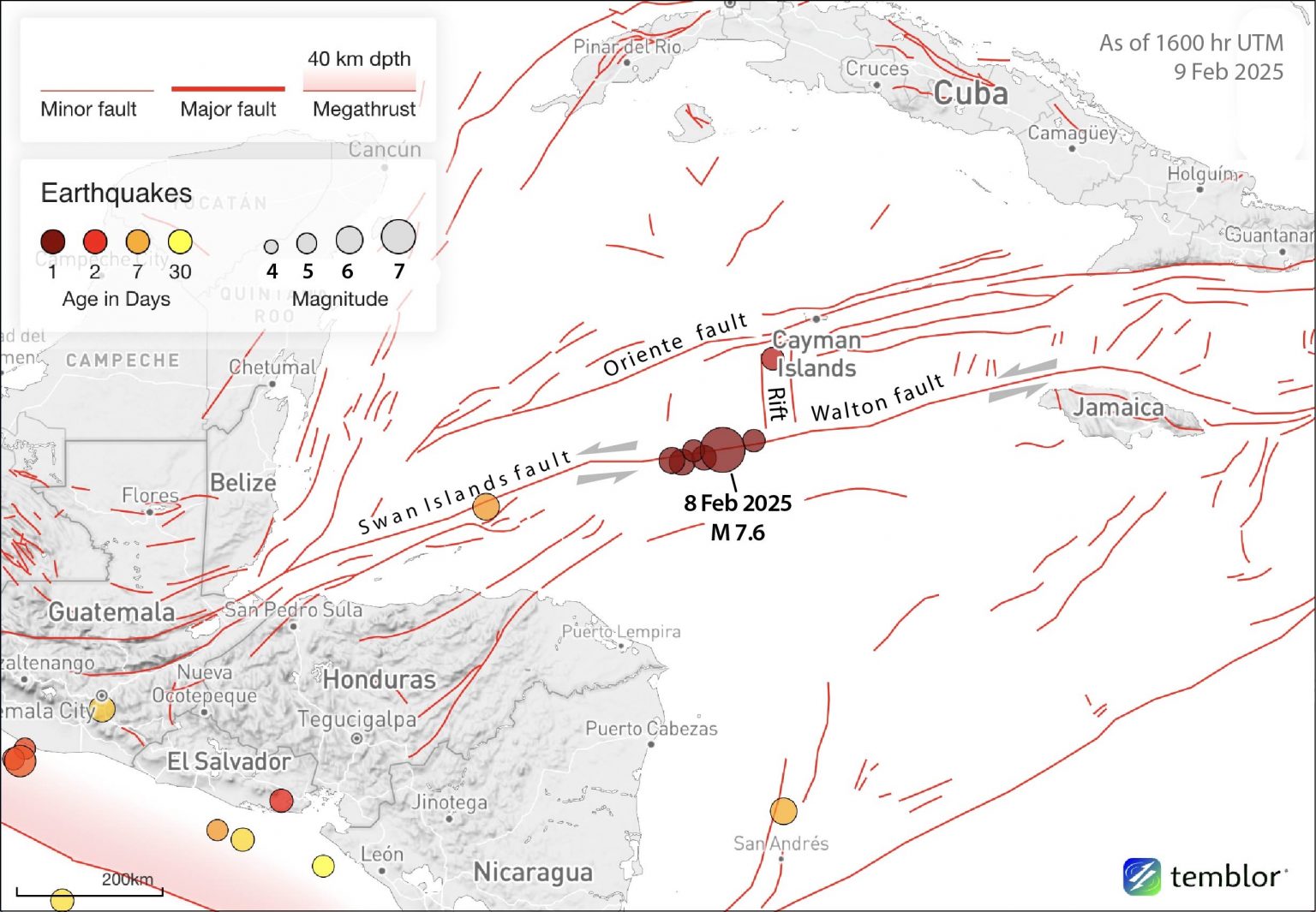
Temblor, Inc. recently issued a report suggesting that the 7.6 magnitude earthquake that occurred 130 miles southwest of George Town on 8 Feb. may have transferred additional stress eastwards along fault lines that run south of the Cayman Islands.
The earthquake, which occurred on the boundary between the North American and the Caribbean tectonic plates, caused no damage in the Cayman Islands, but briefly resulted in a tsunami alert for the region.
Temblor, founded in 2014 by former United States Geological Survey scientists, specialises in seismic hazard and risk assessment. The company serves the insurance, reinsurance and insurance-linked security communities.
The author of the paper, Ross S. Stein, is Temblor’s CEO and cofounder as well as a lecturer of geophysics at Stanford University and a former USGS senior scientist.
In the report, Stein suggests in a map format that the recent earthquake may have resulted in small stress increases on the Oriente transform fault, which runs south of Grand Cayman and the Sister Islands, and increased the probability of additional smaller earthquakes occurring along the short spreading centre, where the two plates spread apart closer to Grand Cayman.
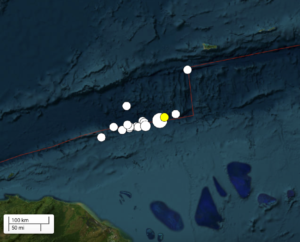
Stein uses what are known as Coulomb stress calculations to determine how stress has been transferred along fault lines after an earthquake.
Local attorney Colin McKie recently submitted a freedom of information request to obtain a copy of a seismological report that was commissioned by the Cayman Islands government, following the 7.7 magnitude earthquake that occurred approximately 80 miles east of the Sister Islands on 28 Jan. 2020.
The report, ‘Probabilistic Seismic Hazard Assessment at the Cayman Islands’, was shared with the Cayman Compass. The findings were produced by the EuCentre and Global Earthquake Model foundations.
According to the report’s conclusion, “the Cayman Islands are exposed to a moderate seismic hazard”, but noted that the building codes in the Cayman Islands are appropriate for the risk.
Within the last 21 years, there have been five significant earthquakes reasonably close to the Cayman Islands: a magnitude 6.8 event on 14 Dec. 2004, magnitude 7.3 on 28 May 2009, magnitude 7.5 on 10 Jan. 2018, magnitude 7.7 on 28 Jan. 2020, and magnitude 7.6 on 8 Feb. 2025.
While strong shaking was felt in the Cayman Islands during the 2020 earthquake, none of the tremors resulted in significant damage to local structures.
Related Videos








“…a report commissioned by the Cayman Islands government after the 2020 earthquake in Cayman concluded that local building codes, along with robust enforcement measures, mitigate the risk for structures here.”
The above statement is not only misleading, it is false. Cayman buildings are primarily designed to withstand hurricane forces, but do not typically incorporate specific earthquake resistant features.
While both hurricane and earthquake building codes aim to protect structures from natural disasters, the key difference lies in the forces they are designed to withstand: hurricane codes focus on resisting high winds and wind uplift, while earthquake codes prioritise resistance to lateral shaking and ground movement, requiring different construction techniques like reinforced shear walls and flexible foundations to accommodate the distinct forces involved.
I don’t believe every building in Cayman, residential or commercial, is built to the earthquake codes (if they even exist).
I don’t believe there is an expertise in Cayman to monitor and enforce the compliance. Does Cayman even have Geotechnical engineers ?
Good article to read: “Here’s why some structures fell in the Alaska earthquake and others didn’t, and how that came to be” Published: December 4, 2018 in Anchorage Daily News.