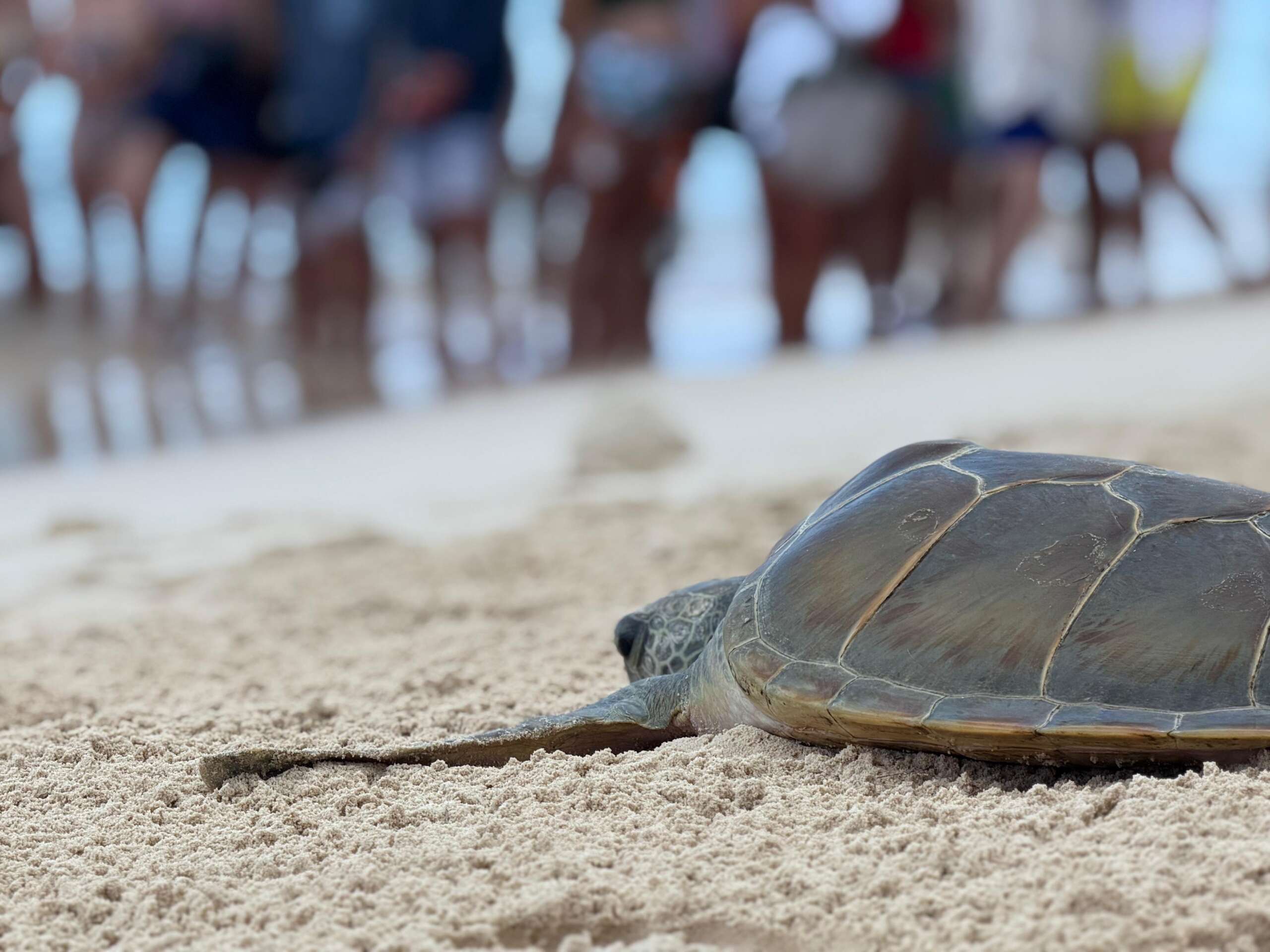
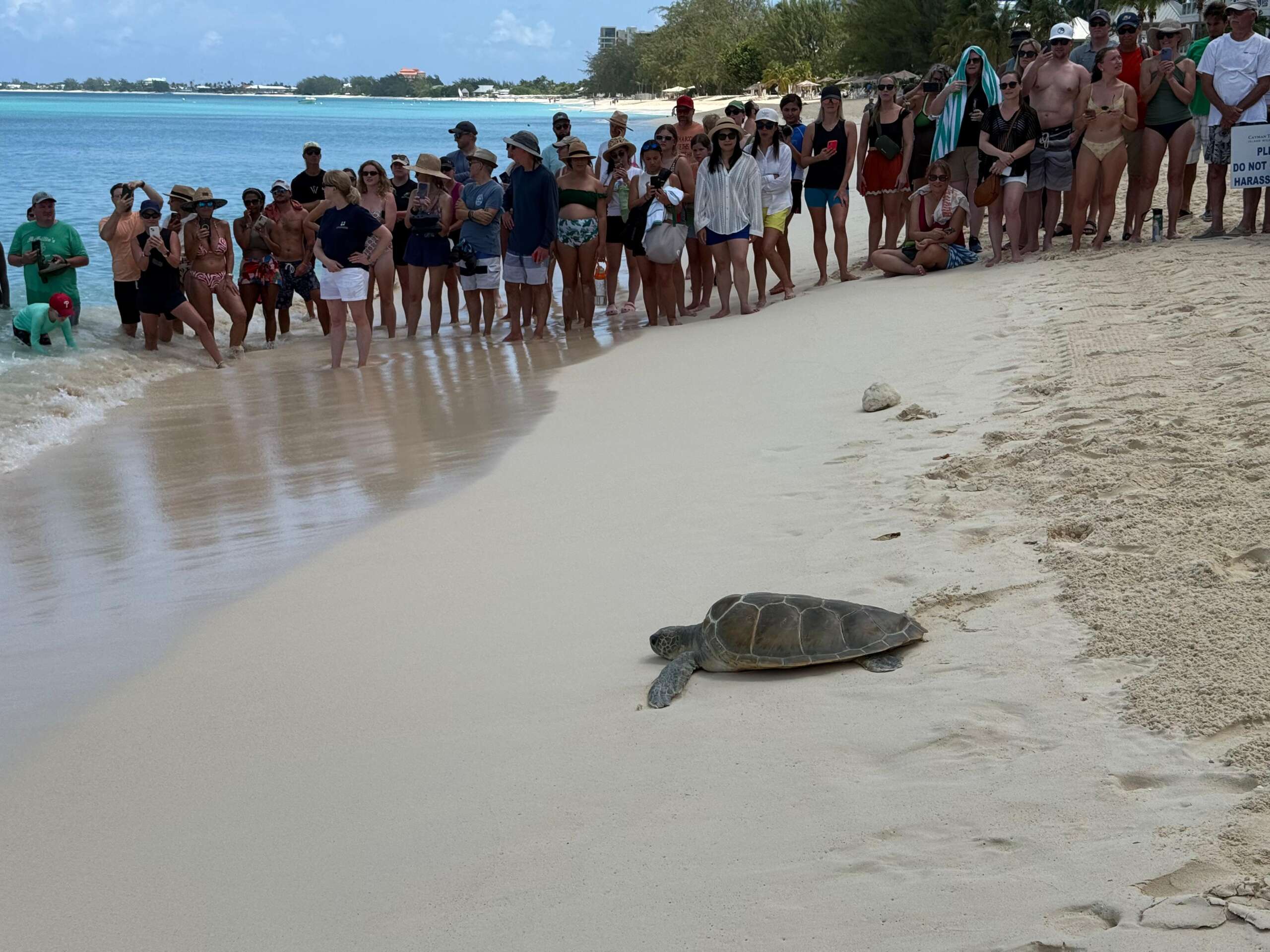
A crowd of spectators gathered on Governors Beach Monday morning to witness and celebrate two green sea turtles being released into the sea, in celebration of World Sea Turtle Day.
From a distance, onlookers watched the turtles being released, the second of three such public events being held this year, hosted by the Cayman Turtle Centre.
Shona McGill, assistant curator of educational programmes at the centre, told Compass TV, these turtles are a part of the centre’s initiative known as ‘head started’ sea turtle release, giving them an advantage as they go into the wild for the first time.
“They stay at the centre for a couple of years, as they wait for their shell to fully harden in that way, they greatly reduce their predation risk out in the wild and increase their odds of survival,” McGill explained.
‘An impressive feat’
The centre aims to release at least 500 turtles a year, but McGill said that changes based on variables.
“A lot of times our turtles go through a quarantine period before we release them,” she said, explaining that included sending samples to get them cleared to release, a process which takes time.
Over 36,000 green sea turtles have been released so far, McGill said, calling that “an impressive feat”.
“Although sadly these guys do face a lot of threats in the wild, whether we’re talking about coastal erosion, climate change, marine pollution especially for sea turtles and natural predation, so the survival rate in the wild for sea turtles is one in one thousand, which is very low,” she said.
Of the four different species that can be found in the waters around in Cayman, three nest here – the green, the loggerhead and the hawksbill.
“All species of sea turtles are important in some way … the health of our oceans. Without them, we wouldn’t have our oceans and without the oceans, we wouldn’t have us either. Fifty percent of the oxygen we breathe comes from there, so we very much rely on green sea turtles for the health of everything that lives out in the ocean, but us too. I think that it’s fair that we celebrate them with their own World Sea Turtle Day and thank them for all the work that they do out there.”
McGill said there’s a lot members of the public can do to help.
“[W]e can all be conservationists at home, so we can all do your part, limit your use of plastics, pick up trash whenever you see it and also try to limit your carbon footprint as well.”
Education component
Geddes Hislop, curator for terrestrial and education programmes at the turtle centre, told Compass TV, the day is more than just celebrating the release of the sea turtles, but what comes after is more important.
“By conserving the sea turtles, you have to conserve its habitat and that benefits us, because cleaner reefs and habitats means happy divers, happy fishermen, and that ultimately benefits everyone else as well.”
He said, “The education component is really important, letting people know what we do and why we do and hopefully they would support us in other ways.”
“We do a lot of research, which is part of the education component because we want people to know that researchers come from all over the world to little Cayman Islands to study sea turtles because of the programmes that we do, so the conservation part is also sharing information with the world as well as locally.”
Related Videos