

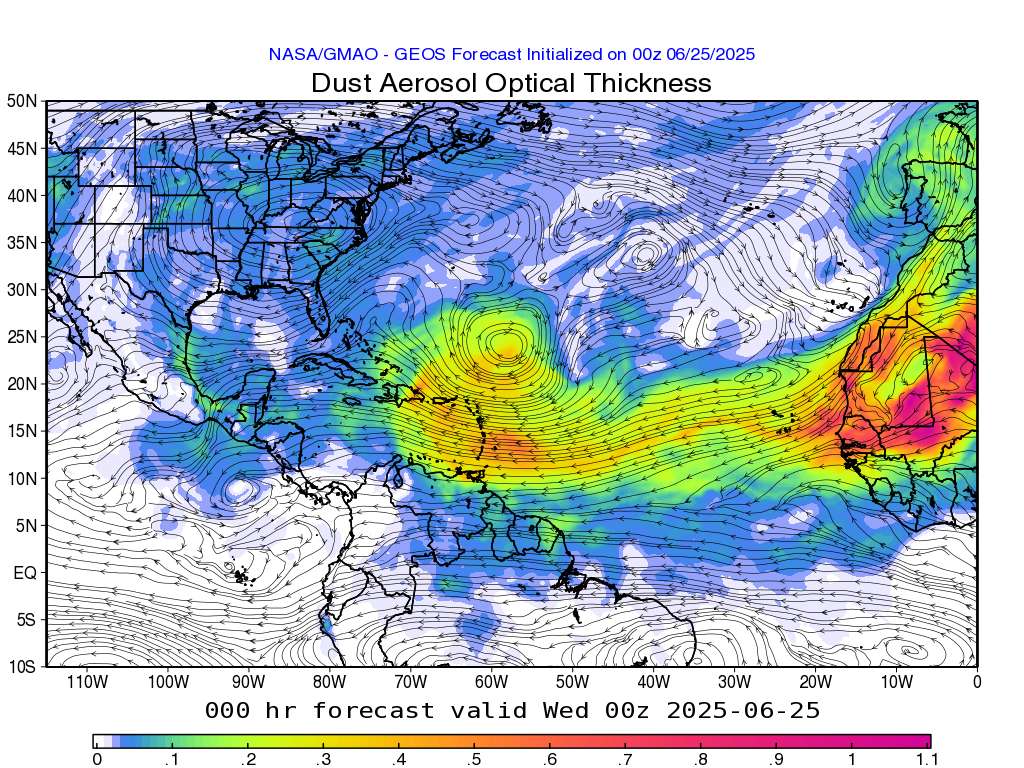
A large plume of Saharan dust that came off the west coast of Africa has moved across the Atlantic Ocean and has now entered the Caribbean Sea.
Over the coming days, the dust plume will enter the atmosphere above the Cayman Islands, causing the sky to look hazy.
Saharan dust plumes are normal and fairly frequent at this time of year. In the early part of the summer, they bring a silver lining: the dust plumes create dry air conditions in the atmosphere, which in turn inhibits the formation of tropical cyclones.
The dust, however, can cause air quality issues. While often the dust remains too high in the atmosphere to affect conditions on the ground, it can move lower in the atmosphere, affecting people with respiratory issues.
An air quality sensor located in Grand Cayman showed on 25 June that the island, which normally enjoys excellent air quality, had an elevated level of particulate in the atmosphere.
In June 2020, a Saharan dust event nicknamed ‘Godzilla’ reached the Caribbean region with such exceptional levels of dust that it prompted the Cayman Islands Public Health Department to issue a statement, saying, “Conditions could potentially increase symptoms in persons with asthma, and other respiratory illnesses due to the elevated dust and particulate matter concentrations.”
At the time, persons with respiratory illnesses were advised to “stay inside as much as possible and contact their healthcare provider if they experienced any difficulties”.
While typically the concentrations of atmospheric dust do not reach such high levels, the Cayman Compass reported that the same large dust plume in June 2020 also forced the Mosquito Research and Control Unit to pause its aerial spraying operations, despite a surge in the mosquito population.
“This is to prevent material released by MRCU planes binding to the dust and rendering that material much less efficient in controlling biting mosquitoes,” Compass reported at the time.
Science behind Saharan dust plumes
The single largest source of dust on planet Earth is the Sahara Desert, which has a vital role in providing nutrients for plants and the marine environment in our own region.
The National Geographic notes, “The mineral fragments that make up the Sahara dust plume are often rich in iron and phosphorus; both plants on land and phytoplankton in the sea need those nutrients to grow.”
The majority of the dust that enters the atmosphere in the Caribbean region originates from the dried-out portions of Lake Chad in Africa. The dust from the old lakebed is mostly made up of diatoms, which are single-cell marine algae that are enclosed in a glass case.
Climate change and uncontrolled irrigation methods in Lake Chad have been blamed for causing the lake to shrink in size by about 90% over the past 70 years and scientists believe this has led to increasing levels of atmospheric dust.
On average, dust storms occur in the Bodele Depression area of Lake Chad 100 days out of the year and, according to Earth.com, “Saharan dust storms happen often because the desert is hot, dry, and has very loose sand. When strong surface winds blow across the ground, they pick up the fine sand and dust.
“These particles don’t just stay close to the ground. If the winds are strong enough and conditions are dry, the dust gets pushed high up into the atmosphere. Once it reaches those higher altitudes, it can ride fast-moving winds called trade winds or jet streams.”
These upper-level winds can carry the dust thousands of miles and sometimes the dust travels so far that it reaches the Cayman Islands. The extra particles in the atmosphere can also contribute to beautiful sunsets.
Related Videos








Hopefully the dust/sand replenishes seven mile beach……