

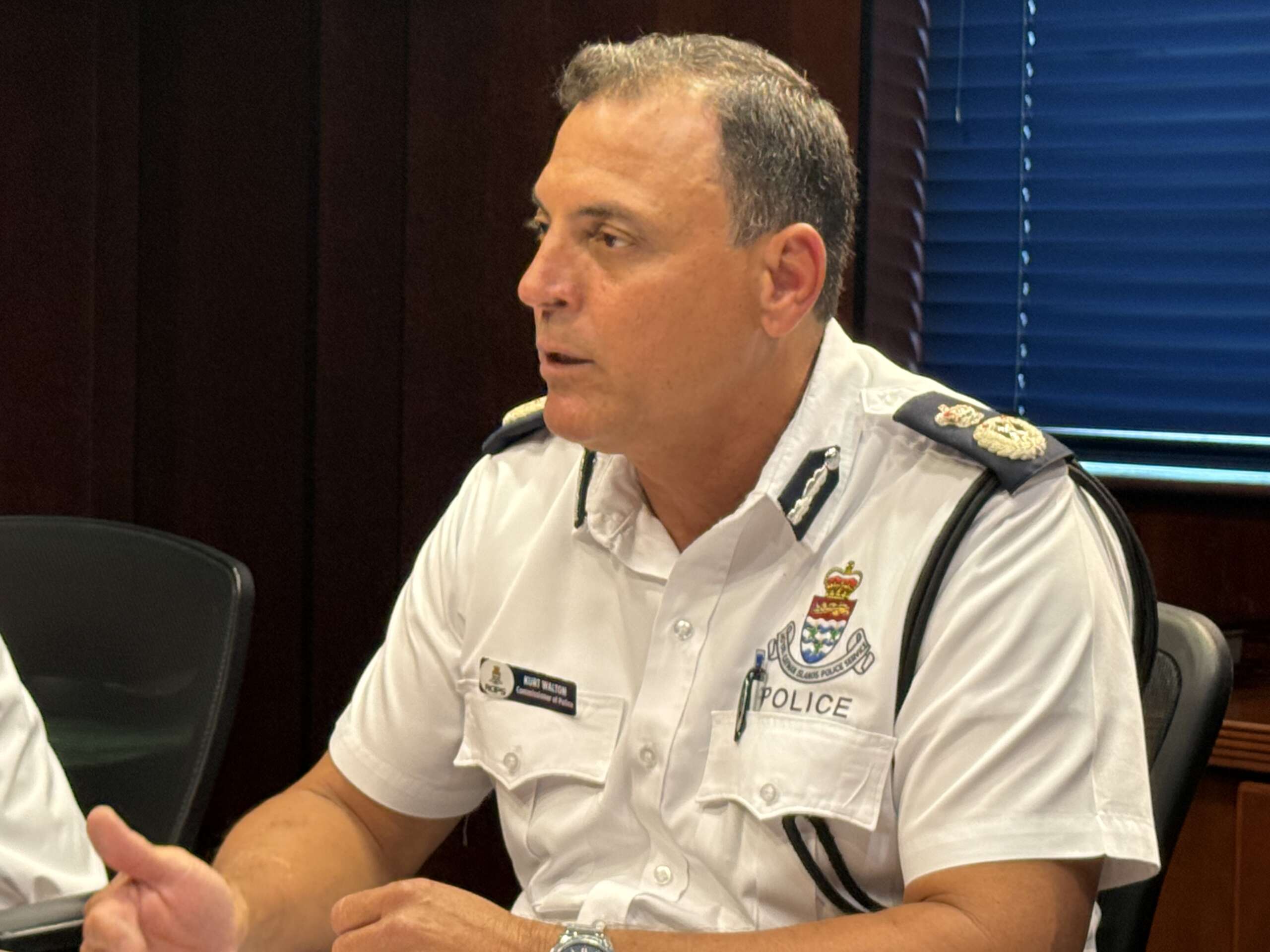
The use of tasers could be extended to beat police officers amid a rising tide of violence against officers, Commissioner of Police Kurt Walton has said.
Walton explained that action had to be taken after the number of officers assaulted so far this year hit 25.
He added that firearms-qualified police were the only officers equipped with the electric stun guns at present, but that could change as early as next year.
Walton said, “I’m looking to see if it needs to be all officers or a number of officers on each shift.”
He added that he awaited a report on how many officers might need to be authorised to carry tasers before further steps were taken.
Walton said drastic action was required to take “a serious stance towards assaulting police officers” and bring the problem to “the forefront” because the public generally only heard about attacks on officers when people were charged and appeared in court.
Walton added that bodycams were also expected to come into regular service after a successful trial.
He said that bodycams had been assessed and that widespread use would not only act as a deterrent to assaults on officers, they would offer protection to police accused by members of the public of acting improperly.
“No one has the right to assault police officers. We are speaking of individuals who are human – husbands, wives, parents, mothers, fathers, brothers, sisters,” Walton said..
“We need to move away from this notion that it is part and parcel of the job and we have to accept it’s part of the job – that’s totally unacceptable.”
Walton was speaking after he highlighted earlier this week that 24 police officers had been assaulted so far this year – an average of three a month.
He said a further attack on a female officer was recorded in the last few days after police were called to a public order offence late on Tuesday night.
Walton said the officer was kicked in the stomach and was treated in hospital, but later discharged. Her alleged attacker was arrested and remains in custody.
He added that police often found themselves dealing with “high-stress situations fuelled by drugs or alcohol”.
Walton said he also hoped to be able to release bodycam footage to the public to help them understand the kind of situations officers were forced to deal with.
“I will look at the legality of it, but I would love to get some of this out in terms of the media to show how some people behave on a Saturday night,” he added.
“We will have a look at the legal issues, but it’s been done across the world – the UK is doing it.”
Walton said that bodycams also protected police, “in the sense it allows officers to record everything that takes place. It’s down to accountability”, and made clear to potential offenders that if they assaulted an officer, it would be caught on camera.
“I am fairly satisfied at this moment with the work already put into it that the bodycam we are looking at is fit for purpose and we would be looking to invest in more of these,” he said.
Walton is no stranger to assaults himself. Throughout his 38 years in the service, he has been shot at but escaped injury, stabbed in the arm, where he still bears a scar, and once had to fend off a machete-wielding attacker with a piece of plywood.
“It’s helpful to understand that I am not speaking from an academic position,” he said.
Walton also called for tougher sentences for those convicted of attacks on police and other public servants who work in potentially vulnerable situations.
There is at present a two-year maximum sentence and/or a maximum fine of $5,000 for assault for cases heard in Summary Court.
Walton highlighted the UK, which passed legislation in 2018 to allow for increased penalties in the lower courts for assaults on emergency services workers, including firefighters, paramedics, prison officers and hospital staff, as well as police officers.
He said Cayman’s two-year maximum was “too lenient” and that there needed to be a mandatory minimum jail term to create an effective deterrent.
“No one should be assaulting a police officer and not going to prison. It’s as simple as that,” he said.
But he said he would have to have discussions with the Attorney General’s office to see if a law change was “a viable option”.
“It’s still a fair ways off,” he said.
Governor Jane Owen, who has overall responsibility for the police service, and Premier André Ebanks have been asked for comment.
Related Videos













Body cams are long overdue. Law enforcement around the world all use body cams. Every law enforcement officer on Cayman should have guns. You’re not in Kansas anymore. Tasers are not enough here on Cayman. Sadly, the crimes are more lethal, with the results being horrific to victims. Time to face the fact that the RCIPS is ill equipped to tackle crime here, and to protect Cayman citizens.