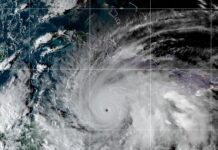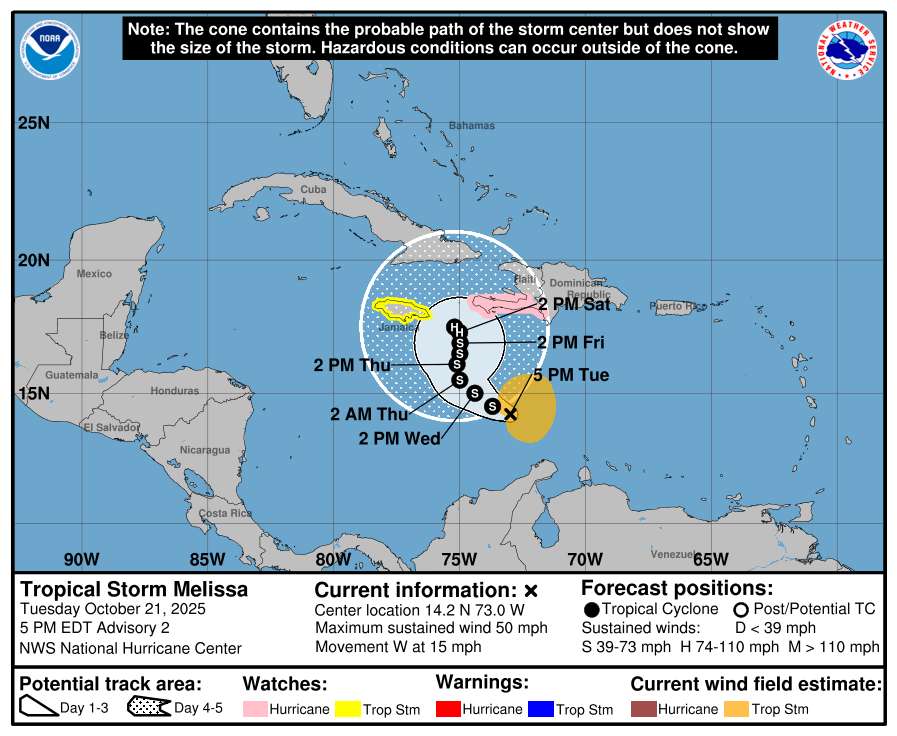
The National Hurricane Center in Miami, Florida is issuing advisories for Tropical Storm Melissa, which at 4pm, 21 Oct. was located 305 miles south Port Au Prince Haiti or 656 miles southeast of Grand Cayman.
Melissa is moving towards the west at 14 mph with maximum sustained winds of 50 mph. Slow strengthening is forecast, and Melissa is eventually expected to become a hurricane on Saturday, 25 Oct.
It is still a long way off from the Cayman Islands, and it is not clear that it will ever present a threat to the Cayman Islands, but the National Weather Service is urging residents in the Cayman Islands to closely track the progress of the storm.
Cayman Islands National Weather Service Chief Meteorologist Kerry Powery-Linwood said it was still too early to say which of the possible track scenarios the storm will take, whether it will curl to the north sooner, or if it will meander and stall south of Jamaica, where Melissa could linger for days in the very warm waters of Caribbean Sea.
He noted that there is a front moving off the east coast of the US which could tug Melissa to the north, moving the cyclone away from Jamaica and the Cayman Islands, but he urged the public to remain prepared, especially until there is more certainty in the track guidance.
“Elevate levels of preparedness and pay close attention to official sources of information, including forecasts from the National Weather Service and information coming from Hazard Management Cayman Islands,” he said.
Hazard Management Director Dani Coleman urged residents to prepare.
“Although it remains premature to determine the precise trajectory and potential impact that Tropical Storm Melissa may have on the Cayman Islands, now is the time to make sure your household is ready,” she said “Review your plan, know where you would go if you need to shelter –particularly if you live in a low-lying or coastal area – and check that your emergency supplies are in order.
“Additionally, take time to check in on neighbours, especially the elderly or those with limited mobility, to ensure they are equally prepared. It’s always better to prepare early and as a precaution rather than waiting until a threat becomes immediate.”
Track uncertainty
The National Hurricane Center said a decrease in forward speed and a gradual turn to the northwest and north is expected during the next few days, and on the forecast track from the NHC, Melissa is expected to approach the southwestern portion of Haiti and Jamaica later this week.
A Hurricane Watch is in effect for parts of the southern coast of Haiti and a Tropical Storm Watch is in effect for Jamaica.
The major computerised models are still showing fairly significant variations in the projected track, with some like, the American Global Forecast System model, pulling Melissa north over the island of Hispaniola on Thursday and Friday and others, like the European and Canadian models, suggesting that Melissa could stall out in the Caribbean Sea and then possibly drift generally to the west or northwest, bringing it closer to Jamaica and even the Cayman Islands sometime next week.
A hurricane hunter aircraft mission into Tropical Storm Melissa on Tuesday afternoon (21 Oct.) showed that most of the heavy convection was well away from the centre of circulation, and wind shear and dry area was impacting the storm, causing it to remain weak and disorganised. However, most of the models continue to show Melissa strengthening into a hurricane while still in the Caribbean Sea.
Forecasters also caution that hurricane intensity is challenging to accurately forecast, and the warm waters and high ocean heat content in the Caribbean, where despite an element of windshear, could be conducive for a stronger and more intense hurricane than current estimates of the intensity.
Related Videos