Liberty Networks has told the Compass that it will bid to partner with the government on the jurisdiction’s third underwater data connection.
The news follows the January announcement that a consortium of Caymanian internet firm SALT Wireless, its sister firm the Cayman Cable Co., and Telconet Latam, an Ecuadorian telecoms firm, will also enter a bid.
Interest in the project has picked up since the government approved the Submarine Cable (Telecommunications Resilience) Act, 2025 in December. Yet no formal bids can be submitted until the government issues an ‘Expression of Interest’, which will then be followed by a ‘Request for Proposals’.
While plenty of details are still to be defined, the government has made it clear that it will partner the successful bidder on the project.
A third cable could cost up to US$150 million with the government liable for a portion of those costs. Yet advocates for the third cable say it’s needed to add capacity to Cayman’s data connections, create additional disaster resilience and create more competition.
Liberty lays down its cards
Carmine Sorrentino, Liberty Networks’ vice president and chief commercial officer for wholesale, disputed the notion that Cayman’s existing cables are old or running out of space. “The new cable is not really about capacity, because both cables today can address the island’s needs,” said Sorrentino. “The cables that are currently landing in Cayman are far from end-of-life.”
One of those cables, MAYA-1, is currently undergoing a multimillion-dollar upgrade that will be completed in March. “With MAYA-1.2, we’re practically making a new cable – the utilisation will be around 10%, so there is plenty of room for more data.”
Liberty Networks already has a controlling stake in the landing station for Cayman’s two existing cables. Some industry experts told the Compass that Liberty Network’s dominance, coupled with Cayman’s high internet prices, means a different company should build the third cable.
But Sorrentino believes it is naïve to assume a new entrant would reduce the price of internet in Cayman. “The misconception is that the international capacity cost is a big driver of broadband pricing. It’s not. The cost of international capacity for broadband providers is really low,” said Sorrentino. “It depends on each company’s [profit and loss], but I’d say less than 5%.”
SALT Wireless CEO, Blair Lilford, also told the Compass that his consortium winning the bid wouldn’t necessarily lead to lower internet costs.
Sorrentino was keen to emphasise that Liberty Networks and Flow are both owned by the same parent company, Liberty Latin America, but operate as independent companies. “Since Flow is a separate entity – we treat them like any other company, so no preferential pricing applies.”
Regional resilience
For Sorrentino, the real reason for the third cable isn’t capacity or price but resilience. “If you think about resilience then it can actually be better having one operator managing the three cables, because in a hurricane you can switch faster and maintain better connectivity.”

Sorrentino thinks Liberty Networks’ track record should stand it in good stead when bids are submitted. “There’s no one with Liberty Networks’ expertise in the region in maintaining these kinds of cables. If the concept is resilience, we’ve demonstrated expertise and quality of service.
“Our resilience and quality of service are proven through the management of highly complex situations, including Category 5 hurricanes such as Beryl in the Cayman Islands and Melissa in Jamaica, as well as by the El Salvador government’s decision to entrust us – based on our technical expertise – with building the country’s first subsea cable,” said Sorrentino. “We will participate in a public process and offer what we think is right.””
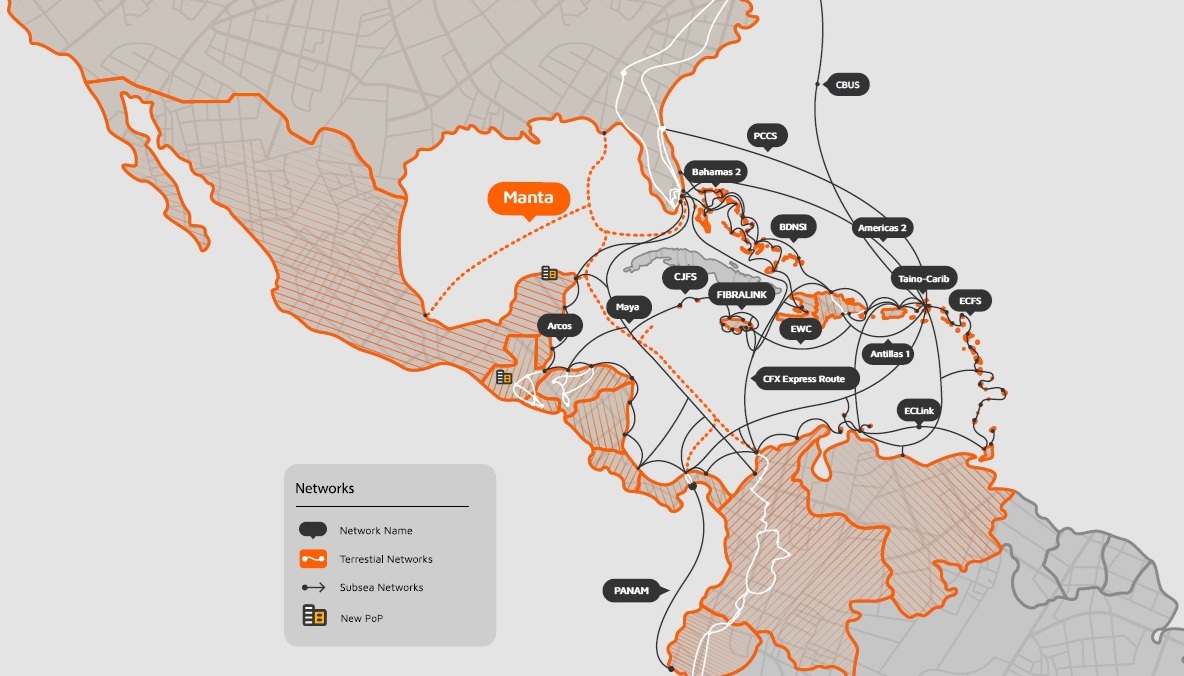
While Cayman has been debating the need for a third cable, Liberty Networks has begun work on a new regional subsea cable, MANTA, which runs from Colombia’s Atlantic coast to Florida. “We have already designed a branching unit, facing Cayman, that will make it easy for us to connect Cayman to MANTA,” said Sorrentino.
The plan has similarities with the potential proposal from the SALT-Cayman Cable-Telconet consortium, that would link to Telconet’s regional cable. Industry experts say that connecting to a regional cable would be cheaper than Cayman building its own direct connection to the US, which could cost up to US$150 million.
Related Videos