

Telecoms regulators are contemplating price-control measures to cut the cost of internet capacity as part of a ‘market power’ review across the sector.
Local internet providers have long complained about what they see as unfair pricing.
Liberty Networks, formerly Cable and Wireless, owns or controls both landing stations for the two subsea cables that provide transport of data into the islands. Those cables are considered crucial to the island’s economy, securing phone and internet communication with the outside world and underpinning everything from Netflix to internet banking.
Liberty Networks also owns local service provider Flow.
Other local providers believe regulators should control or have significant oversight over the price they are charged by the company and its consortium partners.
A spokesman for regulator OfReg said it was aware of the concerns and is currently conducting a “significant market power review” across the ICT sector.
“Depending on the findings, specific consideration may be given to price control on submarine cable service where appropriate.”
Liberty Global says its prices are comparable to the rest of the region and that there is already competition in the wholesale internet market because of the number of consortium members on Maya-1 who can also sell capacity. It says prices have come down over the years.
Maya-1 under repair
OfReg’s comments came in response to enquiries from the Compass about a fault on the Maya-1 cable – Cayman’s main lifeline to the outside world.
C3 CEO Randy Merren said the fault had temporarily left all providers in Cayman reliant on another undersea cable, the Cayman-Jamaica Fibre System, to provide phone and internet service.
Liberty Networks offered a rerouted circuit on Maya-1 via Panama, but this route has much higher latency and a higher price, he said.
The fault coincided with Hurricane Beryl, meaning Cayman businesses were forced to act fast amid fears of a telecoms blackout.
“We were all concerned with Hurricane Beryl heading toward Jamaica it could cause an outage on the Cayman Jamaica Fibre System [and] the results would be disastrous,” Merren acknowledged.
Hours before Beryl passed by Cayman, restoration circuits on MAYA-1 through Panama were brought on line, he said.
Maya-1 is a 4,400-kilometre optical submarine cable system connecting the US, Mexico, Honduras, the Cayman Islands, Costa Rica, Panama and Colombia, owned by a consortium of companies including Liberty Networks.
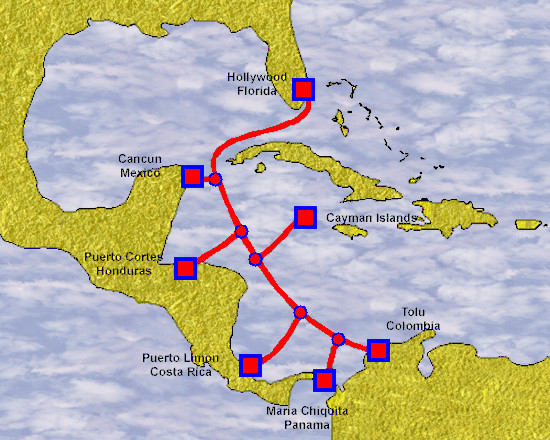
OfReg confirmed a fault on the line close to Cancun, Mexico, just prior to Hurricane Beryl in June. The fault, attributed to “chafing” of the cable on the sea floor, is still being repaired.
The process of rerouting traffic in such cases is similar to a road closure, requiring a diversion.
The handling of that issue has raised the ire of Cayman providers, however, who claim they were forced to pay significantly higher cost for the same capacity on the alternate circuit.
“We can’t rely on a single cable so we had to pay whatever they were charging,” said Merren.
Liberty Networks, in response to these concerns, said the Maya-1 line is owned by multiple companies and it has less than 20% of the consortia. It said the line was split into two distinct northern and southern routes which are sold separately.
It said the fault was on its northern route, through Mexico, and was being repaired by another consortium member.
“If parties purchased only capacity on the northern route from any of the parties that offer services on Maya-1 and did not purchase any alternative routing, they would need to purchase alternatives while this is under repair.”
Price concerns
The issue has reignited more general concerns about how pricing is determined for internet capacity.
Merren said his company and any other internet service providers were forced to take whatever price Liberty Networks charged.
In many other jurisdictions, he said, regulators acted to ensure fairness and transparency on prices.
Without that, he believes Cayman’s telecoms industry cannot be considered to be a fully deregulated competitive marketplace.
“Cable and Wireless (Liberty) controls the landing station of both circuits on the island, how can they not be considered the dominant provider?”
Regulators plan ‘market power’ review
Asked about these concerns, a spokesperson for OfReg said it was looking into the matter.
“OfReg has powers to consider anticompetitive activities and agreements generally and this extends to pricing considerations. Where there is cause to do so we will.
“Additionally, OfReg may impose specific conditions on sectoral providers determined to have significant market power in the relevant markets, following a significant market power review and determination of dominance in a particular market. This may include price regulation.”
Liberty said it was happy to cooperate with OfReg’s investigation. But it laid out quite a different perspective on Cayman’s telecoms infrastructure and pricing.
It denies that there is an absence of competition in the sector, pointing out that other consortium members sell wholesale capacity through Maya-1.
And it says its pricing is in line with the rest of the Caribbean despite Cayman’s higher cost of living.
The company also rejects more general concerns about the robustness of Cayman’s internet infrastructure, claiming there is enough redundancy through Maya-1 and the Jamaican line. It points to the issues during Hurricane Beryl as evidence of this.
“The network was delivered despite the repair fault under these extreme conditions.”
Industry experts question whether Cayman Internet Service Providers really have access to the wholesale prices being offered by other consortium members, highlighting Flow’s control of the landing stations and the costs it can charge for access as a limiting factor.
Bob Taylor, a former CEO of Weststar Cayman and chairman of a Cayman-based submarine cable company, welcomed the review.
He said there were two common options used by regulators globally.
“You can regulate by price or by rate of return, that is how much profit somebody can make. It will be interesting to see what OfReg does, if anything.”
Cayman’s challenges with telecoms infrastructure are complicated further by claims that the Maya-1 cable is coming to the end of its useful life, according to a report from government consultants.
The report recommends pumping public funds – potentially in excess of $100 million – into new infrastructure.
Related Videos











Meanwhile OfReg has banned a viable competitor, Starlink, from sale on the island.
WHY?
Liberty Global says it’s prices are “comparable with the rest of the region”, but is this not because they are the principal supplier in most of the region?.