


UK university tuition fees will rise annually in line with inflation from August 2026, under government plans aimed at stabilising the finances of the British higher education sector – a move likely to be felt by hundreds of Caymanians currently enrolled at UK tertiary institutions.
Further legislation will follow within two years to permanently lock in inflation-linked increases.
According to reports, a record number of British universities – 45% to be exact – are recording deficits. Universities have blamed years of frozen tuition fees as one of the primary reasons for their financial woes.
“The decision to increase fees in England in line with inflation was brave, and the right thing to do,” said Vivienne Stern, chief executive of Universities UK, which represents 141 universities in England, Scotland, Wales and Northern Ireland.
Analysis conducted by the organization revealed that 2025-2026 teacher funding per student in 2025-26 was 64% of 2015-16 levels.
The inflation measure used for the increase – Retail Price Index minus mortgage payments, known as RPIx – will likely be the calculation used for future increases.
Based on those metrics, undergraduate tuition for British passport holders is likely to be about £9,790 a year for the 2026-2027 academic year, reflecting a 2.71% increase. Sources say that home tuition could rise to £12,000 annually by the end of the decade.
UK education secretary, Bridget Phillipson said charging increased fees “will be conditional on high quality teaching”.
Impact on Caymanian students
In August, ‘home’ tuition for the 2025-2026 academic year was increased by 3.1% to £9,535 annually – the first increase in more than eight years. Overseas fees, which are set by individual providers, can be significantly higher depending on the course and institution.
To qualify for domestic or home fees, students must be approved for status by Student Finance England.
The Ministry of Education says that most Caymanian students typically secure British citizenship as part of the government scholarship process and in the event that residency classifications result in international student fees, students receive support through Cayman-based channels in the UK to help resolve those issues.
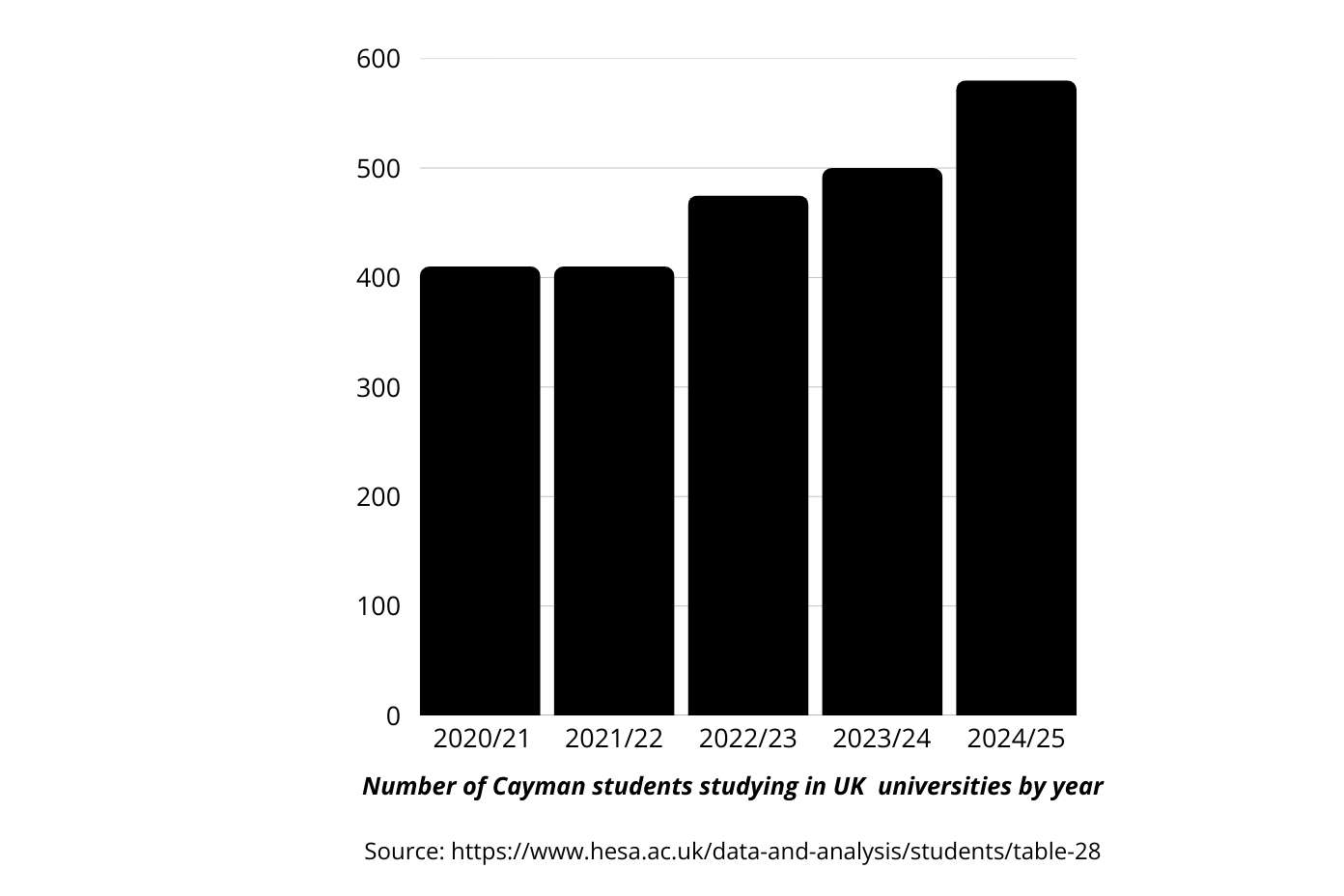
In 2024/25 there were 580 Cayman students and about 1,420 students from Caribbean British Overseas Territories pursuing studies in the UK, with 80% studying at the undergraduate level.
The universities with the largest number of Caymanians were University of Brighton and University of Leicester, with 25 Caymanian students each, and University of Kent, University of Exeter and University of Essex with 20 students each.
Those who do not secure ‘home’ status from Student Finance England face significantly higher fee burdens.
Standard tuition for full-time international undergraduate students at the University of Brighton average between £17,796 and £19,692, for the 2026-2027 academic year, while international undergraduate students at the University of Leicester can expect to pay between £17,750 and £20,750 for their foundation year during the same period. Annual overseas tuition for a UK three-year course can rise to nearly £45,000 in some cases.
 Much of educational funding for Caymanian students comes from government, with Education Minister Rolston Anglin recently announcing that an extra 20% would be allocated towards more than 2,000 local and overseas grants and scholarships. The UK has also made loan finance available to Overseas Territories students since 2022-2023.
Related Videos












Caymanian parents do not pay UK income tax, if they send their children to the UK for higher education their children should pay the higher rate international tuition fee. The Caymanian government can decide to subsidise this with grants or scholarships as they see fit but it should not be for the UK tax payer to subsidise. UK Universities need the international tuition fees to help meet their basic running costs. UK nationals living in the Cayman Islands do not receive any financial discount for educating their children in Cayman nor does the UK government financially assist them in any way. When UK nationals living outside of the UK (for example in Cayman) send their children to the UK for higher education they have to pay the international tuition fee rate despite having a UK passport as they are not contributing to the UK economy with income tax payments. The final decision on what fee status is given rests with each university and how they apply the guidelines on who is a home or international student.
If you are a holder of a standard British Passport which a lot of Caymanians have, it is not clear to me why they should be treated differently when it comes to tuition fees at UK universities. Is some one issuing “second class” British passports,I very much doubt it.